As I’ve set out to plan our latest trip to the Dolomites, I came to the conclusion that there was no single guide exhaustive enough to cover every facet of the travel experience we’d so desperately craved. The strategizing process was truly overwhelming: A million of tabs open simultaneously, a few confusing maps that didn’t overlap right, and advice that was never thorough enough for my liking. It was discouraging, to say the least!
However, you do not need to have the same frustrating time – I’ve done the work and created this information catch-all on how to spend 5 days in the Dolomites, Italy. Here, I will cover everything – best base towns for the hikes, where we stayed on our road trip, tips for renting a car, a day-by-day itinerary breakdown, and as many tips and tricks as I could personally find and test during our Dolomites adventures.
Article contents
- Dolomites itinerary essentials:
- 5-day Dolomites itinerary:
- What about 3 days in Dolomites? Or a week?
- Final tips
1.1 How to get to the Dolomites
1.2 Where to rent a car in Italy
1.3 When to visit the Dolomites
2.1 Day 1 – Alpe di Siusi, lakes, and mountain passes
2.2 Day 2 – Seceda
2.3 Day 3 – Lake Sorapis, doughnuts, and more mountain passes
2.4 Day 4 – Tre Cime di Lavaredo and lakes
2.5 Day 5 – Adolf Munkel trail and churches
Dolomites itinerary essentials
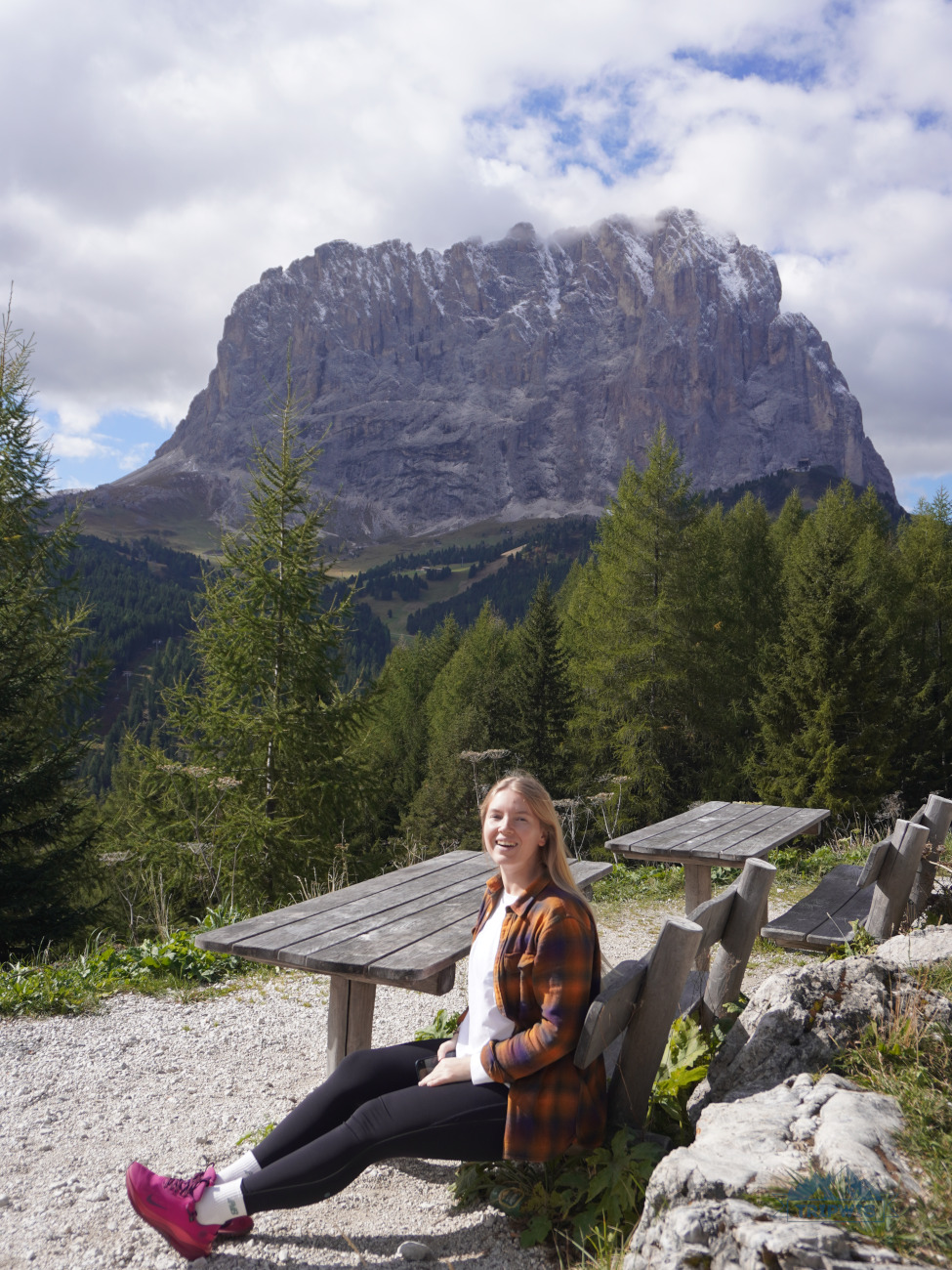 |
 |
As you plan your first trip to the Dolomites, there are a lot of blind spots and choice overload to sift through. Being a part of the Alps (Southern Limestone Alps, to be exact), the Dolomites are no strangers to both geographical and cultural mishmash that I am happy to accommodate in this practical tips breakdown.
However, let’s get one thing out of the way first – despite what many people believe, the Dolomites can also be easily enjoyed by non-hikers! Sure, the trails are the main thing here in high summer season (my list of the best hikes in the Dolomites proves it), but plentiful cable cars that take you straight to majestic viewpoints make for a pleasurable outing without any physical activity.
Okay, now that I’ve doubled the potential audience for my guide, let’s get back to the Dolomites trip planning essentials:
How to get to the Dolomites (and how to get around)
The Dolomites are an intricate region that is pretty difficult to plan your trip for.
You have to first think about which hikes you want to do and places you want to see, then pinpoint the best bases in the Dolomites for the destinations on your must-visit list, and only then figure out the most optimal starting point based on all the info. Of course, you can reverse the decision process from bottom to top – after all, your beginning point for Northern Italy adventures is also dependent on prices of flights, deals on car rentals and hotels.
❗️Make sure you have all the info gaps covered by checking out my guide for the best starting points for a Dolomites road trip.
Here’s a little overview of the topic. Which airport should you choose for the Dolomites?
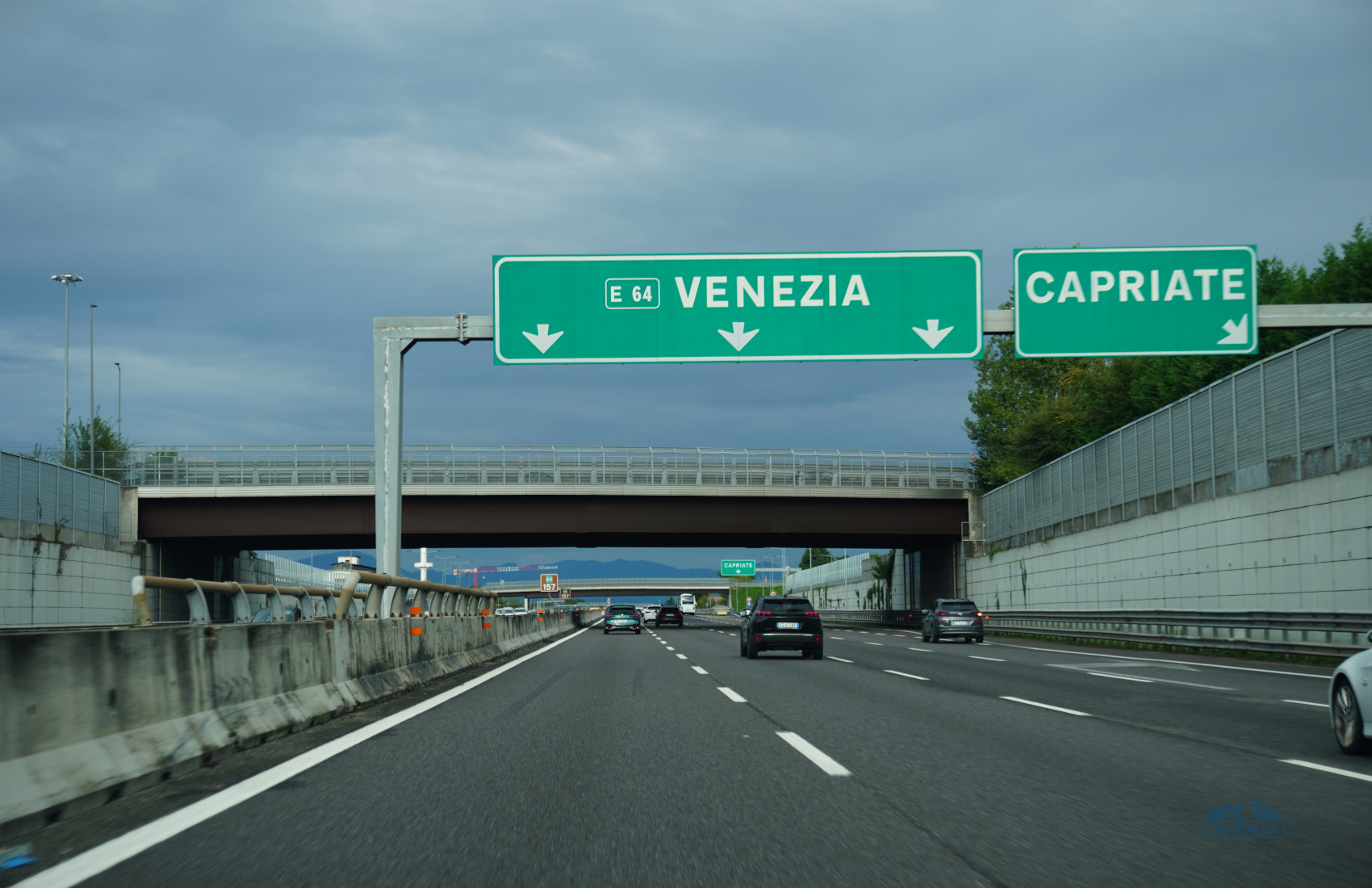
- Milan (our pick) – it will take you around 3–4 hours to get to the Dolomites from Milan if you take the toll roads. But it’s not the worst option, since there are often great deals on flights and rental cars here. Milan serves as the getaway to Western Dolomites.
- Venice – if you land in Marco Polo Airport, it is in your best interest to start your trip with checking out Eastern Dolomites. The driving time from the airport is 2.5 hours on average.
- Innsbruck – time in transit is on the shorter side (2 hours to Western Dolomites), but you will have to cross the border and pay additional toll road fees – both Austrian and Italian, which can amount to €40.
- Verona – it will take you just over 2 hours to get to the Dolomites’ central valleys.
Note that the travel times I’ve given are counted with cars in mind. Though you could potentially get to and around the Dolomites with the help of public transport.
Do you need a car in the Dolomites? I believe that you do. We booked ours on Discovercars as soon as we found out we were going to the mountains!
✔️ It gives you total freedom of movement! You’re not bound by a public transport timetable and you can explore more off-the-beaten-path locations.
✔️ It allows you to base yourself further away from main transport hubs in the region, thus leading to you saving money on accommodation in the Dolomites. A hotel in Ortisei or Cortina d’Ampezzo is undeniably more expensive than a similar dwelling in a smaller, more remote town.
✔️ If your trip falls on shoulder season, a rental car might be your only reliable option of getting around the Dolomites – most bus lines that are frequent in summer stop operating for low season.
✔️ Roads in the Dolomites are excellent and incredibly beautiful, and the distances are relatively short.
Where to rent a car in Italy?
Since you’re reading this Dolomites road trip itinerary, it’s safe to say you’ve landed on the option of renting a car here. Choosing a reputable service is the single most important thing you will do in your planning:
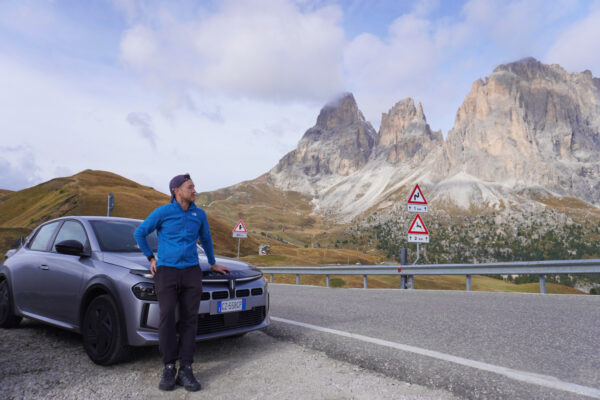
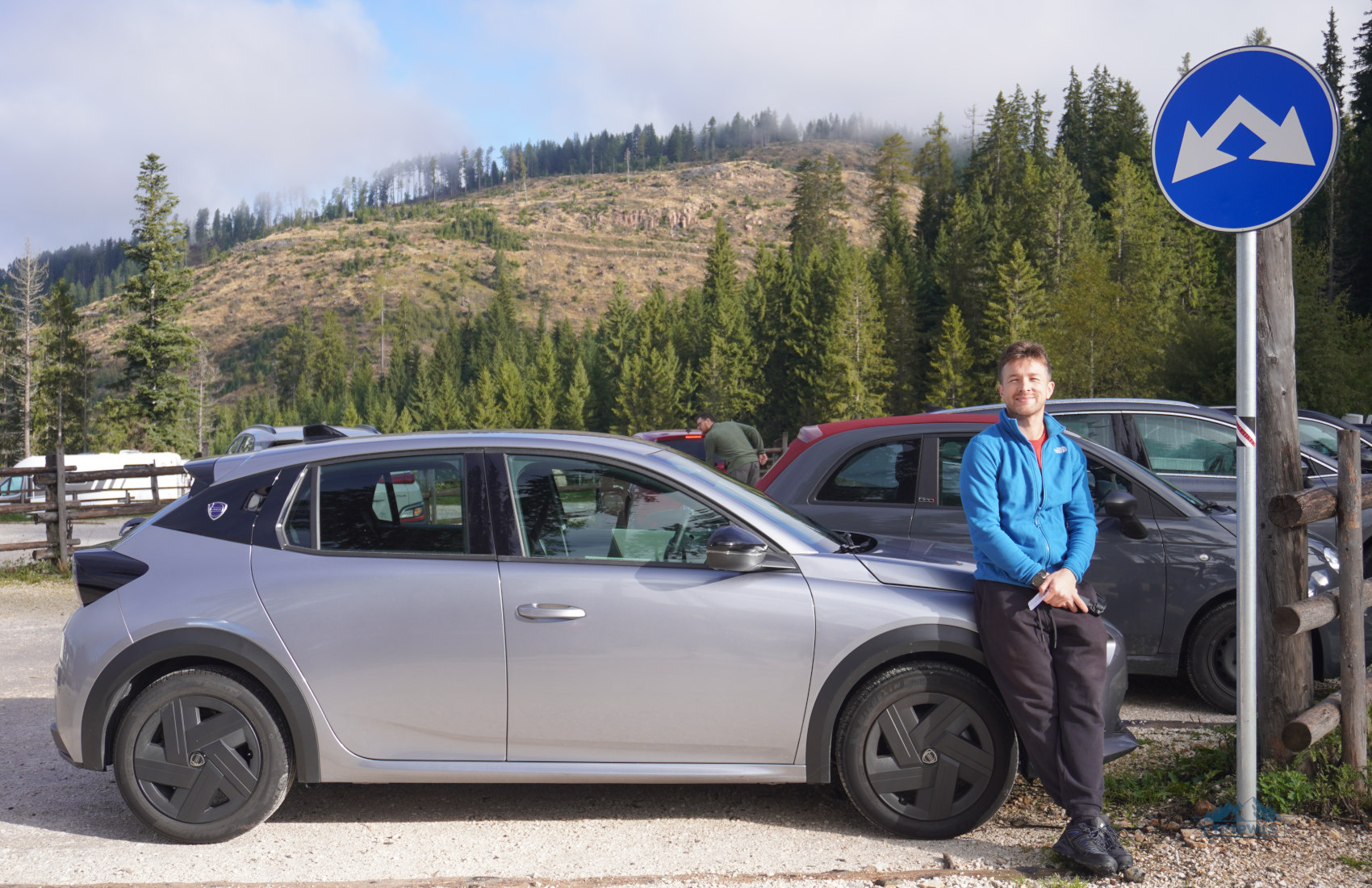
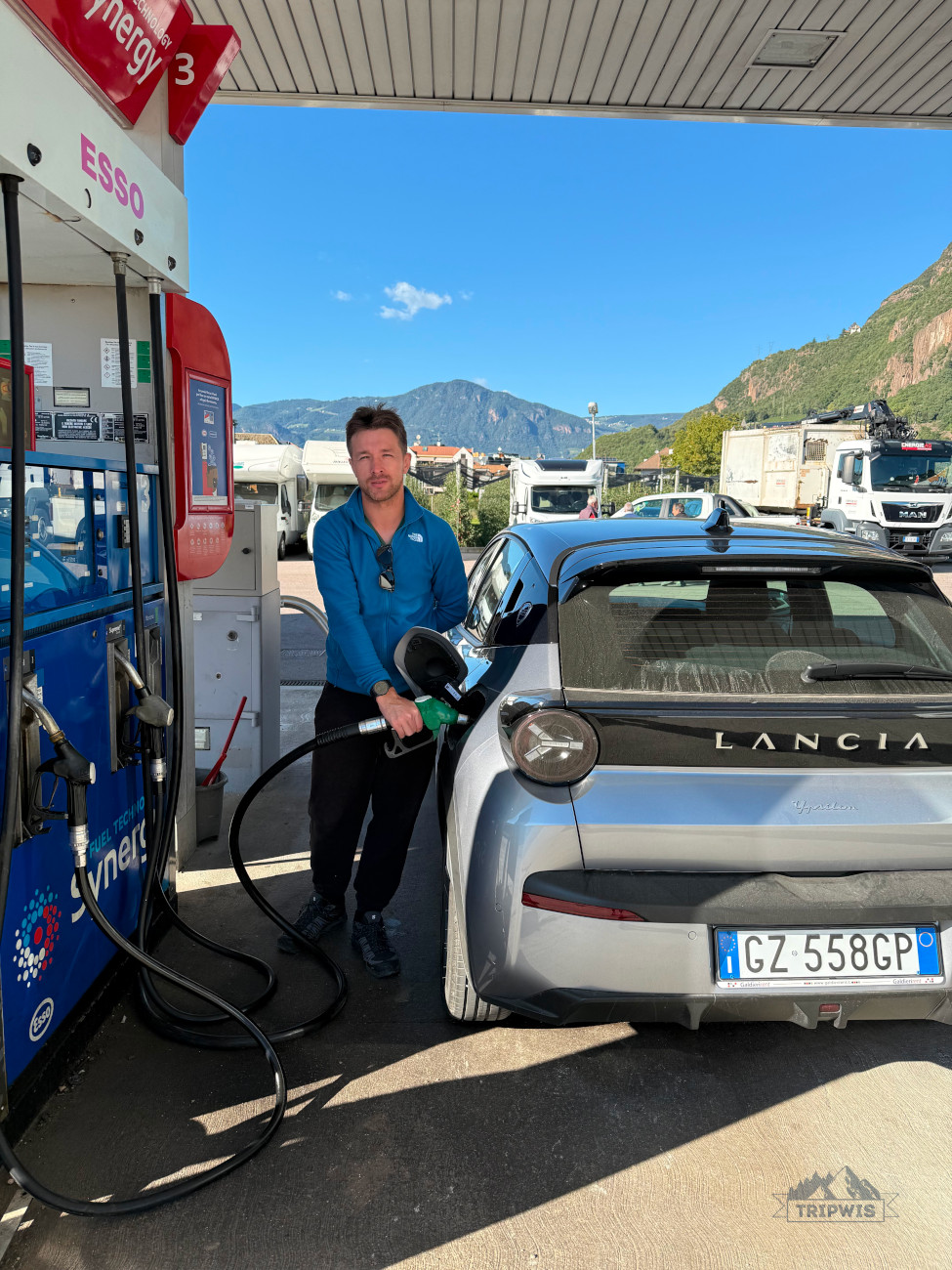
- Personally, we went with Discovercars for our latest adventures. With Milan as our starting point (during shoulder season, no less!), we scored a great deal on a new Lancia Ypsilon – €80 for 6 days.
- EconomyBookings is the service that also has some amazing options of car hire for the Dolomites.
Book your car early for your Dolomites road trip, especially for summer season (at least 2 months in advance). Don’t forget to bring the required documents: A valid driver’s license, an International Driving Permit if your license is from outside the EU, and a credit card in the driver’s name. Also read the “fine print” about insurance, deductibles, and deposits. The gist is this: Get Full Coverage for your peace of mind (we didn’t the last time we were in the Dolomites but only because our bank already covered the deductible).
As for the things to know before driving in the Dolomites, simply rest assured that the process is not as scary as people make it out to be – if you pay close attention to the road and are careful, then you will be fine the entire way.
Just be ready for:
- Winding mountain roads and switchbacks. They are often narrow, so take it slow and look out for potential hazards (cattle, bikers, etc.).
- Spotty reception. Mountains and cell service do not get along, so make sure you download offline maps for better navigation when driving in the Dolomites. Google Maps work just fine here.
- Parking. It’s a major issue in the Dolomites! I will give you more details about leaving your car by the trailheads of each hike further down (they range from €0 to €40), but for now, focus on finding a hotel with free parking on-site – this way, you’ll avoid the stress of looking for a place to park at the end of a day out in the mountains.
When to visit the Dolomites?
 |
 |
To get the best possible experience out of your 5-day Dolomites itinerary, you have to play your cards right in many regards. One of the most important characteristics is the weather – the mountains are notoriously unpredictable and flaky with temperatures and precipitation.
🏔 Late May through late June – the tail end of spring in the Dolomites; the entire infrastructure is just beginning to operate after a short off-season hiatus, but the opening date is not set in stone. The period is a true gamble, but many choose it for lack of crowds and lower prices.
☀️ July and August – the true summer high season; the climate is at its best – pleasant high temperatures, clear skies, and the most beautiful nature. Think lush green valleys carpeted with wildflowers, full lakes and rivers, and snow-free trails. However, this is when overtourism becomes apparent in the Dolomites – even the high price tag doesn’t deter the holidaymakers from visiting the mountain region (book everything early for this period).
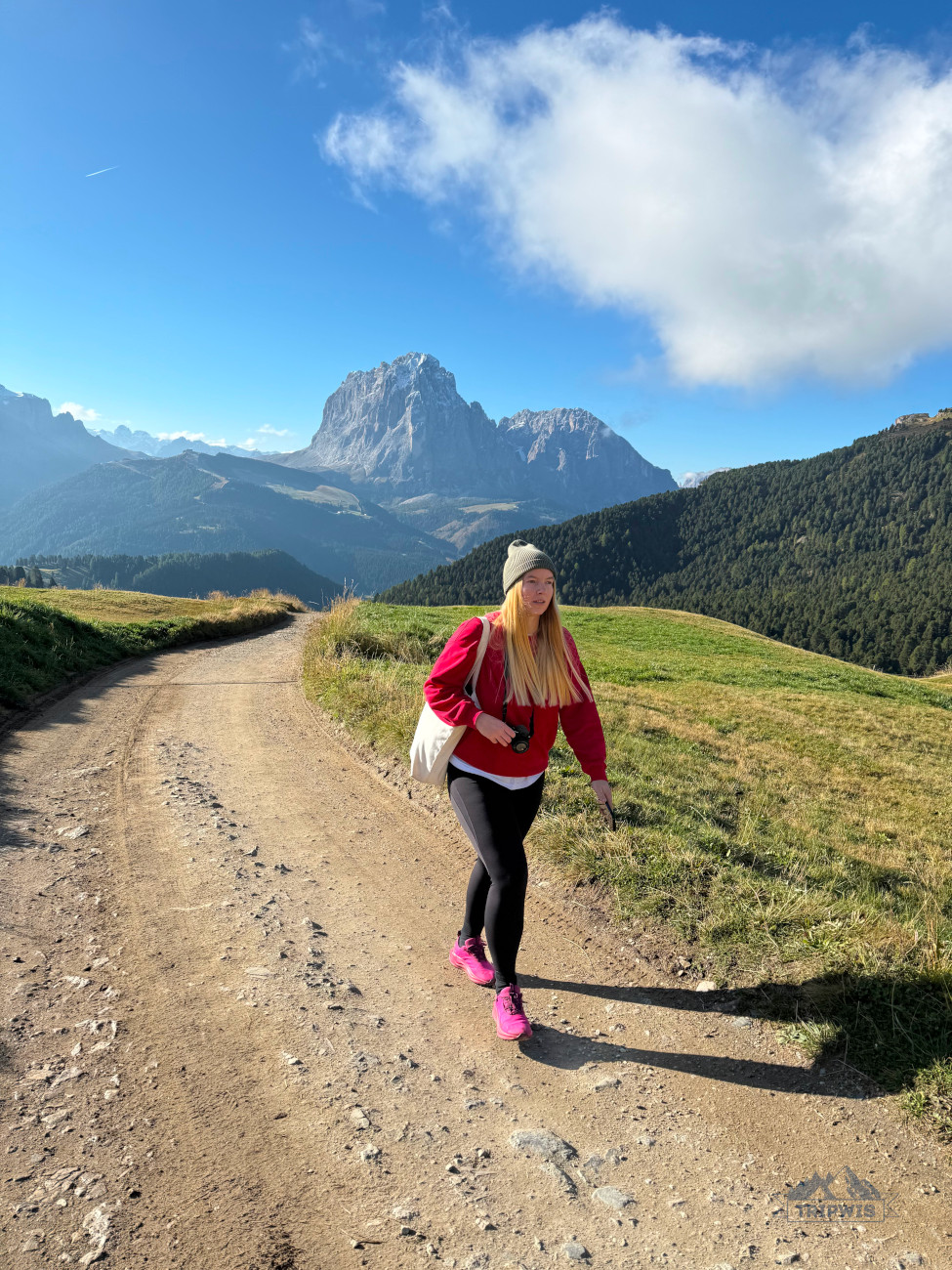
🍁 September and early October – I want to highlight these months because that’s when we traveled, and in my opinion, this is the best time to visit the Dolomites. The crowds start to wane, the temperatures are cooler, and the hazy summer air turns into a beautiful clear autumn light. Hiking is most pleasurable in these conditions – and the photos turn out much better without the blinding overhead sun. If you go to the Dolomites in fall, make sure to watch my Youtube video with fall-related deets!
❄️ December through March – winter season in the Dolomites; skiing is the main event and the slopes and après ski establishments are filled to the brim with people. If you’re after these coveted winter scenes, know that you can hit the slopes as late as March in the Dolomites – in fact, some of the best skiing happens during this time.
When not to come to the Dolomites? November and April are definite no-gos – they are liminal spaces where no fun is being had by anyone in the region.
To get a thorough month-by-month breakdown, check out my guide on the best time to visit the Dolomites.
Where to base yourself for a Dolomites itinerary?
 |
 |
What am I talking about, exactly? Well, if your planned Dolomites hiking itinerary includes, for example, both Alpe di Siusi and Tre Cime di Lavaredo, then it makes complete sense to have two home bases for your exploration.
You see, the Dolomites cover much ground, with some destinations having on average 100 km between them. And considering that you still should start your adventures early in the morning, it is better to have your “home base” in a town that is close to the trails you want to hit.
The most logical divide of your Dolomites road trip itinerary should be between Western Dolomites (Val Gardena with Ortisei at its center) and Eastern Dolomites (Cortina d’Ampezzo is the queen here).
But on the condition that you’re using a rental car to get around, you’re not bound to the principal home bases. We certainly didn’t want to spend extra cash on accommodation in either Ortisei or Cortina d’Ampezzo, so we searched past these hubs, eventually landing on smaller towns and villages within a 15- to 20-minute car ride.
With that, keep in mind these factors when looking for where to stay in the Dolomites:
✔️ Choose a town that is close to the main hub and save money on accommodation. Most Cortina d’Ampezzo hotels charge extra just for being located in this glamorous “Queen of the Dolomites”.
✔️ When possible, pick a hotel with a half-board option. Sometimes the last thing you want to do after a full day of hiking is go out and look for a restaurant; so keeping your sustenance providers close to home might be the best scenario.
✔️ If you’re using a rental car to get around, focus on hotels that offer on-site parking – one less thing to stress about in the moment!
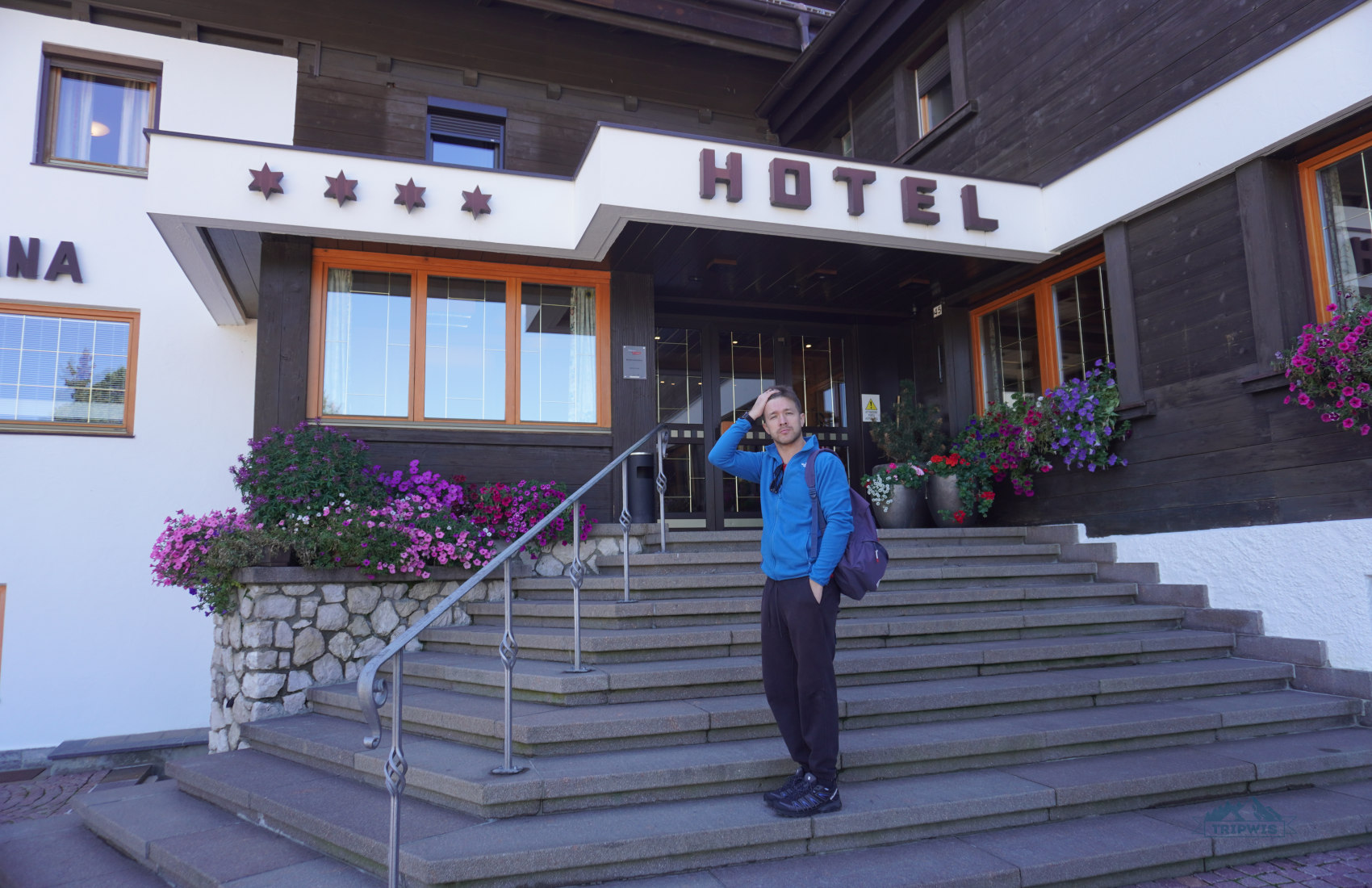
Personally, we changed three hotels during our loop around the Dolomites, with a couple of “in-transit” accommodations that served as relaxing bookends for the adventure:
- 3* Hotel Everest Trento (Trento, from €90 per night) – our first overnight stay in the Dolomites region; in retrospect, we should’ve gone straight to Monte Pana but we didn’t want to drive too long straight from the plane, so a stay in Trento was the best we could do!
🅿️ private parking on-site for €10 per day; we used free street parking - 3* Best Western Hotel Nevada (San Vito di Cadore, close to Cortina d’Ampezzo; from €100 a night) – our getaway into the sites of the Eastern Dolomites: Tre Cime di Lavaredo and Lake Sorapis. It’s a way cheaper option that anything I’ve seen in Cortina itself!
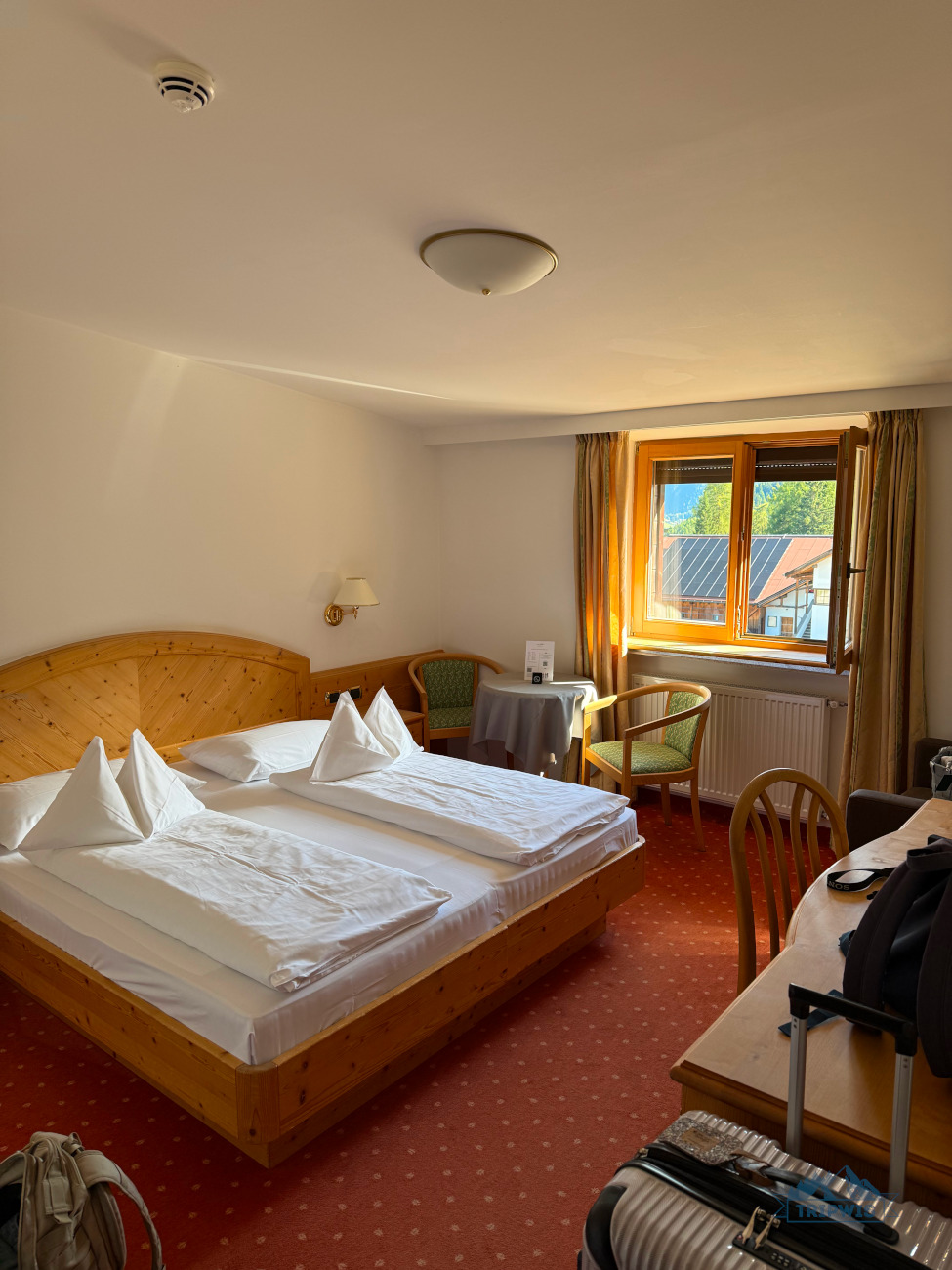
🅿️ free off-site parking available near the hotel - 3* Gasthaus Zum Weissen Kreuz (Latzfons; from €120 a night) – our scenic overnighter between Tre Cime di Lavaredo and Adolf Munkel. It is one of the more remote hotels I’ve picked in the Dolomites; however, the natural setting was just what we needed to pause a bit and make some sense of the exciting trail experiences.
🅿️ free private parking on-site - 3* Hotel Raffl (Bolzano; from €140 a night) – for our last sleep in the Dolomites, I picked the cheapest Bolzano hotel I could find. It was up to the task – comfortable enough for a restorative sleep before our big drive back to Milan the following morning.
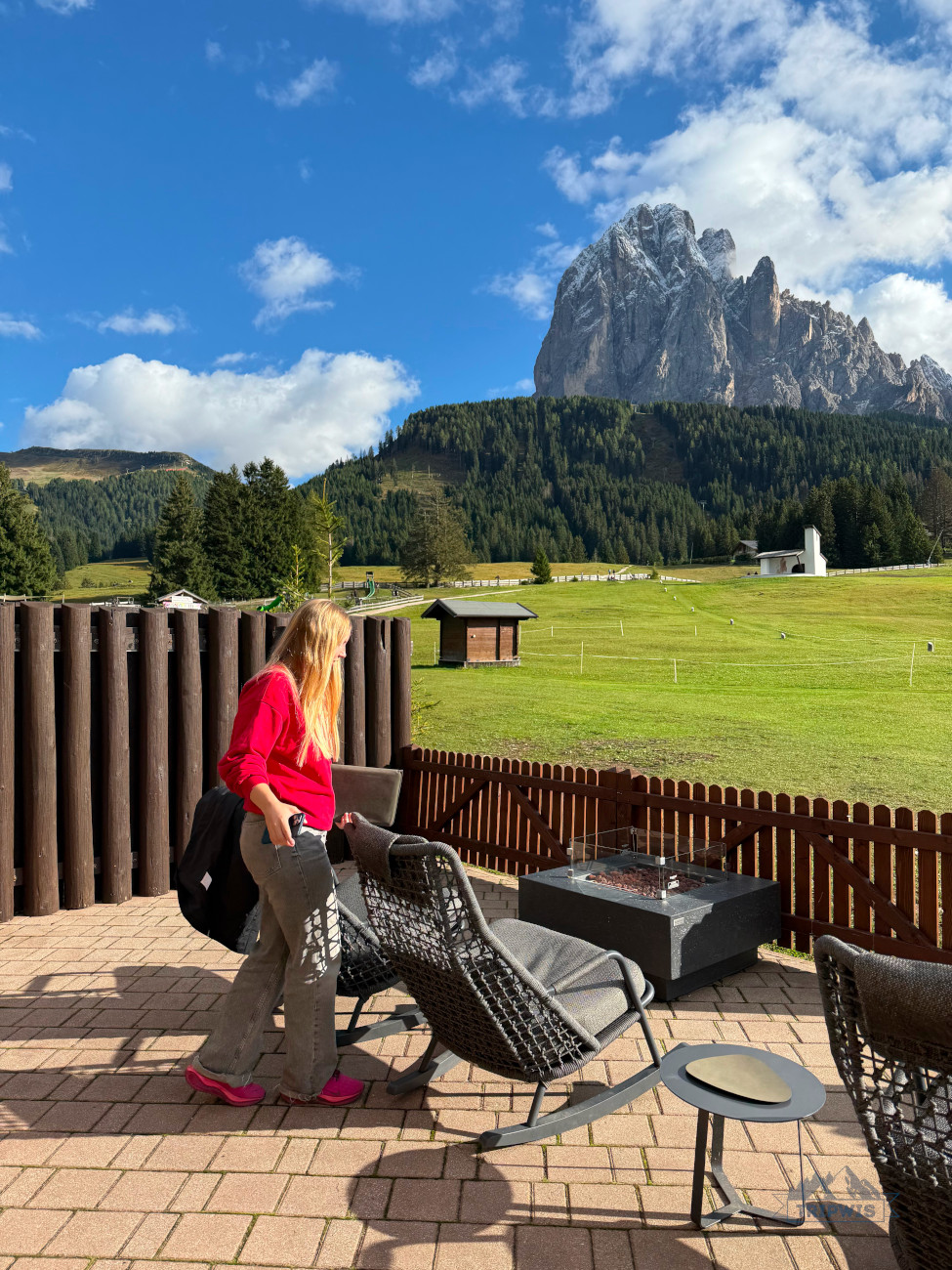
🅿️ free on-site parking - 4* Monte Pana Dolomites Hotel (Santa Cristina, which is a short drive from Ortisei; from €210 a night) – a perfect base for Alpe di Siusi and Seceda; a half-board option was a huge plus for us in the first half of our Dolomites itinerary. The sweeping Sassolungo views from the terrace was the cherry on top of the entire experience!
🅿️ free on-site parking
You will soon delve into my detailed breakdown of the 5 days Dolomites itinerary where I also give you plenty of hotels to choose from each day.
Dolomites trip overview (map)
Which region to visit in the Dolomites? This UNESCO-listed landscape covers multiple regions, provinces, and valleys. I encourage you to check out both Western and Eastern Dolomites – the area surrounding Val Gardena and Cortino d’Ampezzo, respectively.
As you make your way through the itinerary, make sure to refer back to this Dolomites road trip map – I didn’t draw harsh lines between the regions; you’ll know that you’ve shifted east or west when one big cluster of pins is replaced by another.
I also didn’t divide the contents of the map into days, which is perfect for travelers who want to mix and match the places according to their personal preferences and not a rigid timeline of an online guide. The map will definitely come in handy starting from the next part of my guide – it’s easier to choose your base in the Dolomites when you can see every notable destination and the distances between them so clearly.
5-day Dolomites itinerary (day by day)
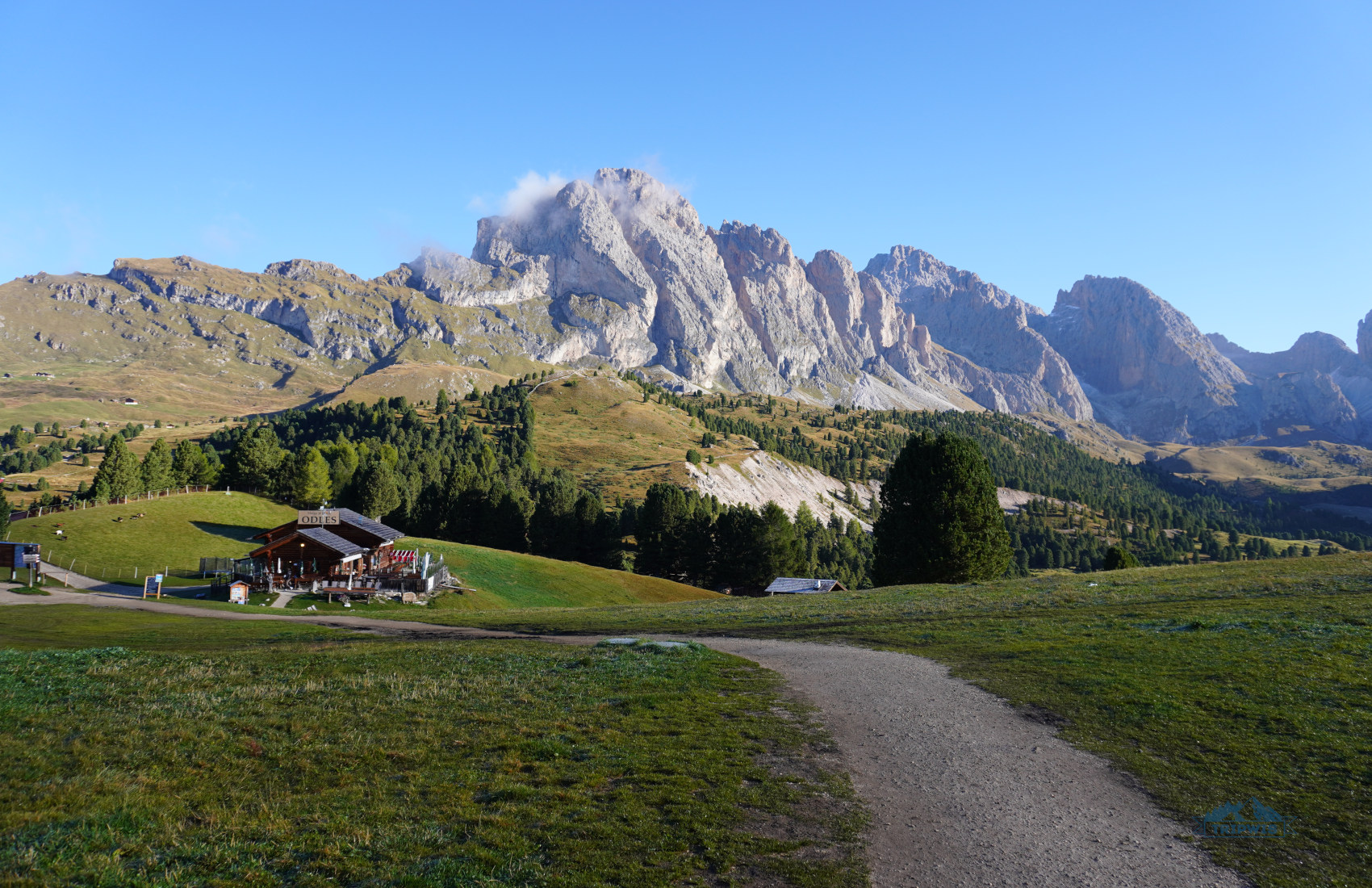
Is 5 days enough for the Dolomites? I think that it is, but with an asterisk: Five days here is a sampler platter for learning about the region (if you split your focus between West and East Dolomites) – it will give you enough time to get the feel for the mountain areas and vibe out to their heightened vibration (not to be too woo-woo, but it’s true).
I believe that I have created the best Dolomites itinerary for first-timers: Keep reading to learn what destinations to visit, where to eat, which hotel to choose to spend the night, and what tips and tricks to use to have the most well-rounded and exciting experience!
Side note: Our 5 days Dolomites itinerary technically starts with the second day – we usually like to leave a little buffer for a travel day. Our “first” dawn-to-dusk included landing in Milan, picking up a rental car, driving it for 3.5 hours in the direction of the Dolomites, and finally landing in Trento. The next morning, our mountain adventures finally took off with a bang!
In short, expect your days to look something like this:
(this itinerary works well if you’re entering the Dolomites from Milan, Innsbruck, or Verona. If you’re coming from Venice, it makes more sense to do Days 3–4–5 first, and then continue with Days 1–2)
Day 1: A visit to the Rainbow Lake (Lago di Carezza), Passo Gardena detour, a cable car to and a loop trail on Alpe di Siusi, settling into Val Gardena
Day 2: A cable car ride (budget-friendly version) and a half-day loop hike to the iconic Seceda Ridgeline
Day 3: The most beautiful mountain passes in the Dolomites, Coffin Lift, donuts, a treacherous trek to Lake Sorapis, and a move towards the stately Cortina d’Ampezzo
Day 4: A taste of hiking around Tre Cime di Lavaredo, then three lakes – Lago di Braies being the most memorable (and the most crowded) destination of the day
Day 5: An all-around perfect wrap up experience of the 5-day Dolomites itinerary, which includes a shift towards Val di Funes, hiking the scenic Adolf Munkel trail and visiting one (or two) cinematic churches.
And now, for the details!
Day 1 – Alpe di Siusi and more
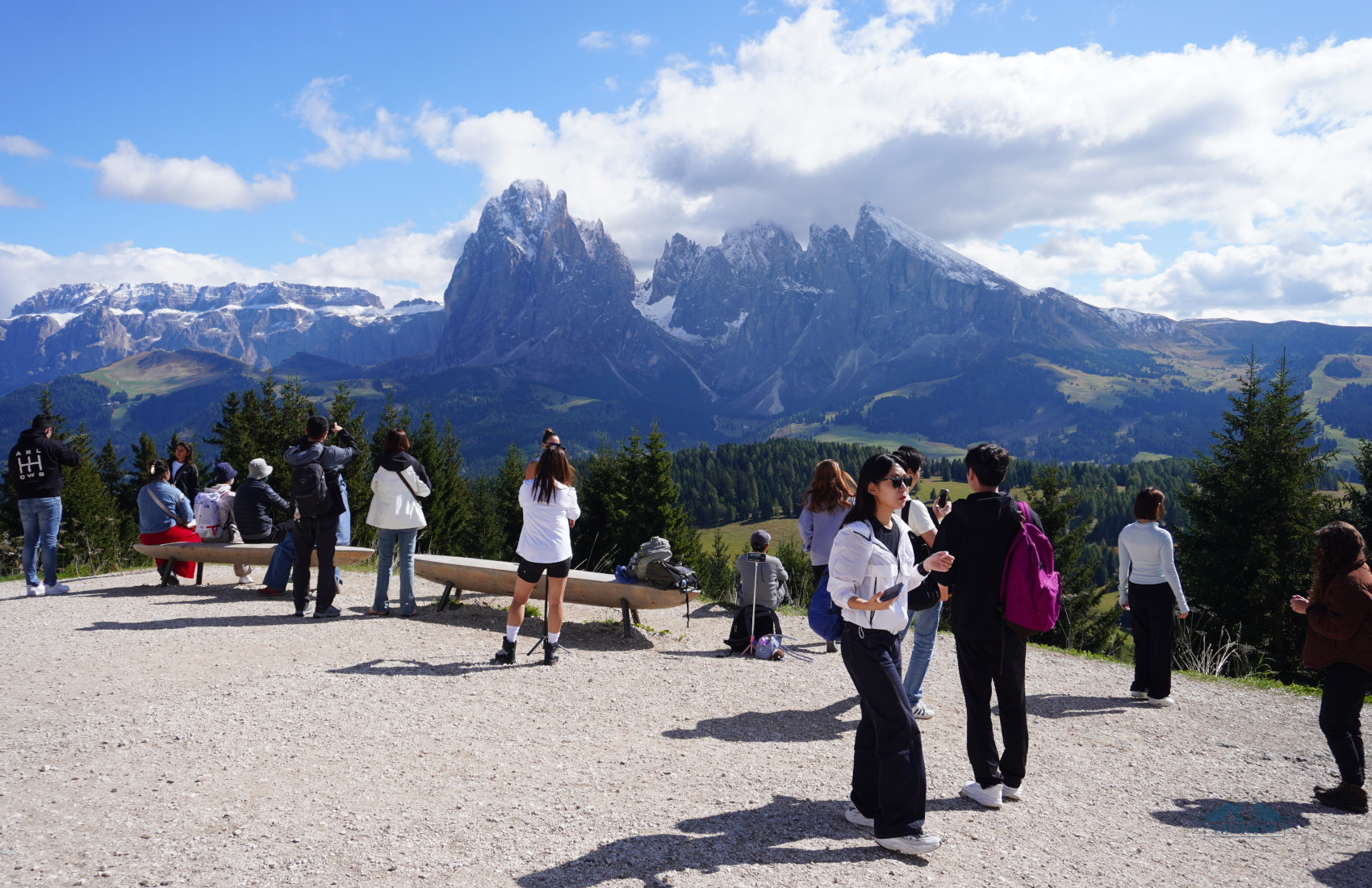
Base town: Ortisei (our pick – Monte Pana Dolomites Hotel)
Focus point: Alpe di Siusi / Seiser Alm
What to expect: Easing your way into the Dolomites itinerary, winding mountain pass, emerald green pastures, Sassolungo views, Rainbow Lake and Ortisei exploration
In my opinion, your first day in the Dolomites should be relatively simple, while keeping up a high level of whimsy – a balance that we’ve struck with the places I’ve put into the itinerary. Note that it is a “soft” day – there will be *some* hiking, but not enough to tire you out right away.
Lago di Carezza (Karersee)
 |
 |
🅿️ €3 per hour
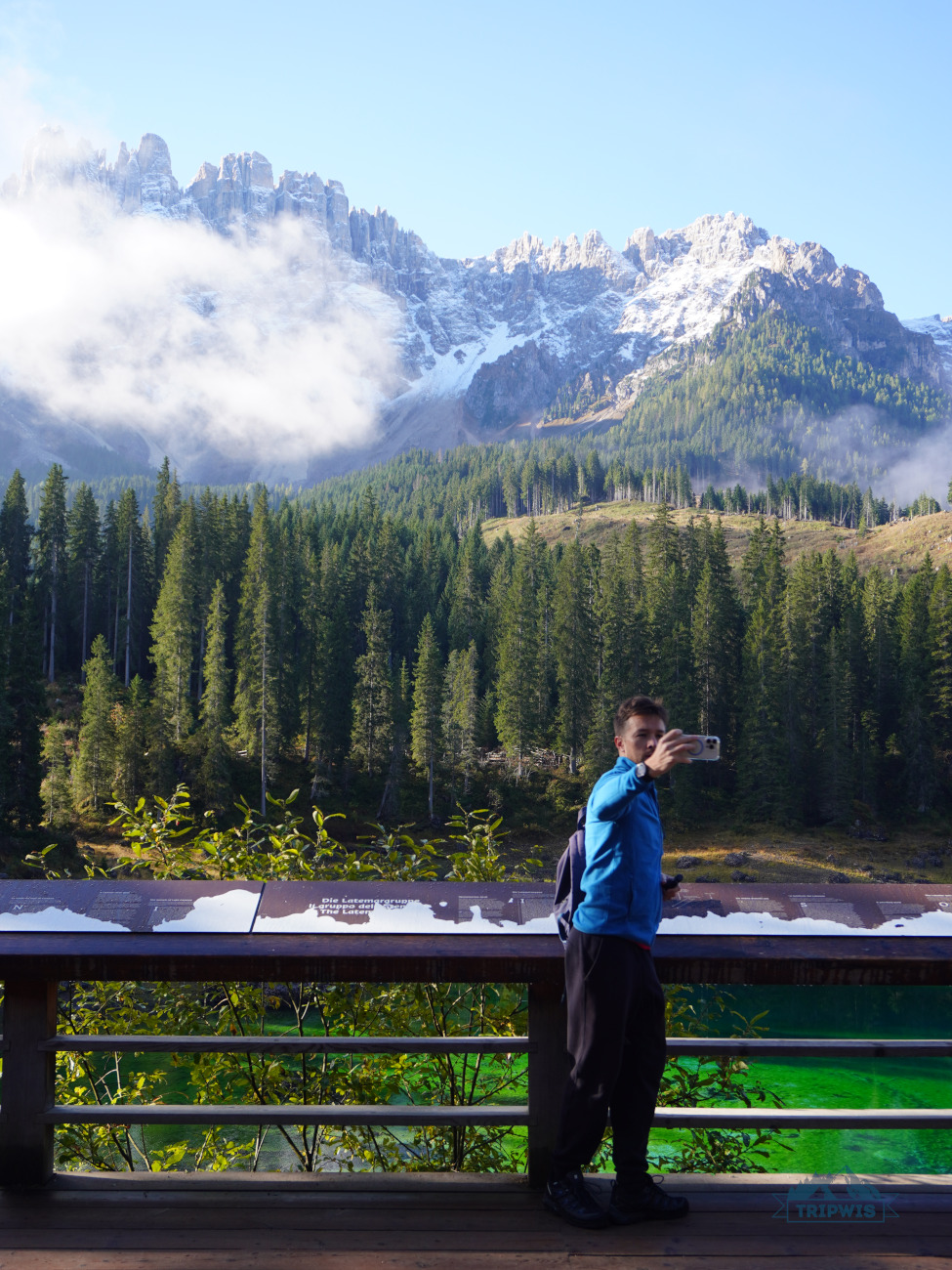
You should begin your journey with a destination that has both a jaw-dropping view and a classic South Tyrolean legend to back it up and keep things interesting!
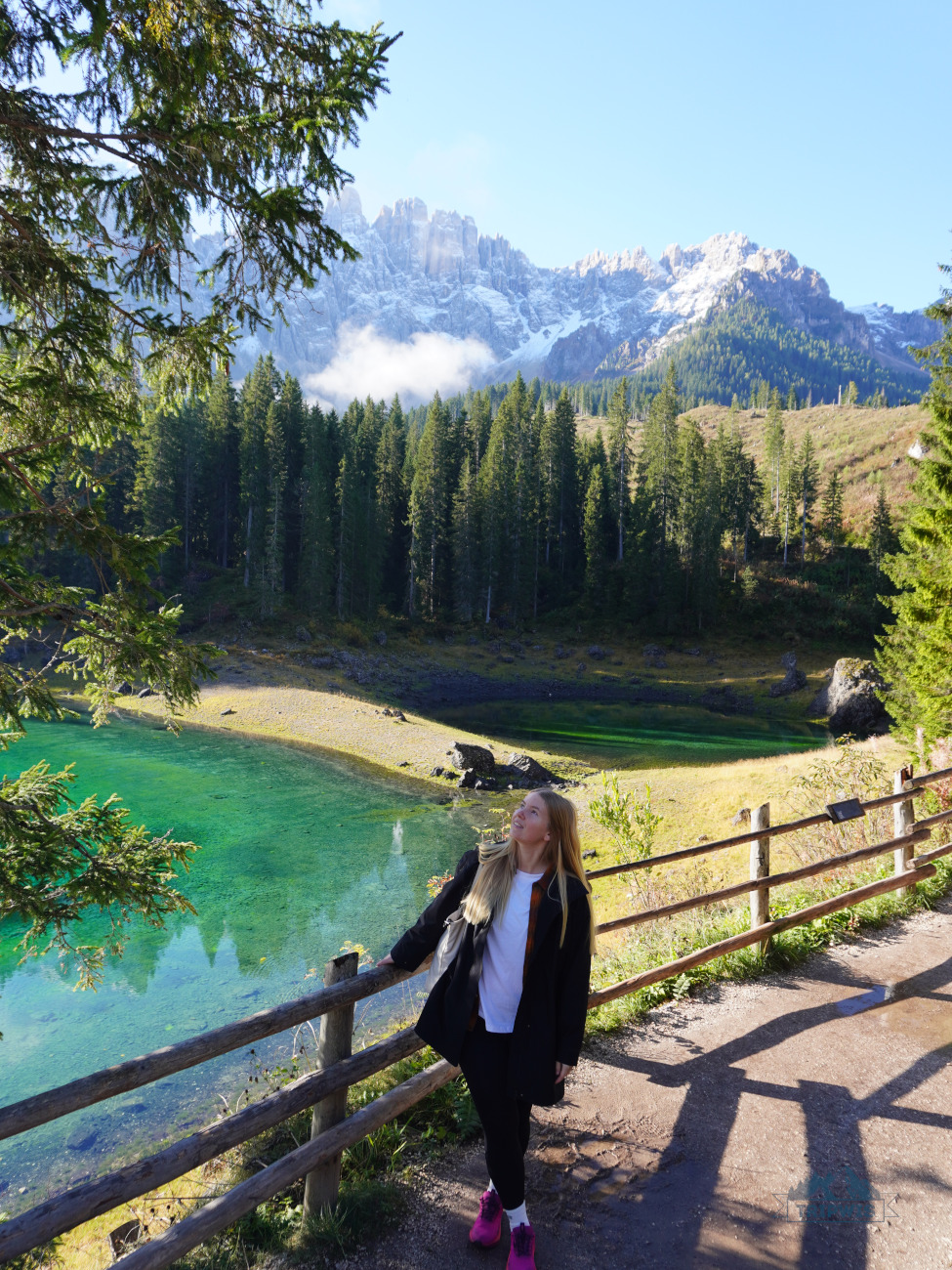
This small alpine lake is just what you need – also known as the “Rainbow Lake”, this body of water has lore for days: They say that a wizard tried to capture a water nymph that resided in Lago di Carezza by luring her with a rainbow made out of jewels. The effort was futile, and the sorcerer threw the rainbow into the water. Even now you can still see the remnants of the rainbow here – in kaleidoscopic sparkles that play in the sun.
On most days, the reflection of the dramatic Latemar range (the mountain that feeds the lake) and thick spruce forest in the water of Lago di Carezza is the prime panorama for tourists to enjoy.
Even though it is located at an impressive level of 1,520 meters, you are not required to exert any physical effort to get the full picture – just drive up to the parking lot, leave the car there, and get closer to the main viewing deck.
- Visit the lake early in the morning for most optimal light conditions and fewer crowds
- There’s a hiking option here as well – a well-maintained and marked loop trail around the lake can be undertaken in just under a half an hour
- There is a paid parking lot set close to the lake – P1; but there’s also a free lot here (however, recent reviews say that it’s crawling with burglars)
Our experience: After the lake, we went ahead and checked into our favorite hotel of the trip – 4* Monte Pana Dolomites Hotel. Once that was done, we tried to weasel our way into Alpe di Siusi – into Mont Sëuc cable car station parking garage. No luck, since it was around noon and the entire lot was packed! In the end of September! We rallied by paying a visit to Passo Gardena – one of the most beautiful highlights of South Tyrol and the Dolomites in general.
Passo Gardena (Gardena Pass)
🅿️ €4 per hour
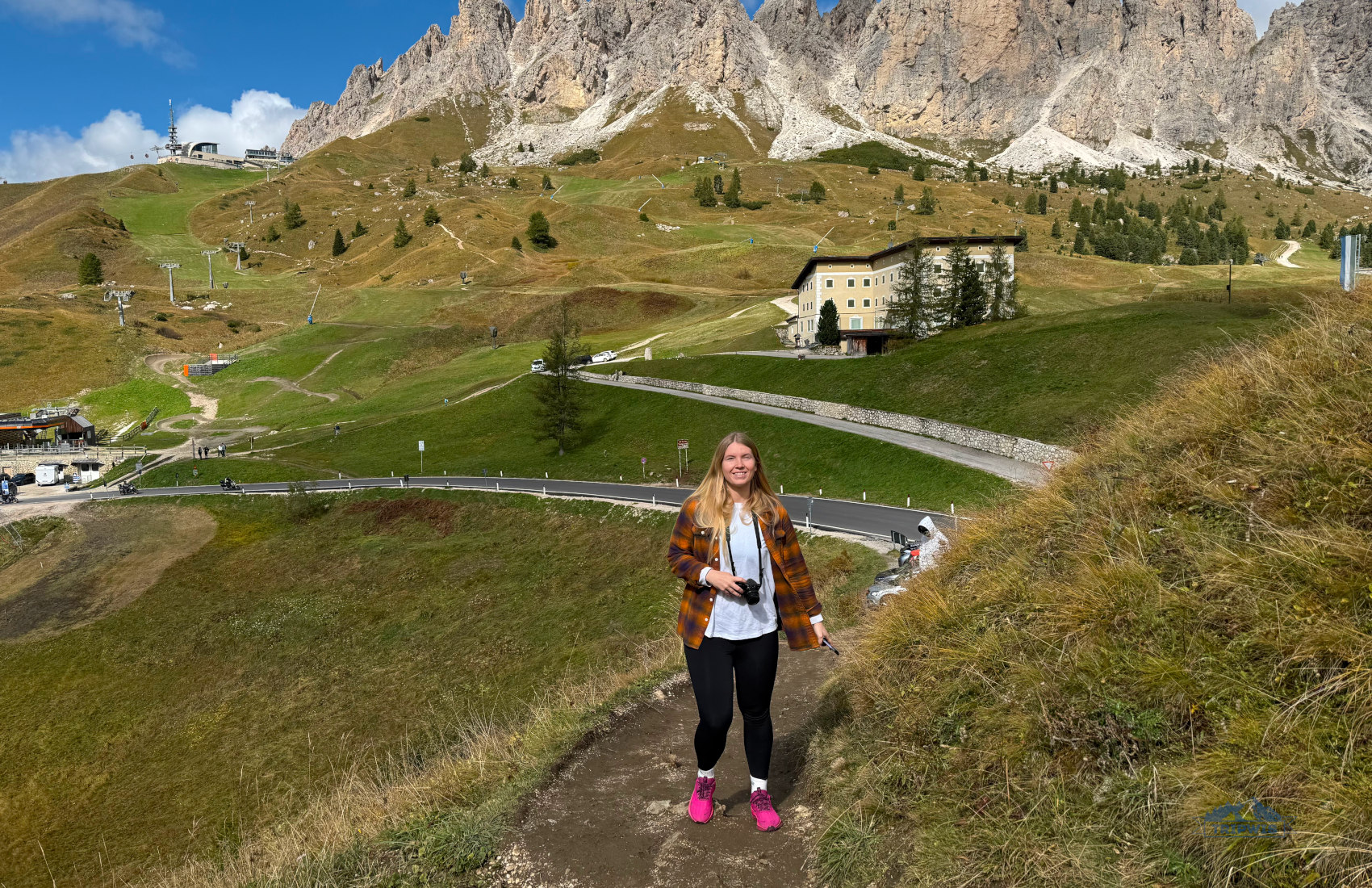
It’s a high mountain pass, a perfect road winding its way through those iconic Dolomite peaks. The wall of granite giants feels incredibly close – almost hanging over you. They look harsh, lifeless, dark grey and black, and quite awe-inspiring. Fall makes it even better: Some of the summits are lightly dusted with snow, which only adds to the drama. And then, on the other side, the scenery changes – green hills and alpine meadows gradually give way to sharp, rocky peaks rising out of nowhere.
If you’re coming from Ortisei, you can simply drive up to the highest point (Rifugio Frara), enjoy the views, and then turn back. The speed limit is around 60 km/h; the road is very twisty but in perfect condition. The only annoying part is the motorcyclists – there are quite a few of them.
- The main parking lot at Passo Gardena is paid, but we parked for free near rifugio. There aren’t many spaces there, though
- From this rifugio, the trail to Rifugio Cavazza al Pisciadù also starts – it’s about 2.5 km one way. But you can simply walk the first 500 meters, climb up the hill, and get those wide-open, all-encompassing views of the Gardena Pass
Alpe di Siusi (Seiser Alm)
🅿️ €0.5 per hour
After getting some nice shots at the pass, it was time to head back to Ortisei to look for a free parking spot at Mont Sëuc cable car station to hopefully make our way to Alpe di Siusi. Second time was the charm!
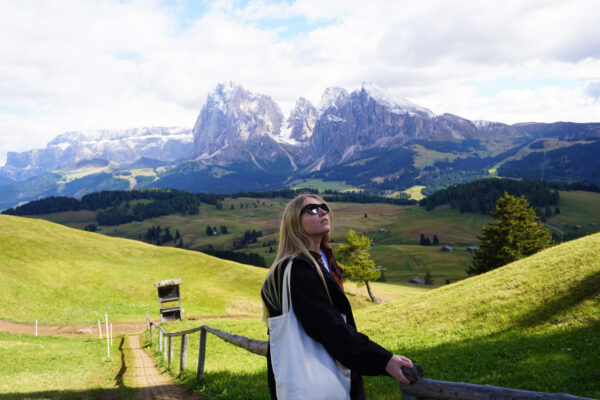
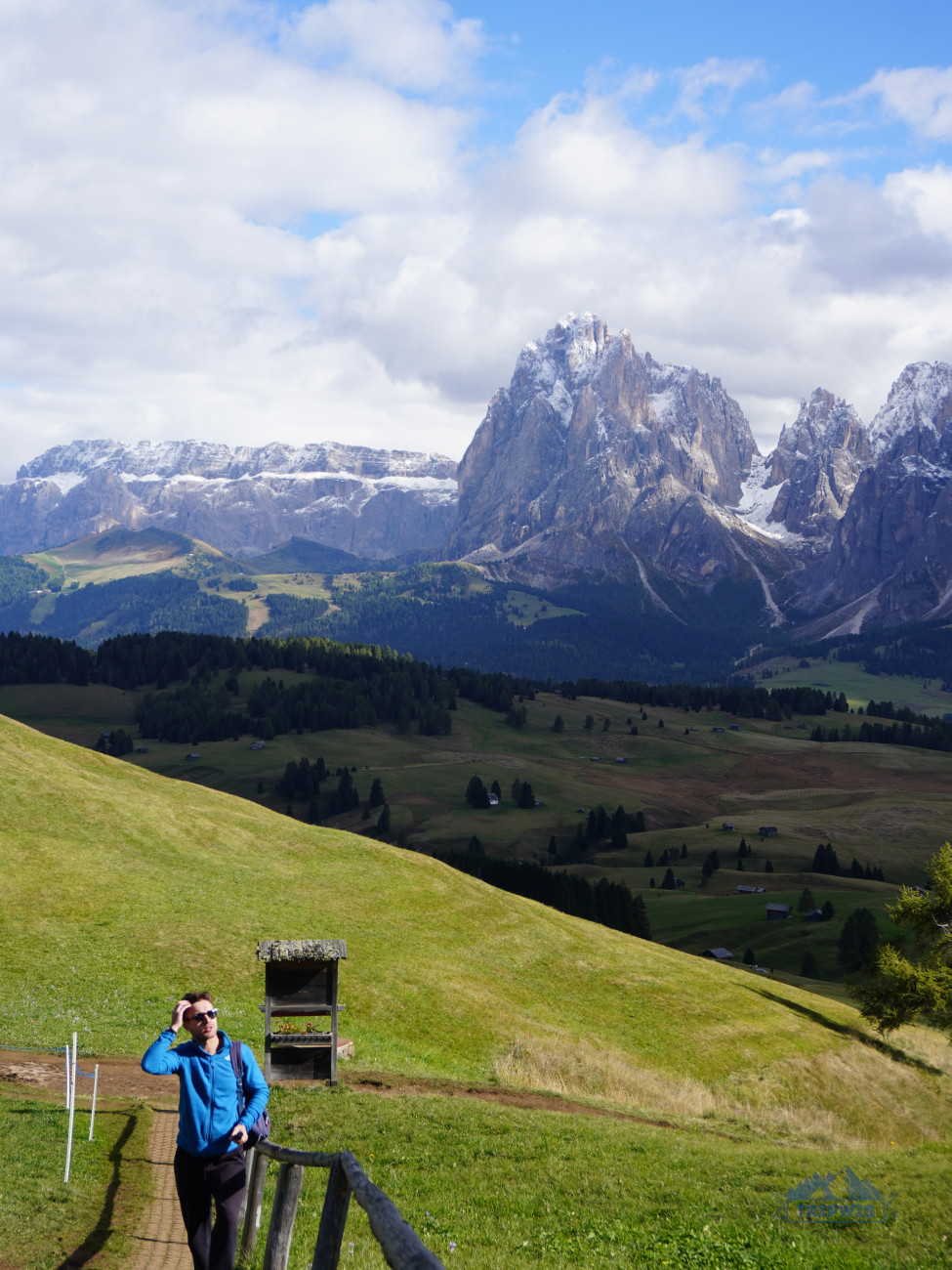
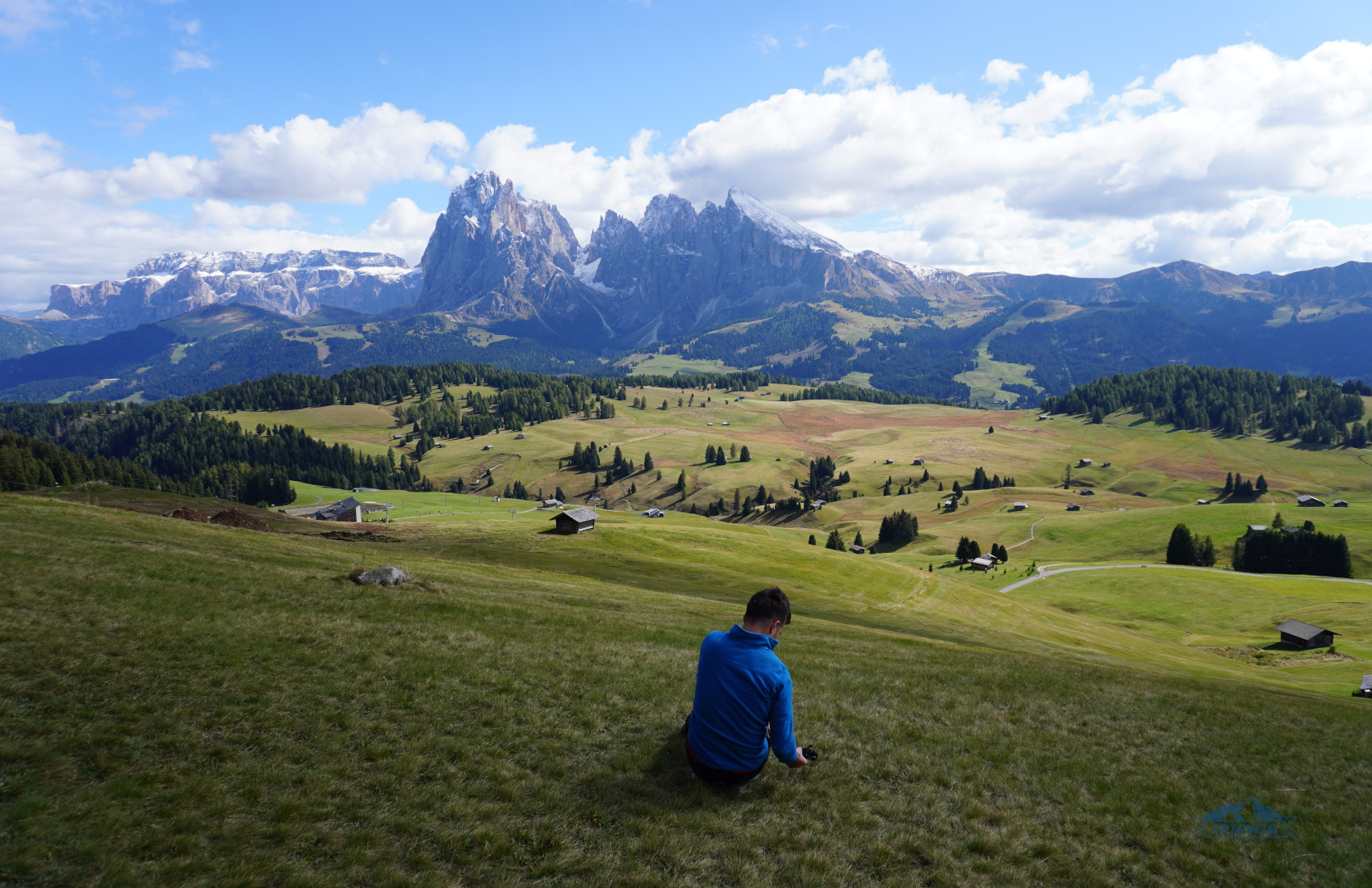
We took a gondola ride to the top, and… were particularly stricken by the beauty of this vast meadow surrounded by tall mountains (the Sassolungo group standing out from the crowd as the most spectacular and intense mountain wall).
Honestly, it is hard to imagine how much the scenery at the top of the pasture resembles a classic Dolomites-themed postcard: Rolling green hills with tall grass swaying in the wind and wildflowers hiding like jewels in these waves, charming huts both intentionally and haphazardly spread around the valley, small forest patches guarded by hillocks and peaks, friendly cows with real-life cowbells adding sound to the experience – it doesn’t get more enchanting than this!
Your Alpe di Siusi visit will go without a hitch if you have the following info under your belt:
- Parking your car at Garage Mont Sëuc will be your main source of stress – either come early in the morning or later in the afternoon (around 3 or 4 p.m.) to snag a spot. The price is €0.5 per hour per car; however, the amount is subject to changes (seasonal and otherwise)
- In summer season 2026, a price for a roundtrip cable car ride is €41 per person
- If you don’t feel like taking a cable car to the top, you can get to Alpe di Siusi by car and then hike up, but only before 9 a.m. I’ve covered all the details in my guide to Alpe di Siusi
- There are many trails crisscrossing the valley, but the most doable (and the most popular) one is the Alpe di Siusi Panorama Loop Trail. It covers 4.5 kilometers, takes around 2 hours to complete, and has barely any elevation gain
Ortisei (St. Ulrich)
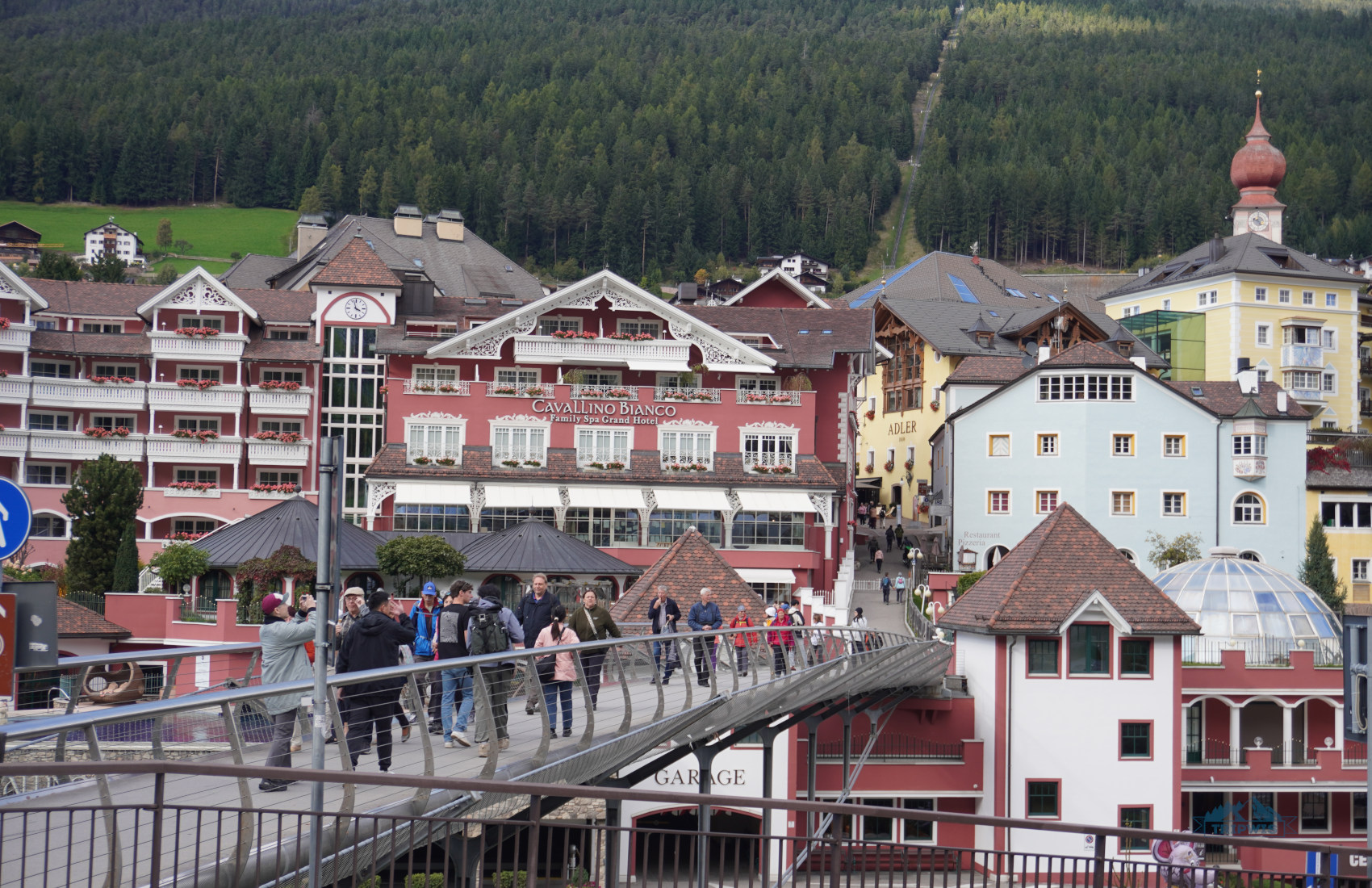
After you’ve seen enough of these Sound of Music-esque landscapes, it’s time to lay low for the night – do not tire yourself out on the very first day in the Dolomites!
Grabbing a bite in Ortisei (the central hub of Val Gardena and a beautiful town in and of itself) or retreating back to your hotel is the way to spend your evening. It was around 4 p.m. when we took the gondola back down to Ortisei, leaving us with just enough time to relax before waking up and hitting the trails again.
Where to eat for day 1 in the Dolomites: For comforting South Tyrolean food on Alpe di Siusi, peek inside the rifugios: Malga Contrin and Malga Schgaguler Schwaige will give you enough hearty fuel to keep going. If you have money set aside for exemplary culinary experiences in the Dolomites, check out Ortisei’s Turonda – a trendy pizza place with a wildly creative menu, and Anna Stuben – a renowned Michelin-starred restaurant that elevates local classics into the stratosphere (advance booking is essential).
Where to stay:
— B&B Lavi Ortisei val Gardena (Ortisei; from €180 a night)
— 4* Hotel Angelo Engel (Ortisei; from €355 a night);
— 3* Hotel Edda (Selva di Val Gardena; from €250 a night)
Day 2 – Seceda
 |
 |
Base town: Ortisei (our pick – Monte Pana Dolomites Hotel)
Focus point: Seceda Ridgeline
What to expect: Close-up views of dramatic Seceda peaks that look snatched, sickening, fierce. Plus, a moderately challenging hike to the top and back through a gorgeous landscape
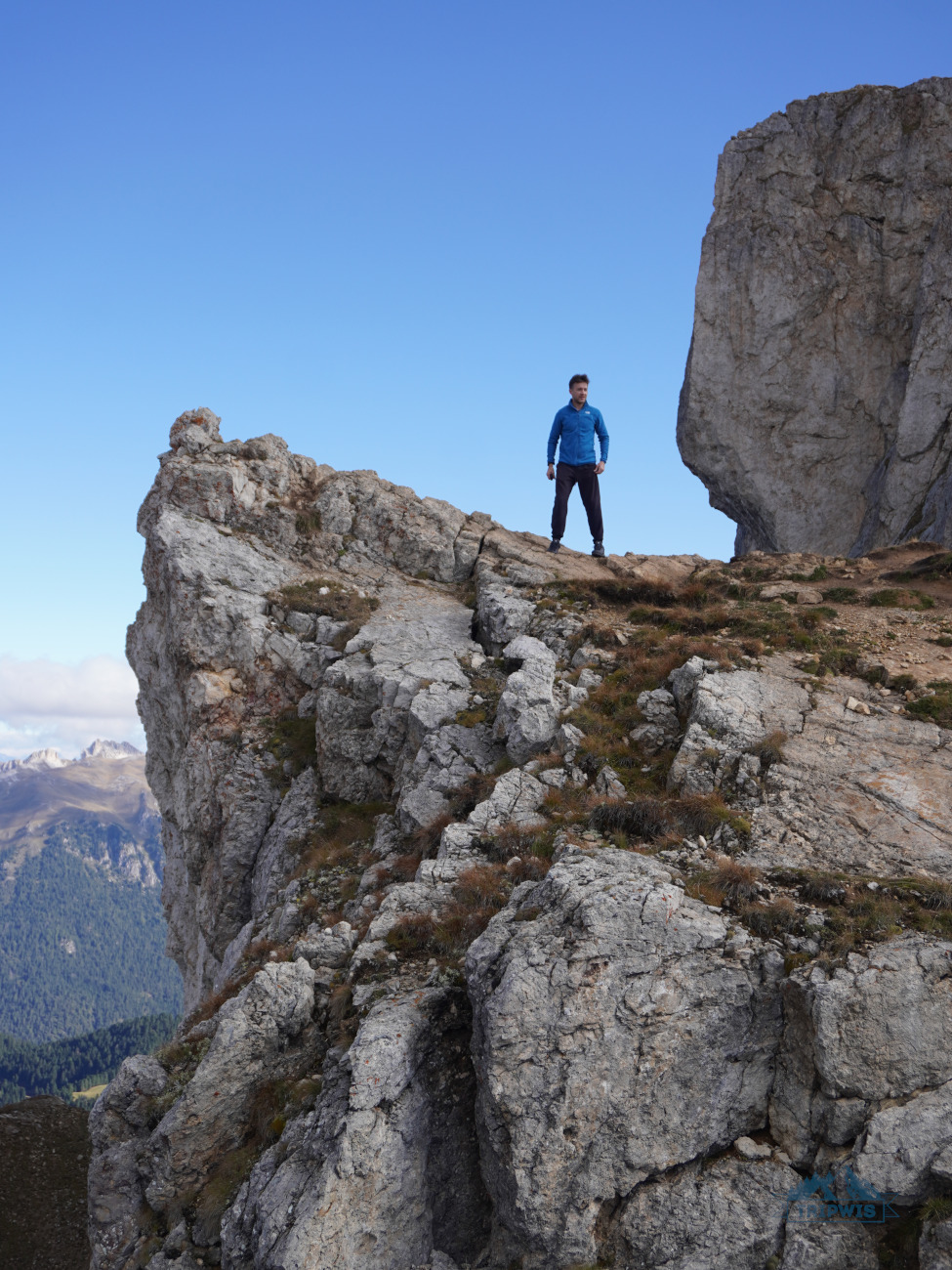
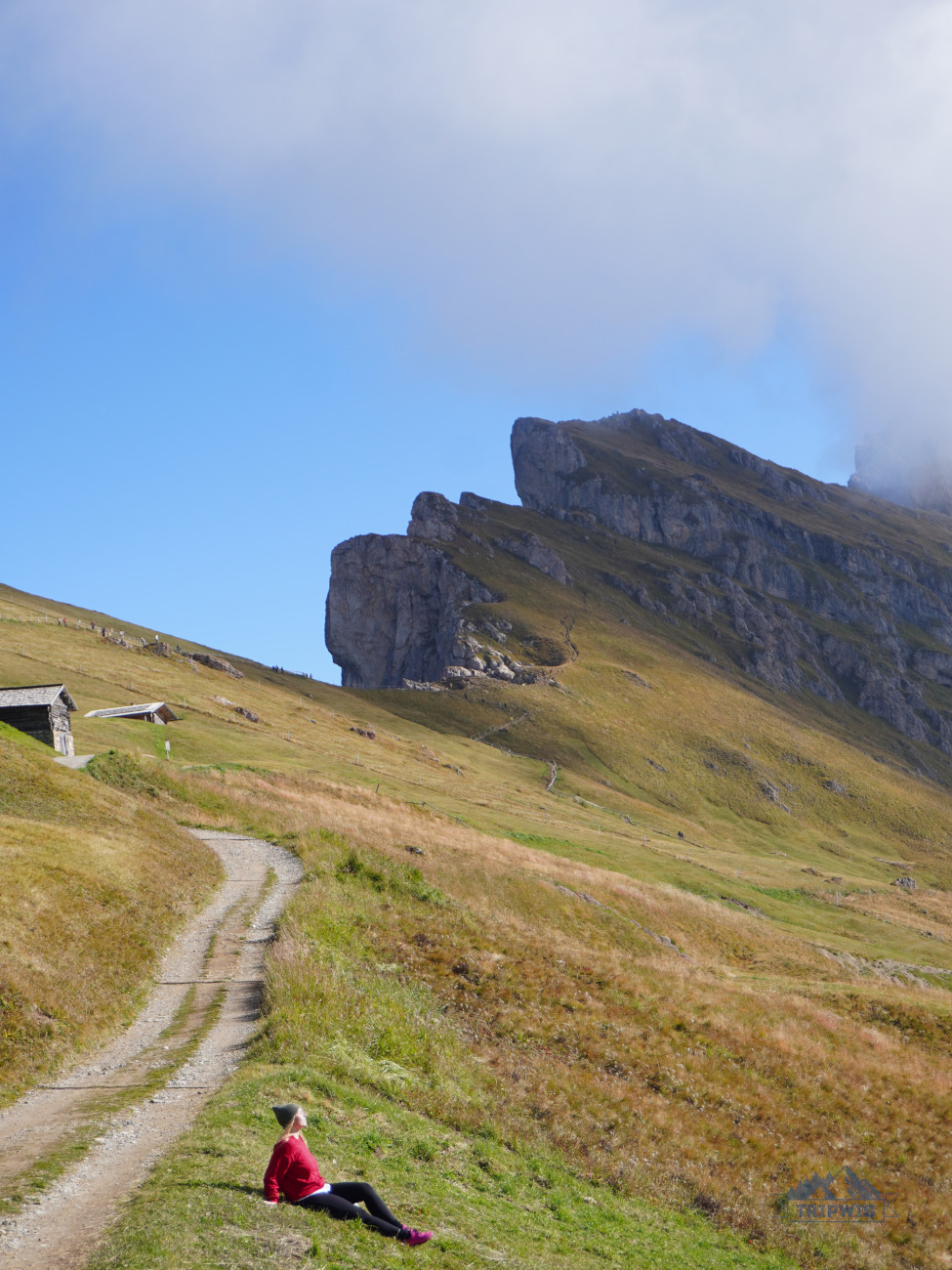
Though many guides claim Seceda to be a quick hit-and-run type destination in the Dolomites, we personally found a way to turn it into a real half-day adventure that is full of exciting views and some decent hiking.
Why Seceda? This iconic ridgeline comes with a significant price tag and crowds (yes, even in shoulder season). If you’re also on the fence about visiting Seceda, know that the pictures and videos do not do it justice – these needle-like vertical peaks are even more dauntingly beautiful in person! Plus, add sweeping views of the valley below, the vertiginous cliffside, and you’ve got yourself a proper well-rounded adventure.
Col Raiser-Seceda-Col Raiser loop hike
 |
 |
🅿️ €1.5 per hour
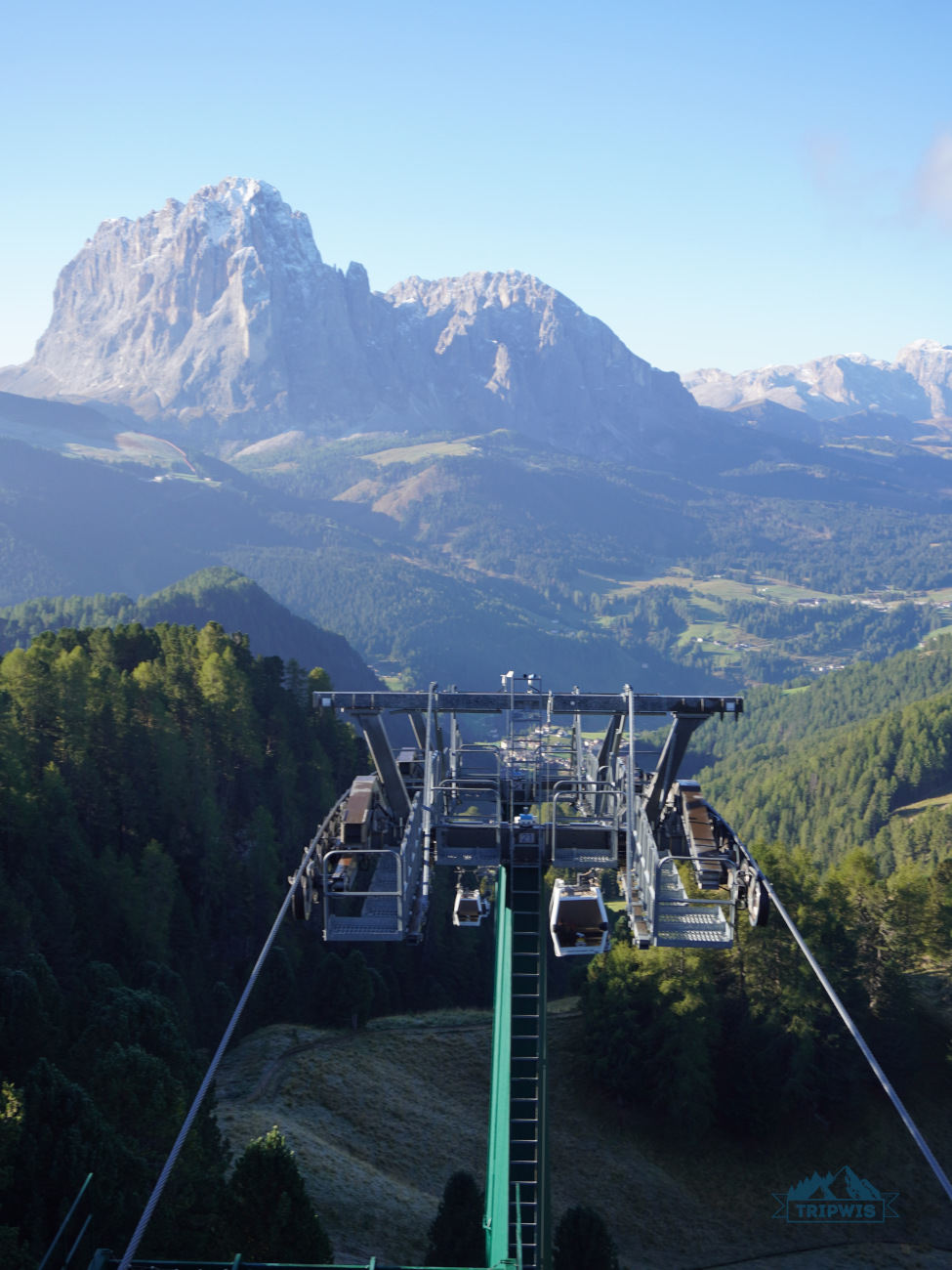
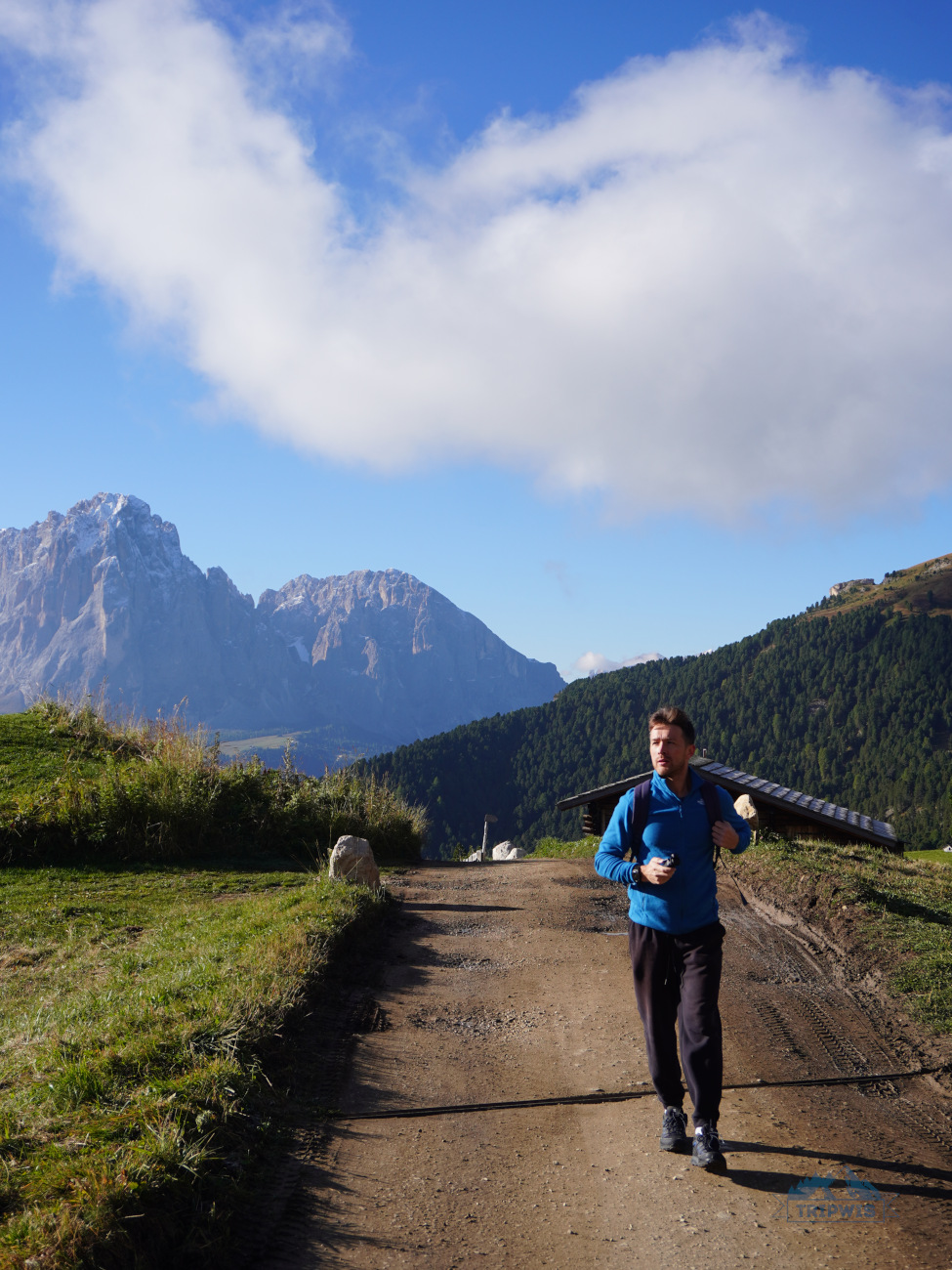
Not to get too “out there”, but I believe that the loop trail from Col Raiser to Seceda and back is one of the best hikes in the Dolomites – it is such a shame not a lot of people know about this option!
Staying in a quaint village of Santa Cristina meant that we spent mere 10 minutes in the car while driving to the Col Raiser cable car lower station (it would’ve taken just over 15 minutes to reach it from Ortisei). We arrived at the station’s car park bright and early, around 8:15 a.m.
Since doing the combination of a cable car ride and a hike might not be on your radar, here are the stats:
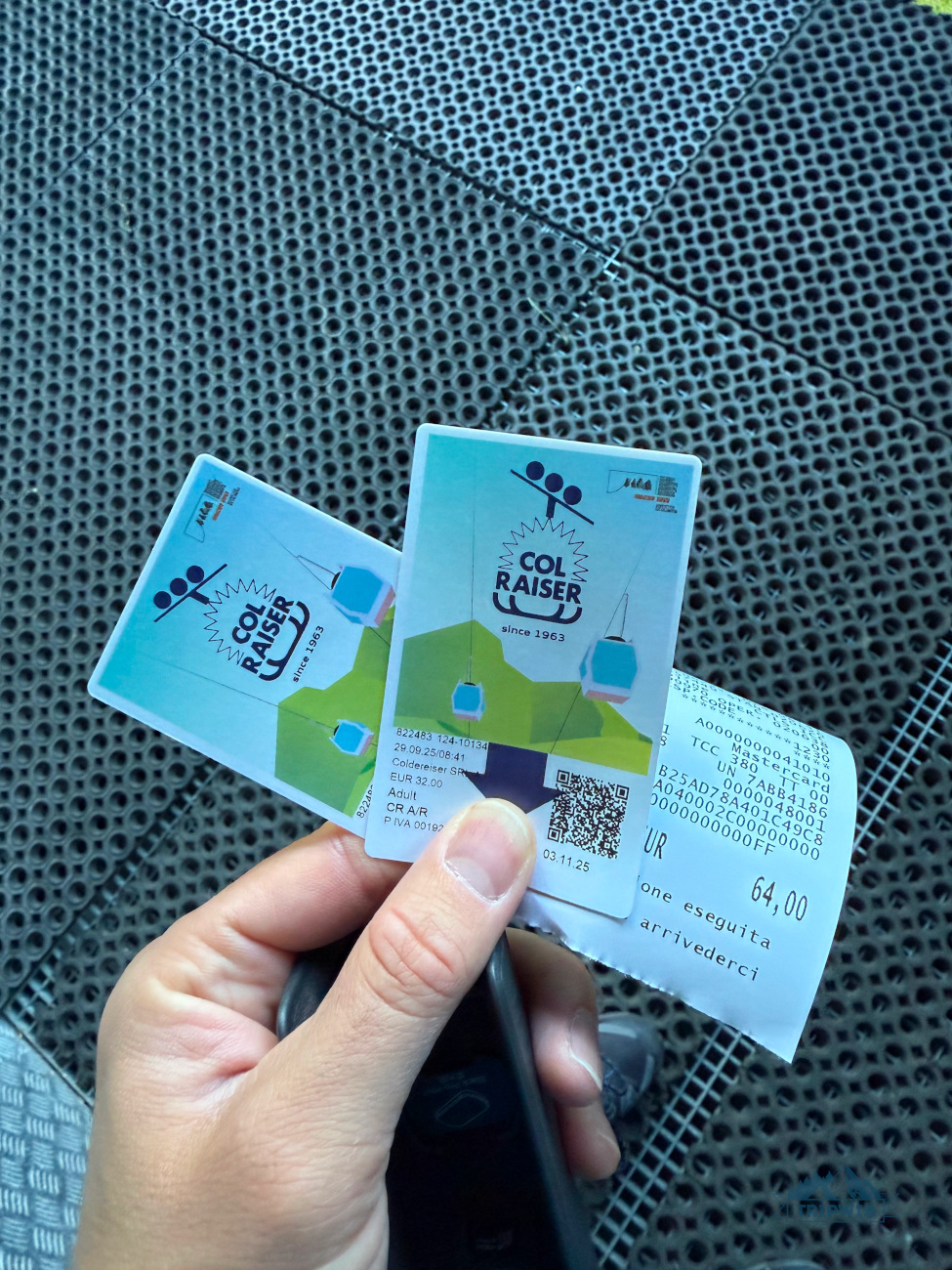
- You have to take the Col Raiser cable car from Santa Cristina to Col Raiser upper station that sits at 2,100 meters. The price for a roundtrip ticket is €34 – it might look like a lot, but actually that’s saving money when compared to the main way to get to Seceda (I’ll touch upon it later)
- After you reach the upper station, you embark on a 10-km Col Raiser-Seceda-Col Raiser loop trail with an elevation gain of 550 meters. It will take you about 4 hours to complete the loop – we came back down on a gondola slightly after noon
The alternative ways of getting to the ridgeline do not sound even remotely as exciting as the one we did (you can learn about all of them in my guide to Seceda). The most used one is the Ortisei-Furnes-Seceda cable car. Taking this gondola ride is one of the most popular things to do in the Dolomites – it results in huge lines to the ridgeline at the top in summer months. The tickets are €74 per person for a roundtrip! The outrageously high price tag is worth it though – you emerge from the top station right towards the majestic panorama of the peaks. A short 10-minute hike along the ridgeline and you’re face-to-face with the towering mountain range. Parking at the cable car station in Ortisei will set you back €3 per hour.
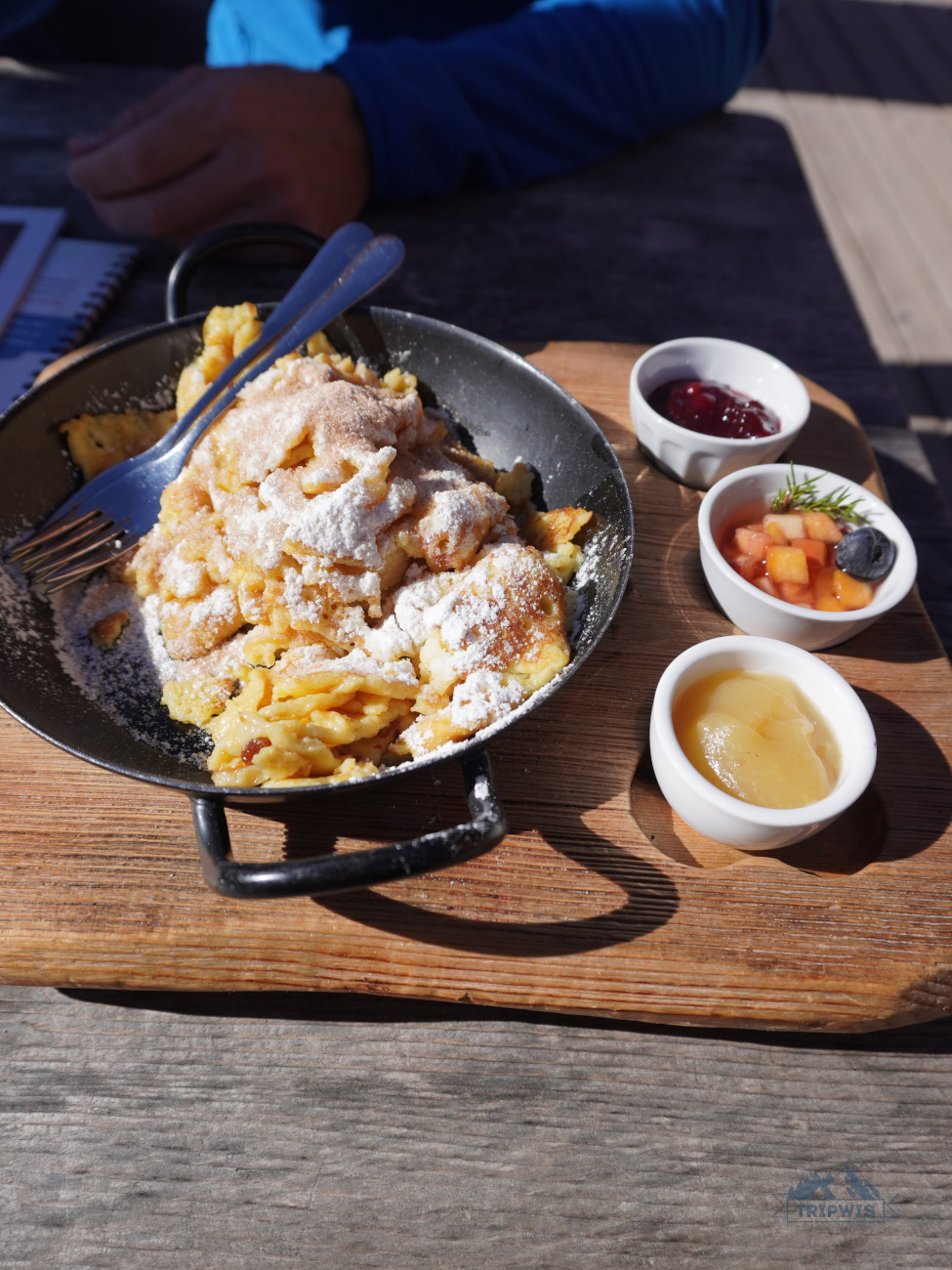
Where to eat for day 2 in the Dolomites: You do not need to even set foot in any of the Ortisei’s restaurants when you have such a wide choice of rifugios on the trail – Baita Odles, Baita Daniel, Baita Sofie. This is the land where Hugo Spritzes flow like rivers, speck dumplings jump out of the plates, and kaiserschmarrn (shredded sweet pancake) envelopes you like a big sugar-dusted hug.
Where to stay:
— 4* Hotel Touring Dolomites (Santa Cristina; from €210 per night)
— 5* Adler Spa Resort Dolomiti (Ortisei; from €440 a night)
Day 3 – Lake Sorapis and mountain passes
Base town: Cortina d’Ampezzo (our pick – 3* Best Western Hotel Nevada)
Focus point: Lago di Sorapis / Lake Sorapis
What to expect: Transfer to Cortina d’Ampezzo, mesmerizing mountain passes, terrifying cable car ride, a treacherous hike to a high altitude lake, a courtly and sophisticated home base – this is a pretty packed day, so, in the words of legendary Stanley Tucci, gird your loins!
Another early morning meant packing up our belongings and heading away from Ortisei and Western Dolomites in the direction of our next base – a small settlement near Cortina d’Ampezzo. On the way there, however, we embarked on countless journeys – some hard, some terrifying, some disappointing, but all unforgettable.
Passo Sella, Coffin Lift, and doughnuts
🅿️ €4 per hour
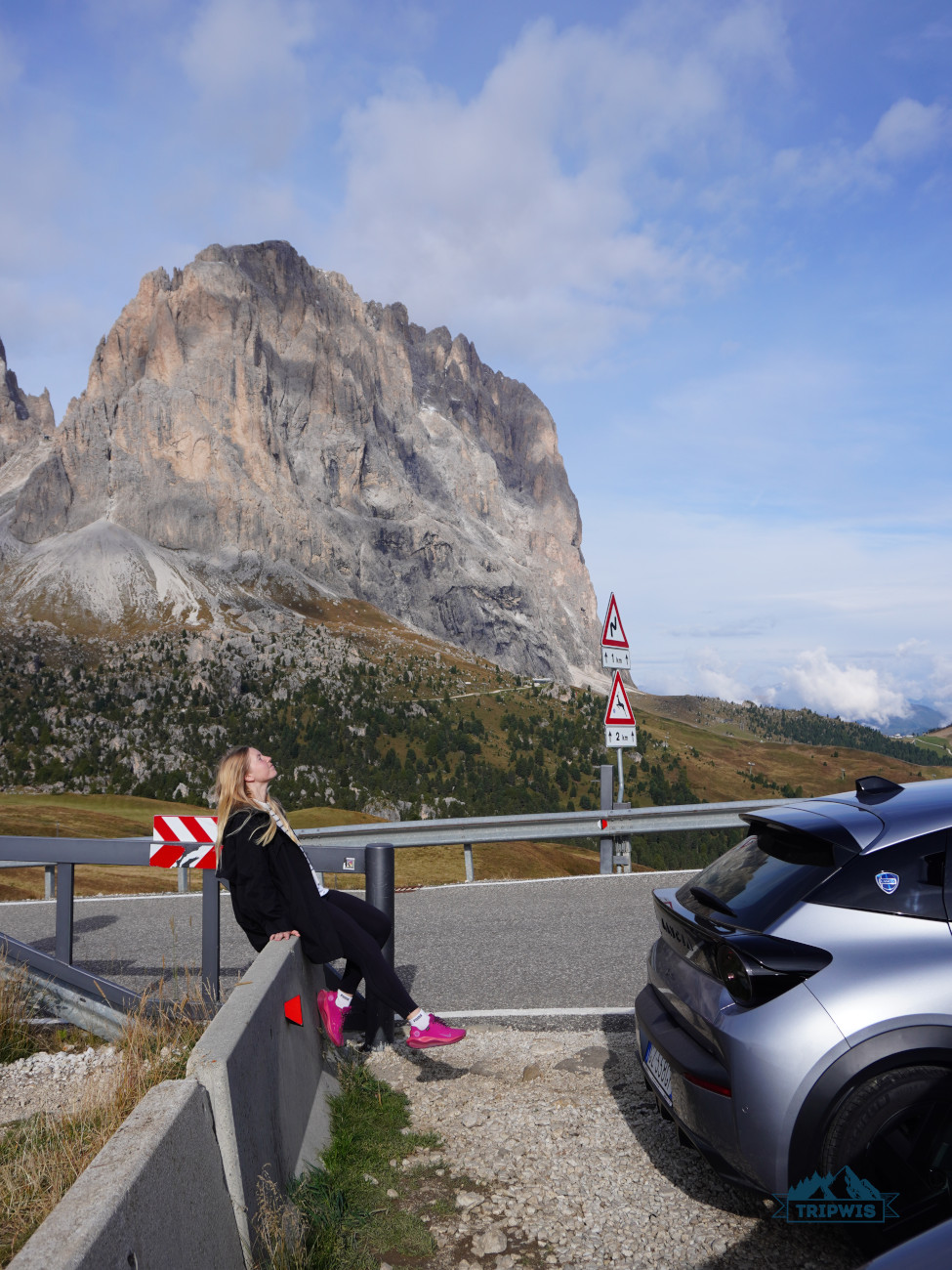
The Dolomites’ driving experience is highly accentuated by the plentiful mountain passes you will be traversing while on the road. Our first stop of the day was Passo Sella – a striking mountain pass that has no shortage of things to see and do.
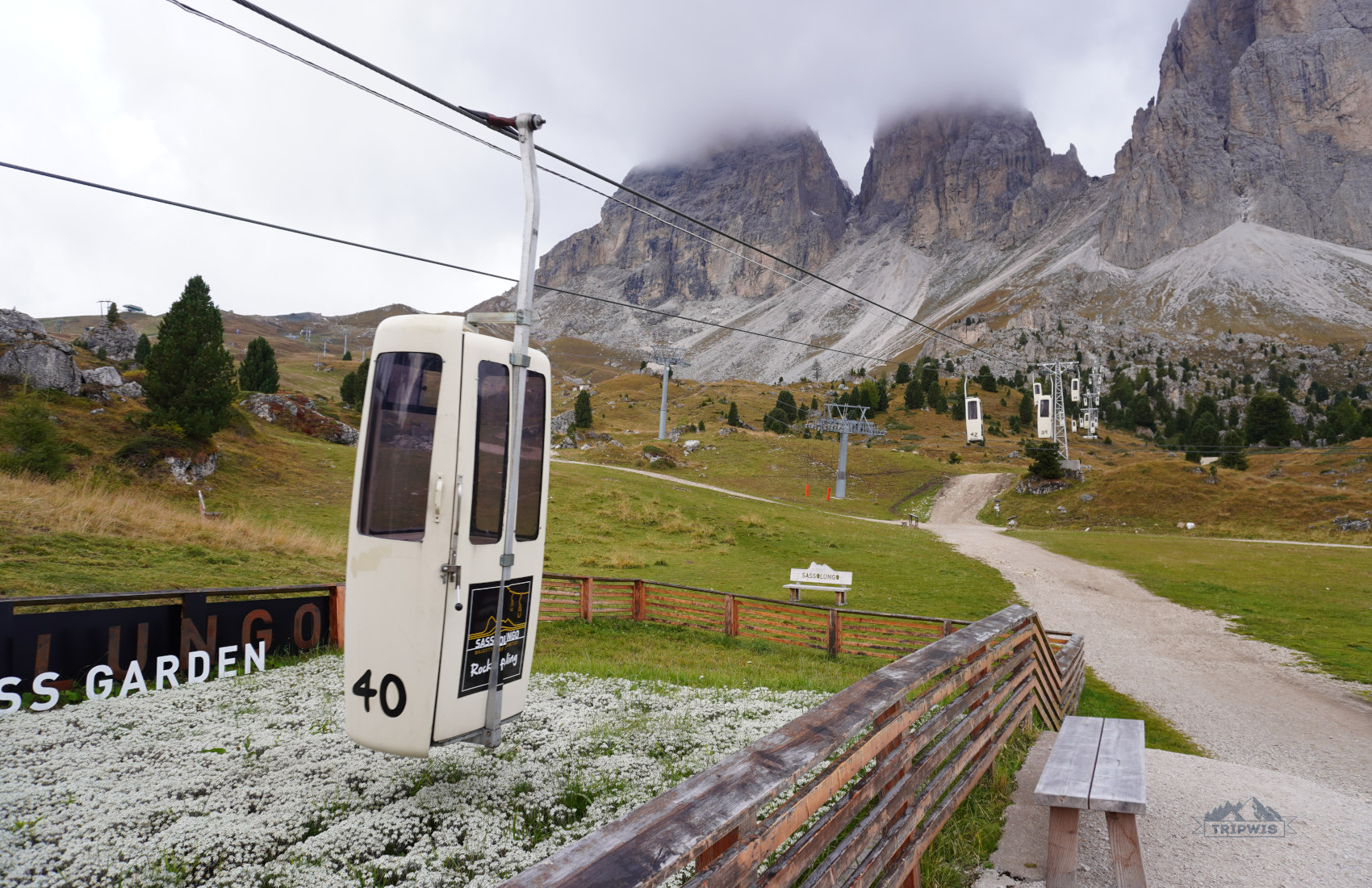
The daredevils might try to ride the Forcella Sassolungo cable car – also known as the “Coffin Lift”. Why? Its unique construction and operation process are to blame – the narrow vertical cabins only fit two people (standing!) and they do not stop for getting in or off; you have to jump while the car is in motion! A roundtrip in this torture chamber up into the Sassolungo mountains costs €45 per person.
 |
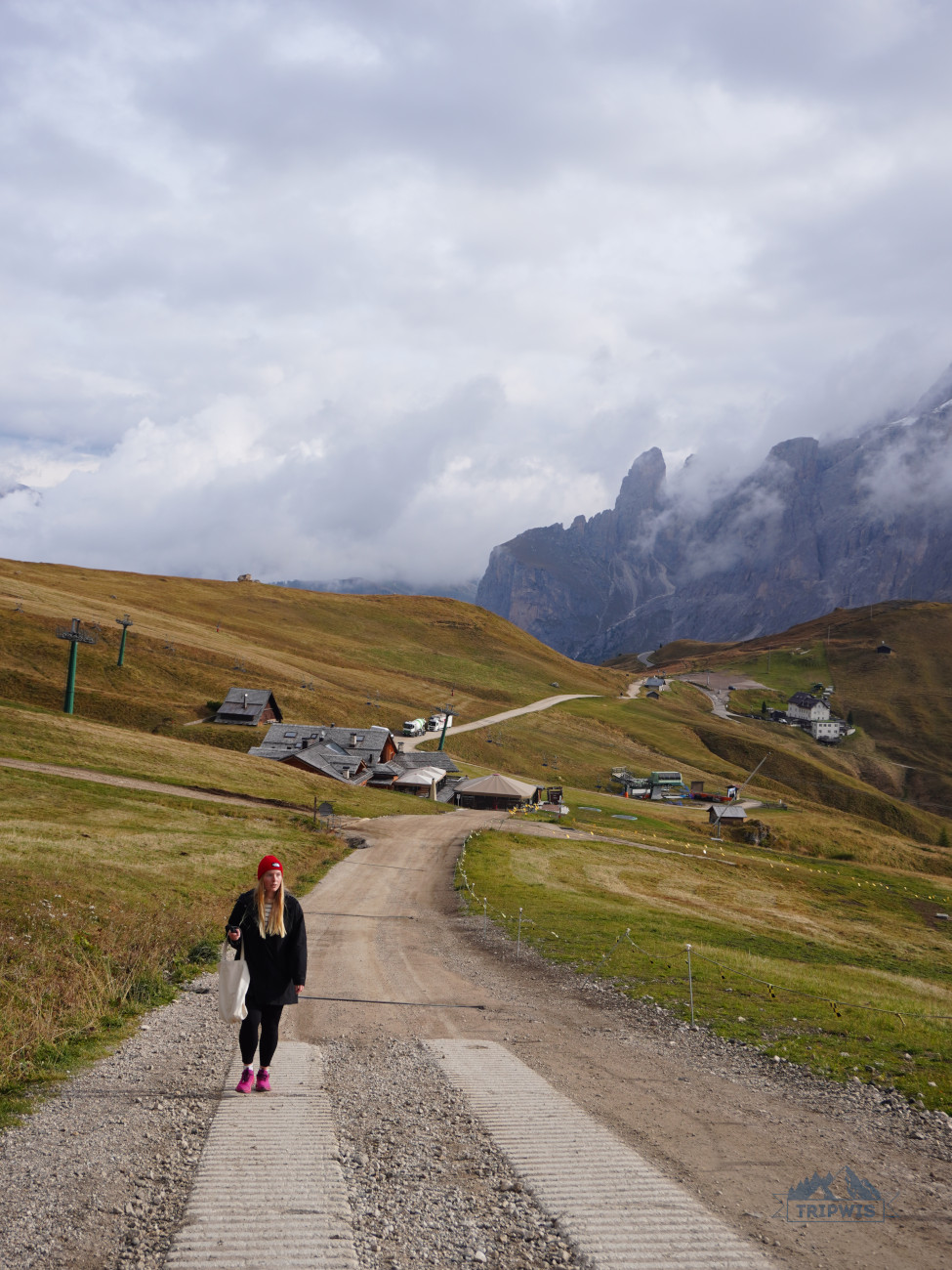 |
If a scary cable car ride is too far out of your comfort zone and if you prefer the stability that your own two feet bring, then you can embark on the long Sassolungo Circuit trail that starts at Passo Sella and runs around the striking mountain range of Sassolungo – it’s an almost 18-kilometer loop trail with an elevation gain and loss of 850 meters. No bueno because of the distance? I feel you!
Our experience: Since we knew that the main activity of the day would be the trek to Lake Sorapis, we wanted to take it easy in the morning and cut corners. Because of this, we started off on the first leg of the circuit trail, hoping to reach Rifugio Friedrich August in about 30 minutes (1.7 kilometers) before retracing the same steps back to the car park. The destination was not random – we wanted to try the legendary bomboloni (which are custard-filled donuts) at this rifugio. However, we were out of luck, yet again – the mountain hut was already closed on October 1st. This is the reality of coming to the Dolomites in shoulder season! Cold (it started snowing a bit) and bomboloni-less, we got to the car and drove off in search of other beautiful passes in the area.
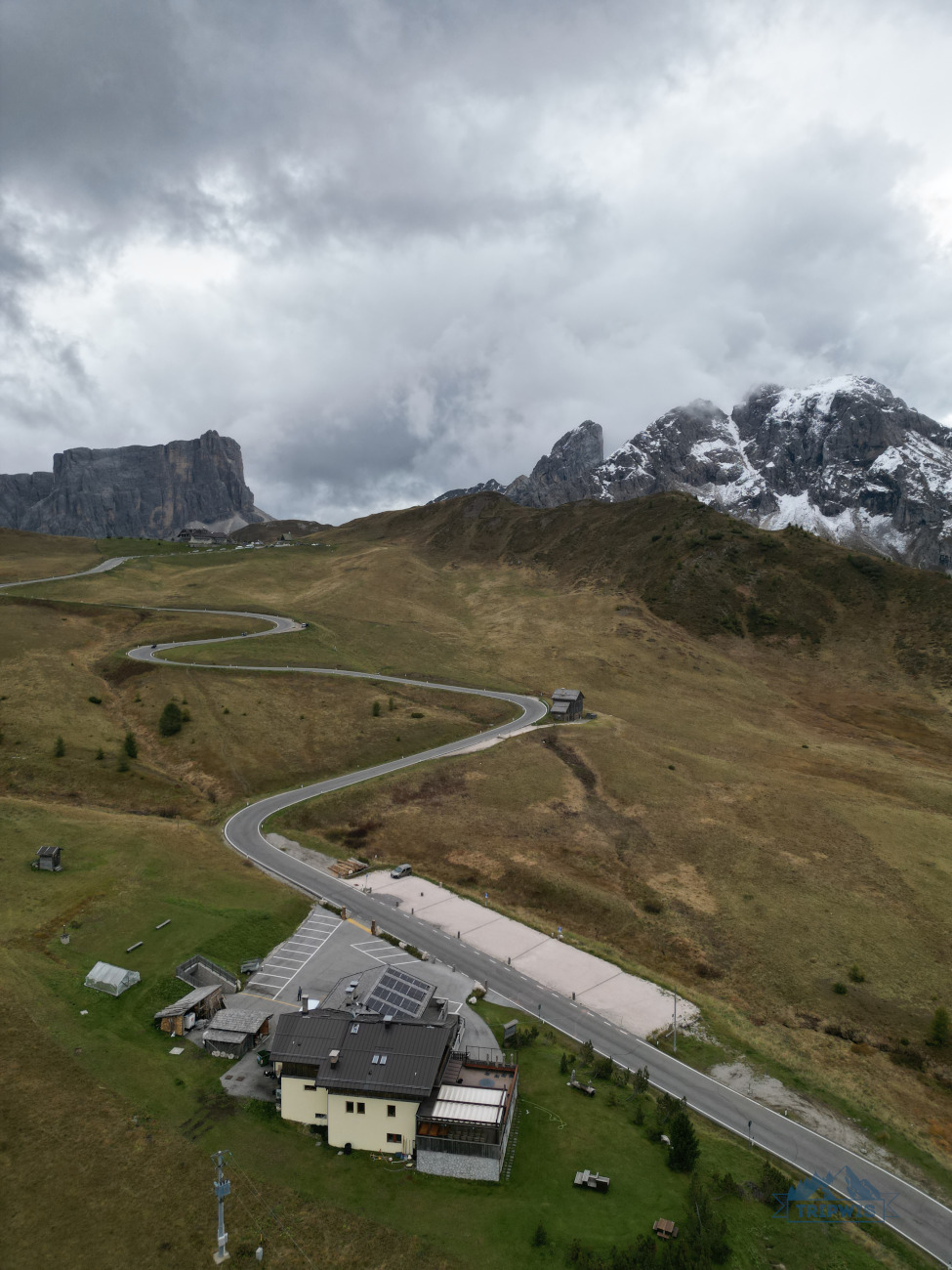
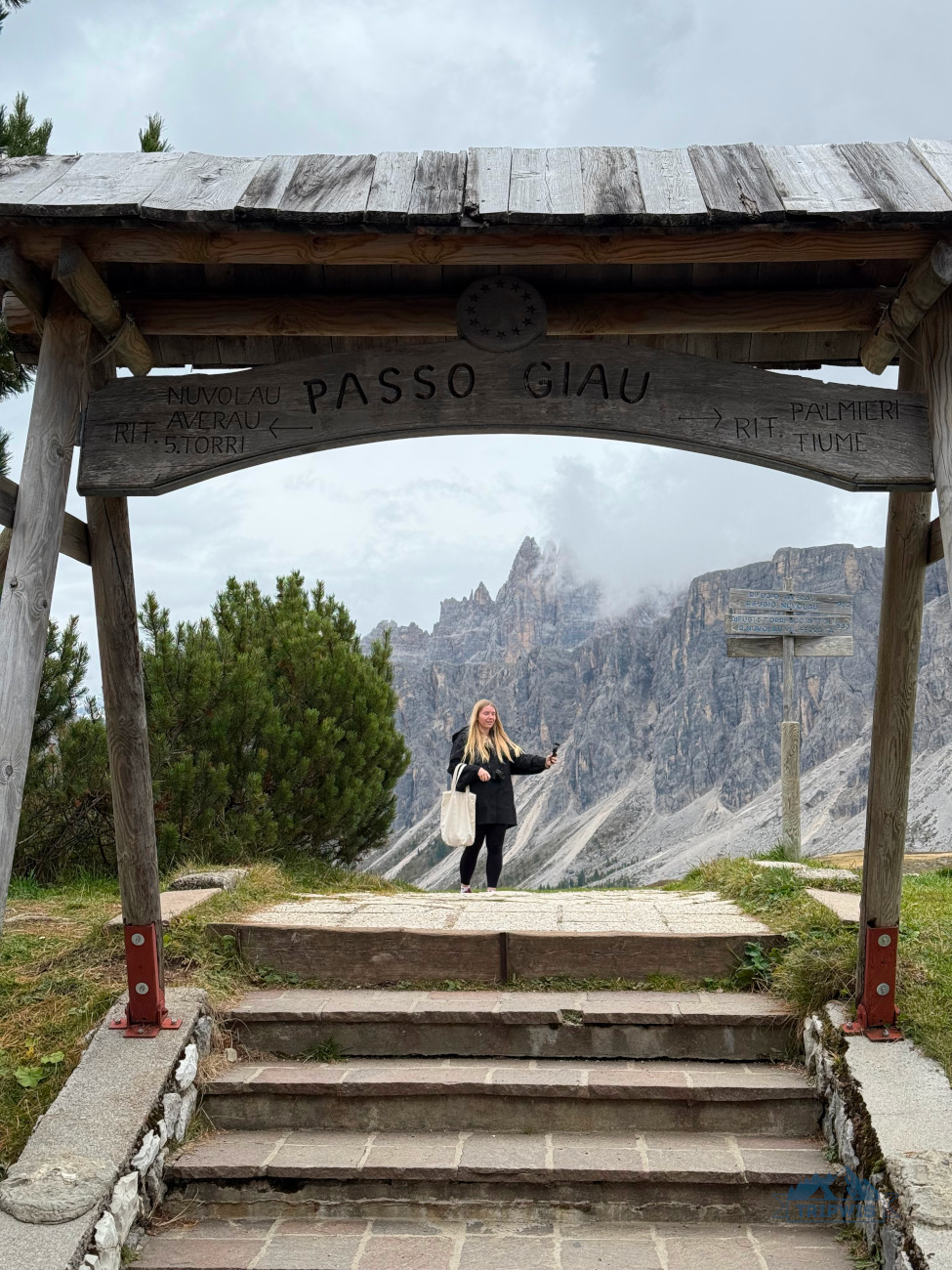
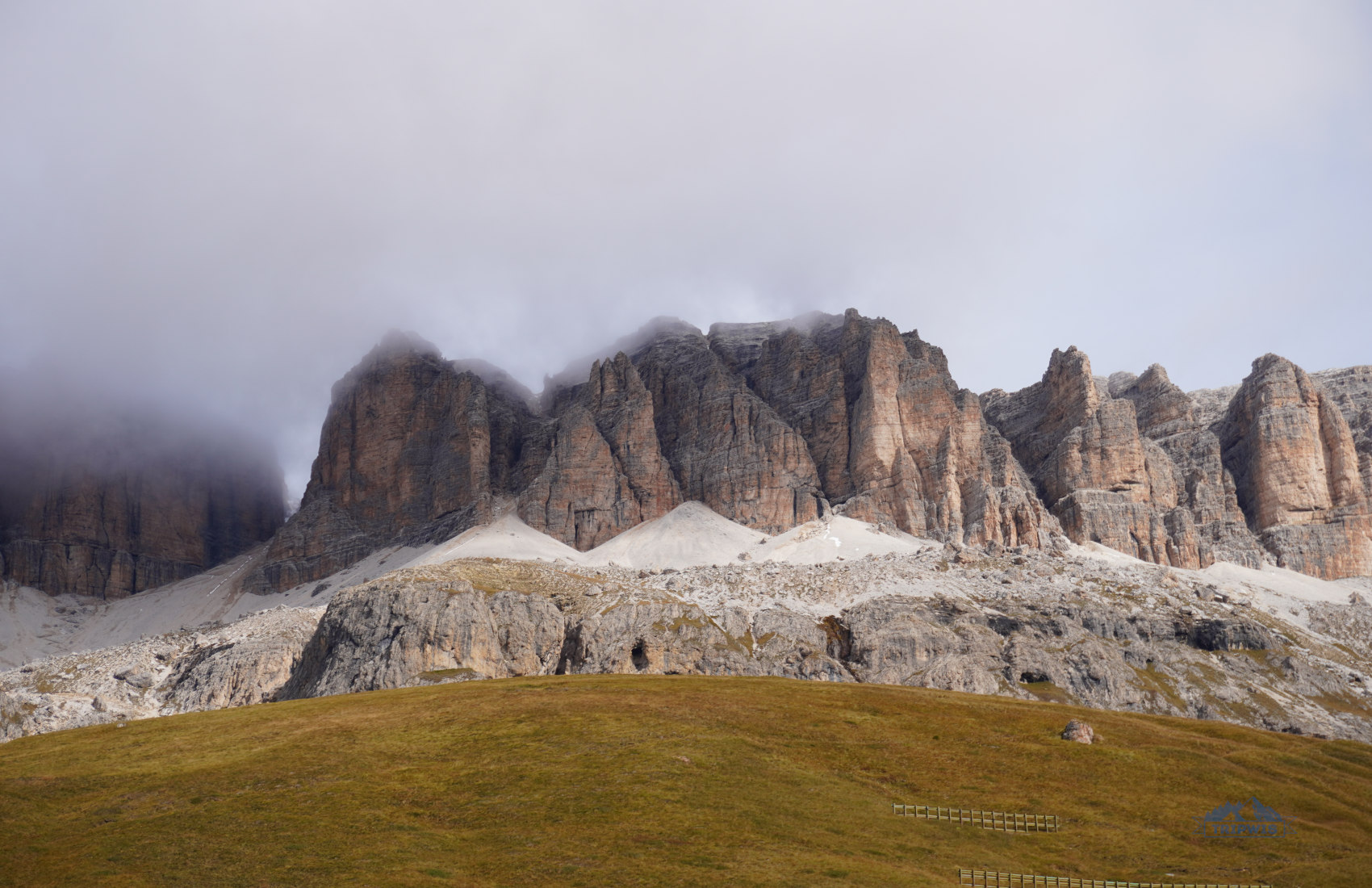
Passo Pordoi and Passo Giau
 |
 |
🅿️ free
These passes followed suit – we used them to get to Lake Sorapis and enjoy the panoramas. Though the combination of views is similar from both of them (towering mountain ranges, sweeping valleys, and high altitude open landscapes), some characteristics of the destinations are different.
Passo Pordoi is more crowded (there’s a cable car there), while Passo Giau offers a more remote feeling that sits well with photographers and other tourists alike. After taking what seemed like a million photographs, as well as some drone shots, we grabbed a bite at Hotel Ristorante Passo Giau before finally making our way to the trailhead of Lake Sorapis.
Lake Sorapis
 |
 |
🅿️ free
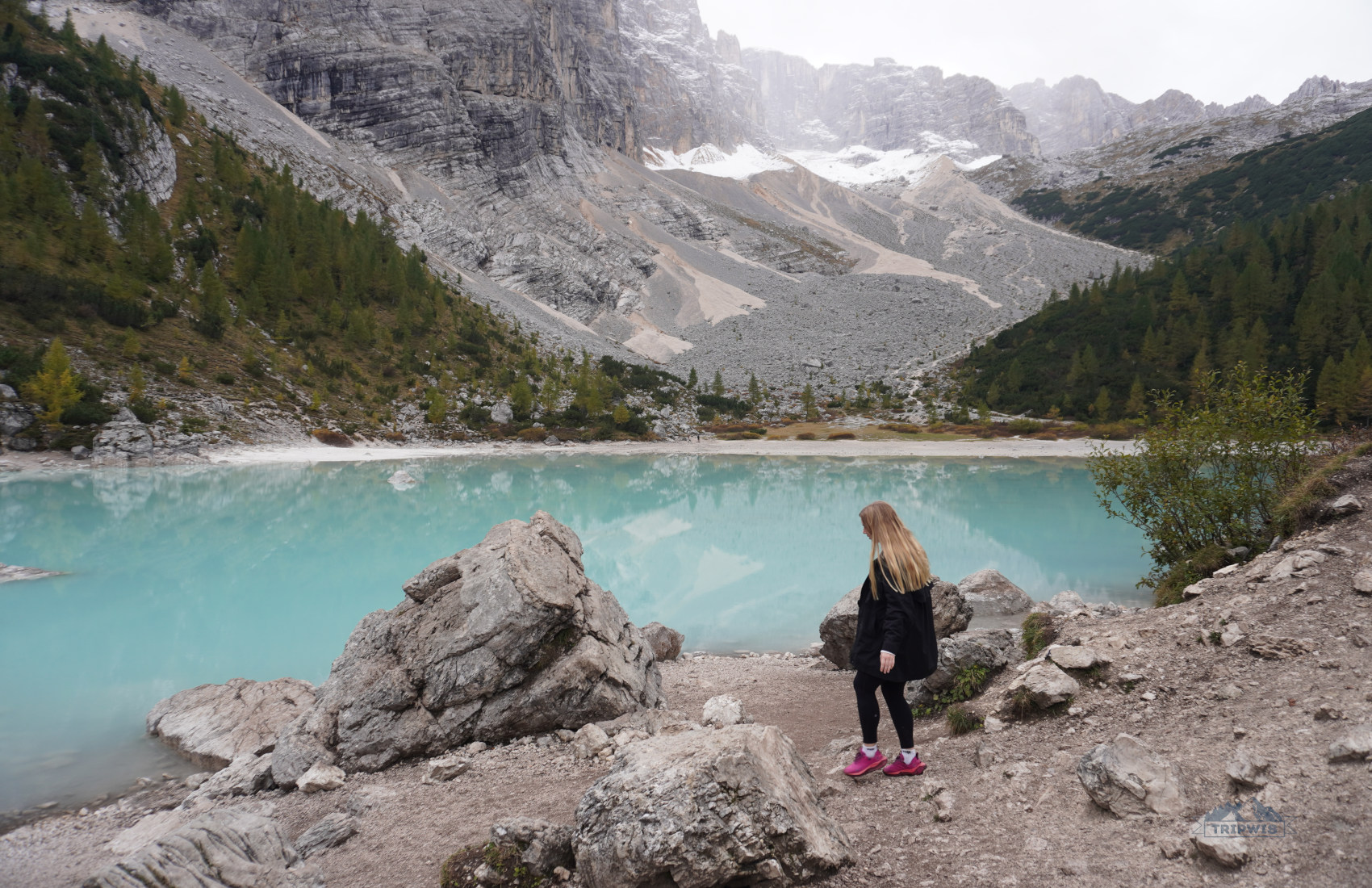
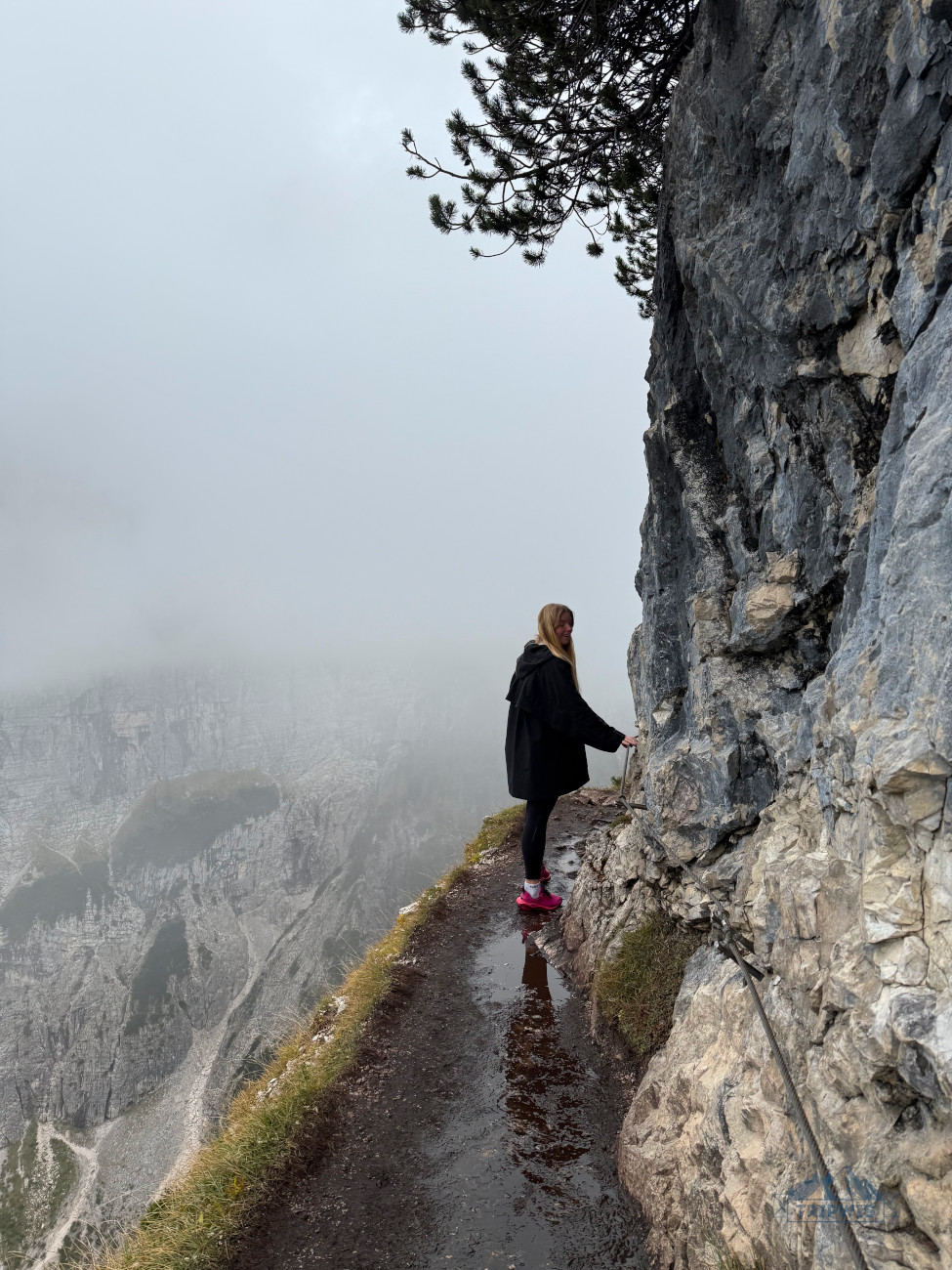
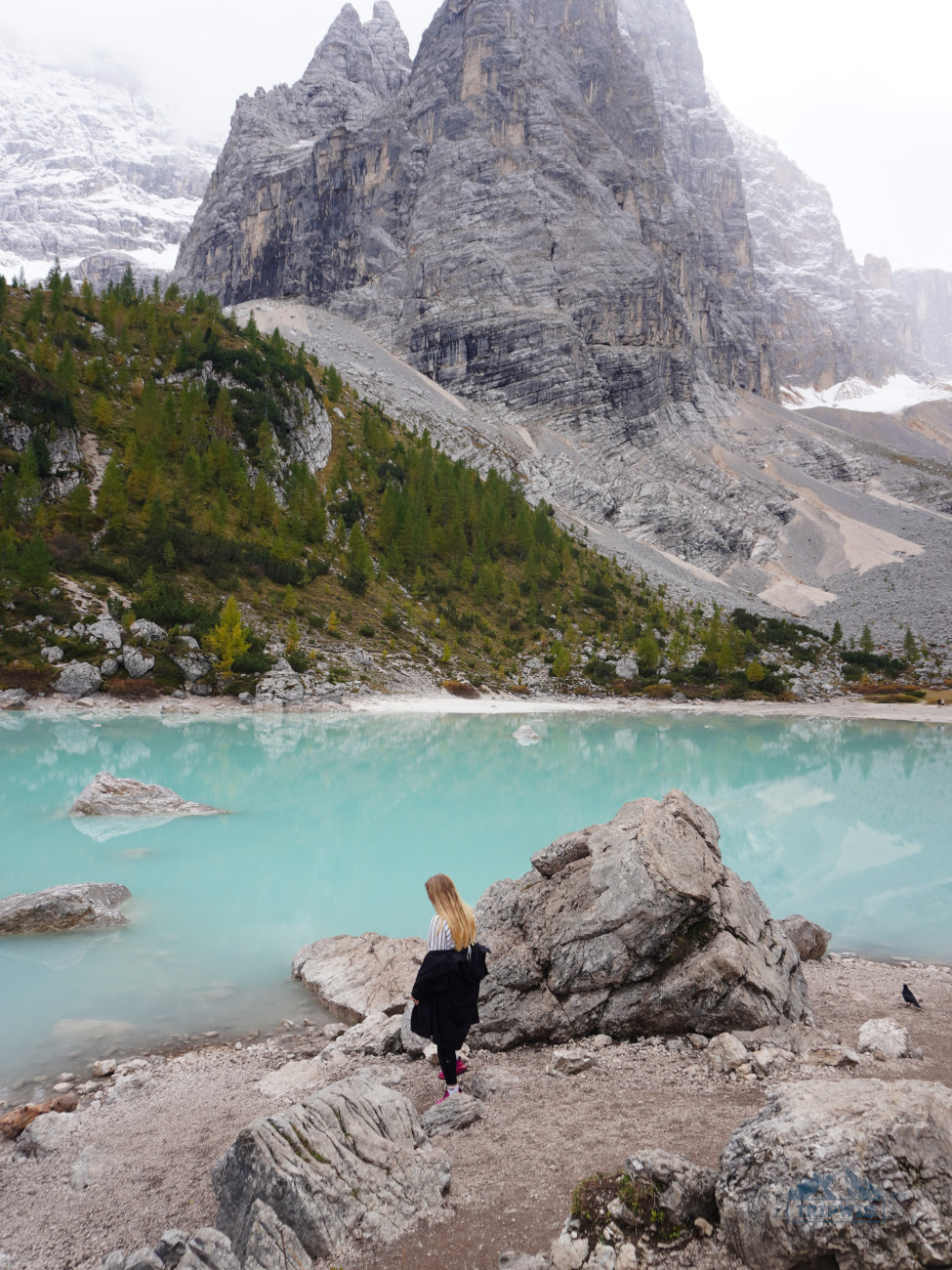
Now for the star of the show – again, I have seen the footage of this unbelievably blue alpine lake many times on social media. Everybody says that “if you didn’t come to Lake Sorapis, you haven’t done the Dolomites right!”, but nobody tells you how hard (and dangerous at times) the trek to the lake really is.
We didn’t even know that it would be a long hike – we got bamboozled by the trail sign that listed “2.5 hours”. It turns out, this is a time estimation just to get to the lake (you still have to get back!).
Despite the late start (at around 1:30 p.m.), we made it to the lake and back before the sunset (we were at the car at 5:45 p.m.). Hiking in the dark on such a treacherous trail would’ve been a nightmare – next time, I vow to pack a flashlight just in case.
The magical sight of Lake Sorapis – high alpine lake that gets its milky-blue color from glacier runoff – and the unbelievably tall mountains that frame the water is worthy of the struggle to get to it.
I don’t want you to go into the adventure blind, so here are some stats for the hike:
- There’s free roadside parking by the gate and a bigger (but also free) parking lot set further downhill
- It’s a moderate-to-hard trail that covers the distance of almost 13 kilometers, with total ascent and descent of 600 meters. The overall hike time is between 4 and 5 hours
- It’s not an outrageously difficult trek – it’s not technical like some via ferrata routes in the Dolomites, it just has some sketchy parts where you have to be vigilant about your footing. A scree field is better traversed on all fours (or with the help of hiking poles) and a narrow rocky path alongside a steep drop-off requires you to use steel cables mounted to a wall (do not look down!)
- You can’t get to the lake any other way, just by your own two feet
- Apart from an optional lunch at the one rifugio of the trail (set close to the lake), there are no expenses for the Lake Sorapis adventure – here, you pay with your energy and not your wallet!
- It is best to embark on the hike in shoulder season. The lake is at its fullest in early summer, but we were there in late September and the view was still spectacular
The trail to Lake Sorapis was arguably the most fun and exciting time we had in the Dolomites – despite dirty sleeves and wet butt from sliding on rocks, we felt invigorated by accomplishing such a physically demanding feat (with views to beat!).
Cortina d’Ampezzo
 |
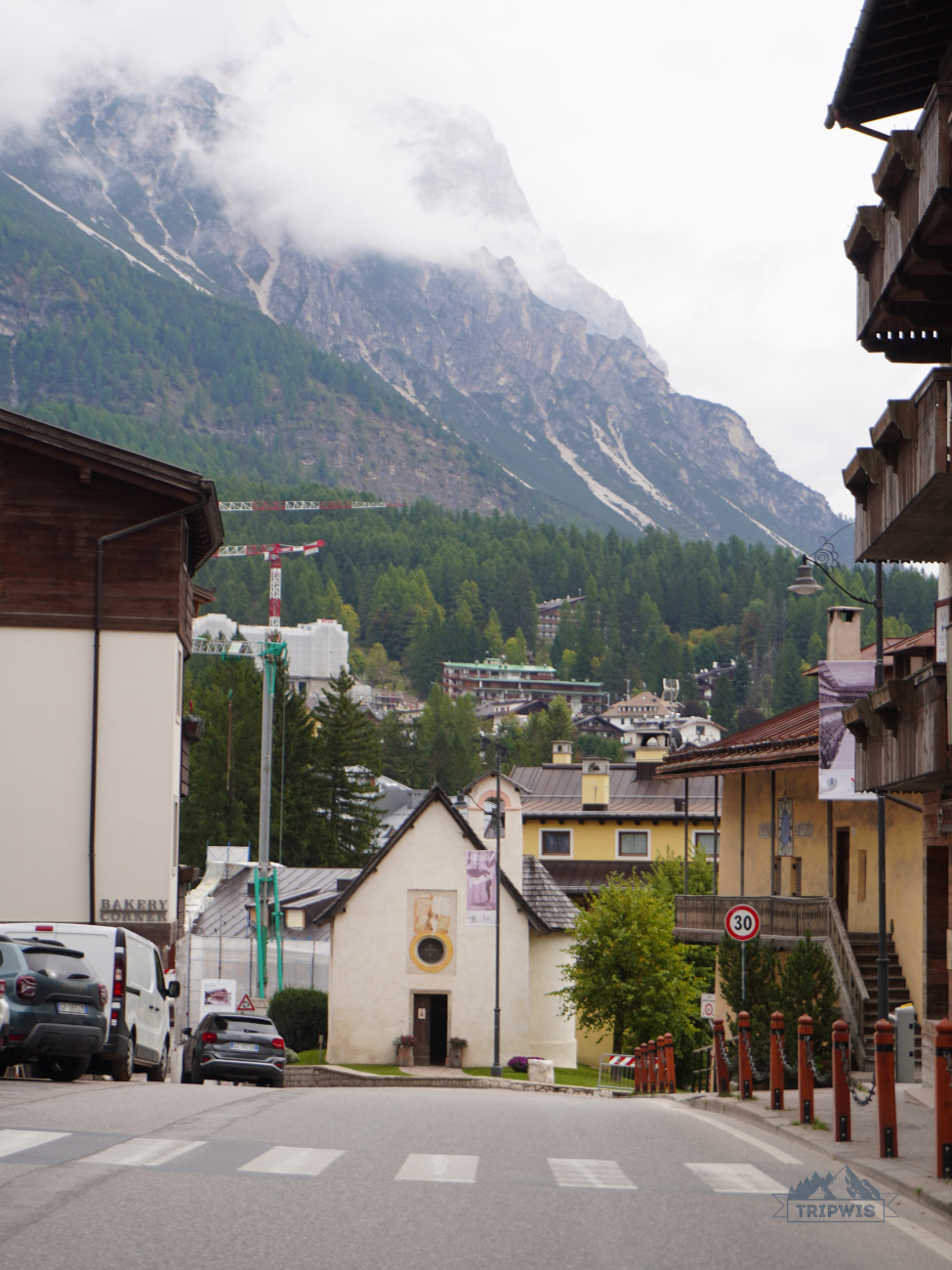 |
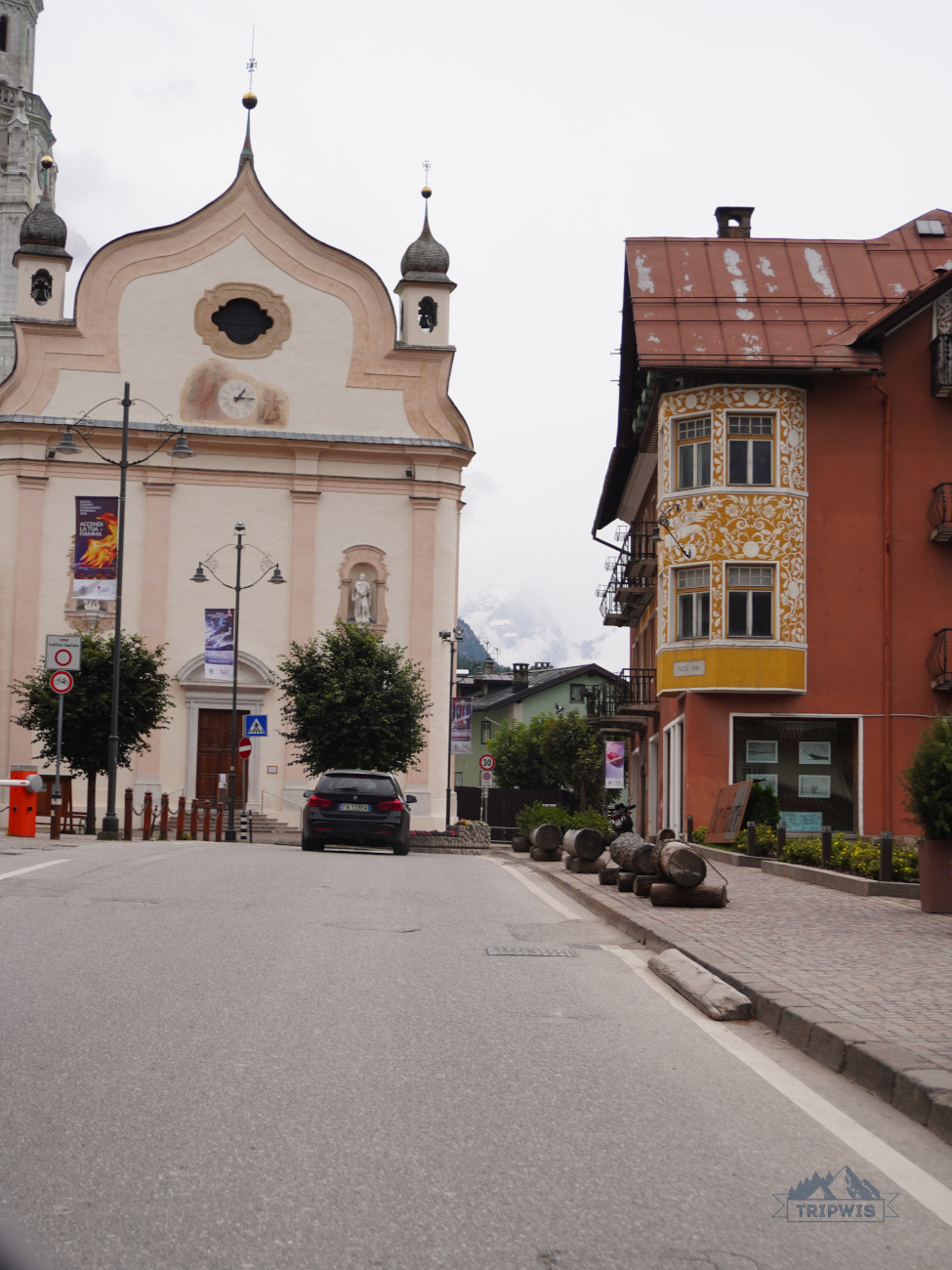
Your Lake Sorapis shenanigans are bound to leave you bone-tired, with legs aching and full body soreness lingering well into the next day. However, you cannot get this close to Cortina d’Ampezzo – the “Queen of the Dolomites” – and not pay this charming town a visit.
Cortina has long been a premier year-round destination in Eastern Dolomites, but Olympic winter games of 2026 have put an even bigger spotlight on the town. We popped into a grocery store in Cortina and stumbled upon tons of Olympics-themed souvenirs (mind you, it was still late September!).
The atmosphere of Cortina’s historic center is upscale – walk along Corso Italia (the main pedestrian street) and see it for yourself! There are tons of high-end boutiques, galleries, and restaurants. Because we didn’t want to pay double just to say that we stayed in Cortina d’Ampezzo, we made our way outside city limits, to a small town of San Vito di Cadore, where we spent the night at a cheaper Best Western Hotel Nevada.
Where to eat for day 3 in the Dolomites: Hotel Ristorante Passo Giau made the Friedrich August fiasco be a distant memory with an order of hot coffee and a classic strudel (€10). If Rifugio Alfonso Vandelli by Lake Sorapis is already closed, you should pack a picnic to have by the water. San Vito di Cadore, though very small, has some great eats as well: Stuzzica La Voglia pizzeria curbed our hunger with a large pizza to share (€15–€19). If you’re staying in Cortina, then grab a morning pastry at Pasticceria Panificio Alverà or treat yourself to a nice dinner at IL Vizietto di Cortina.
Where to stay:
— 3* B&B HOTEL Passo Tre Croci Cortina (Passo Tre Croci trailhead for Lake Sorapis; from €160 a night)
— 3* Hotel Olimpia (Cortina; from €170 a night)
Day 4 – Tre Cime di Lavaredo
Base town: Cortina d’Ampezzo
Focus point: Tre Cime di Lavaredo / Drei Zinnen
What to expect: Windy hike around towering peaks, jumping through hoops to access a couple of destinations, gorgeous lakes, and opportunities to desert the trail whenever you feel like it
The early start is essential to beat the crowds at the main destination of the day – the iconic Three Peaks of Lavaredo.
Tre Cime di Lavaredo
 |
 |
🅿️ €40 for 12 hours
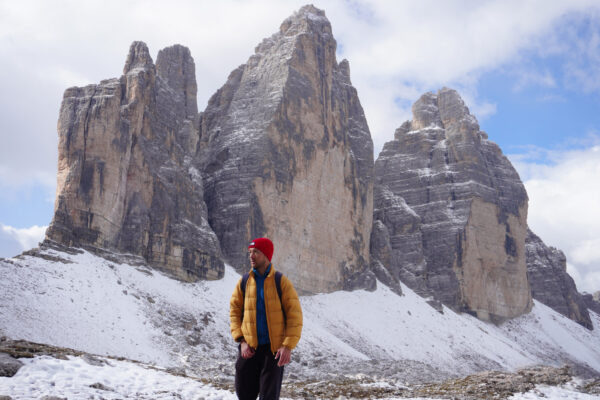
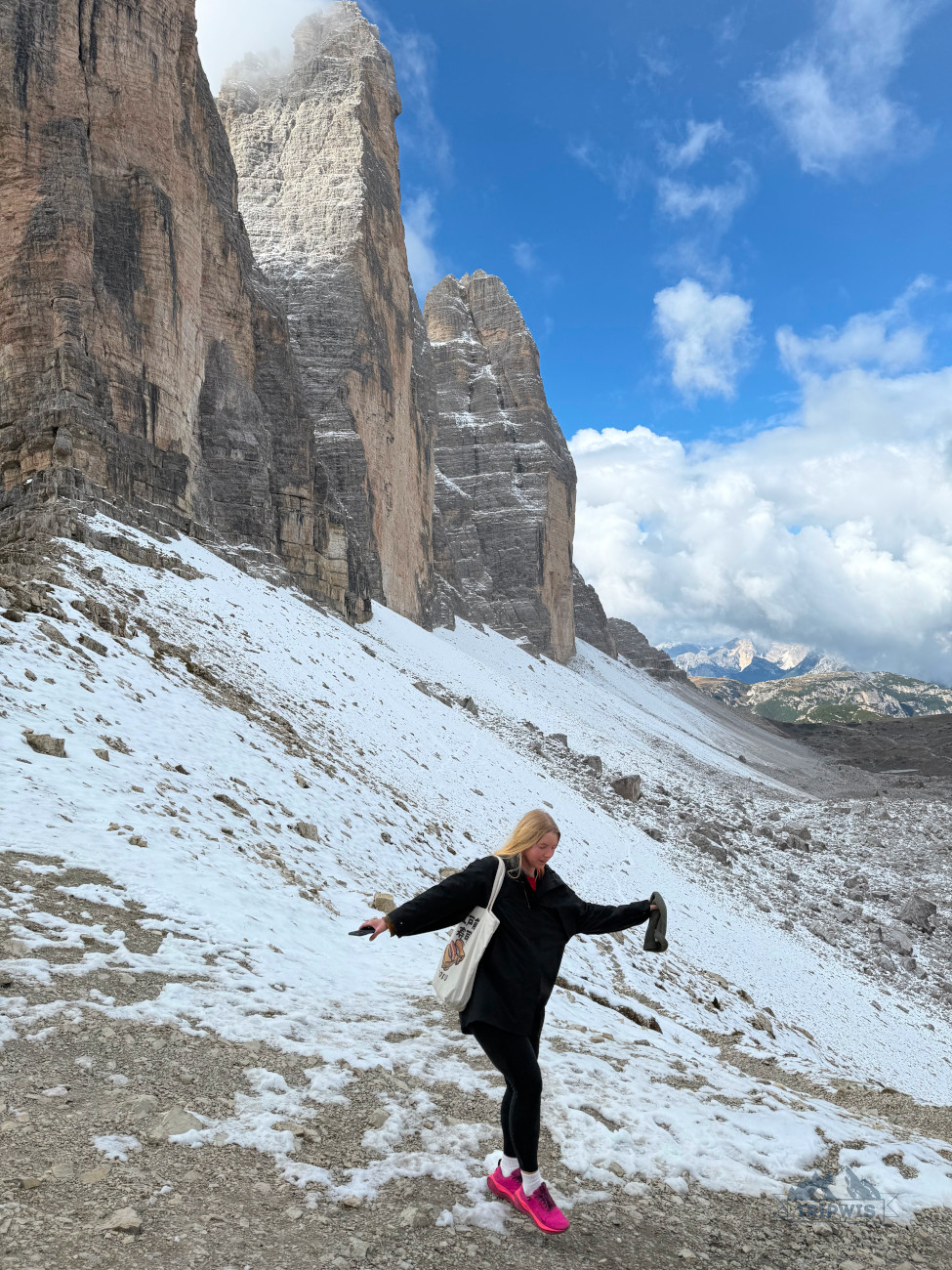
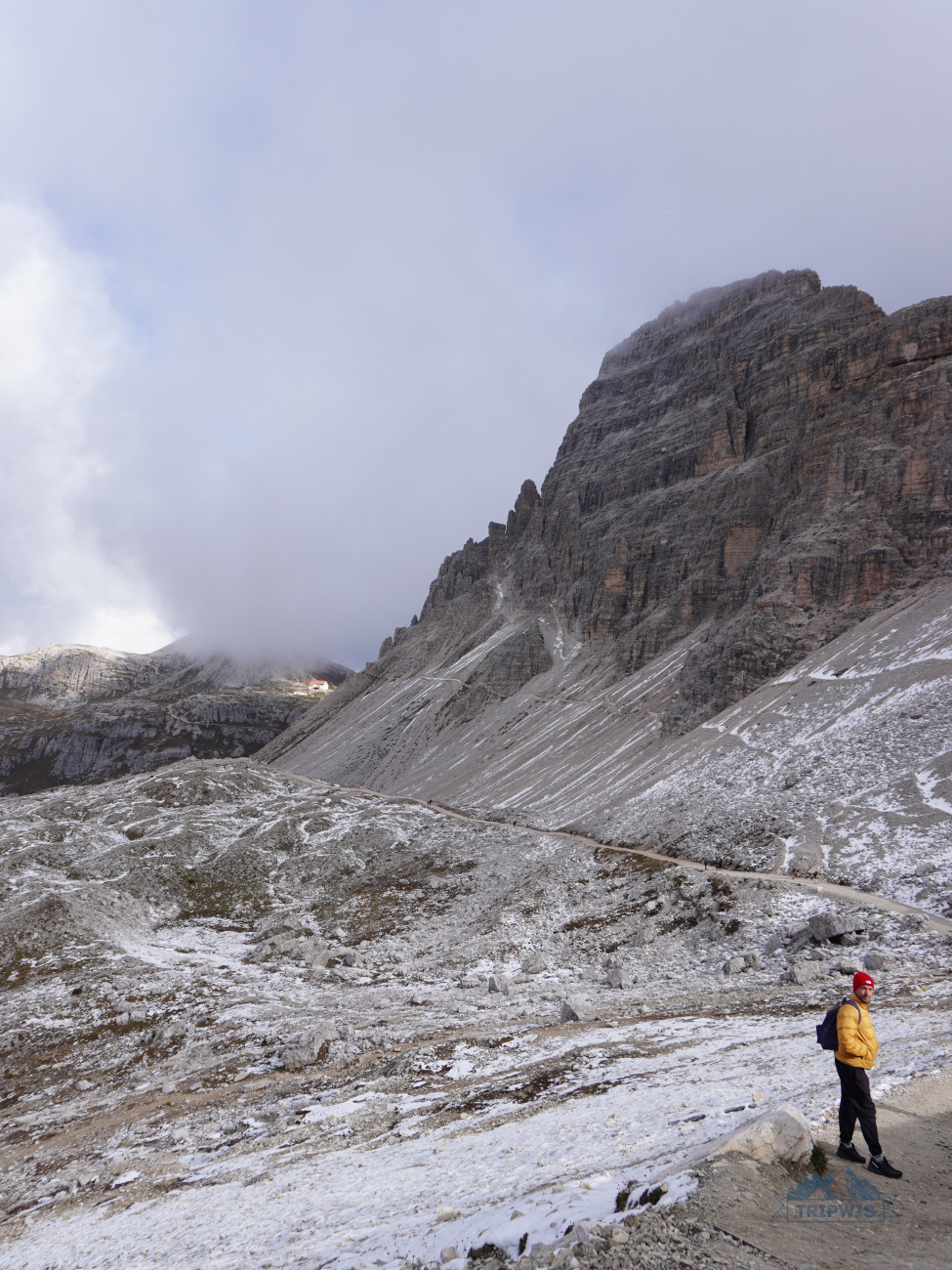
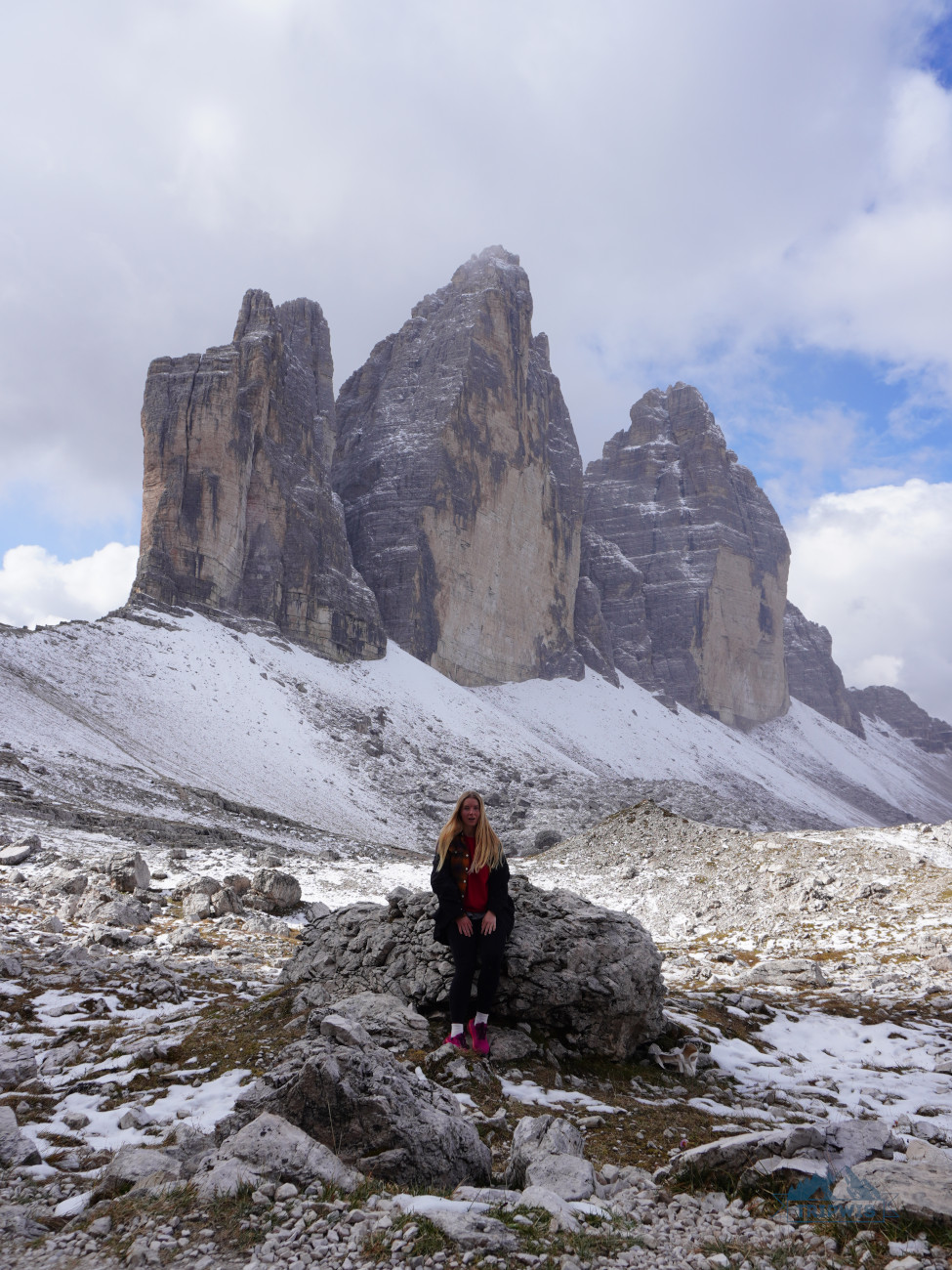
The sight of the three tall granite peaks grouped together like siblings is the quintessential Dolomites postcard view. You will instantly recognize them – chances are, these gray giant mountains have come across your feed many times.
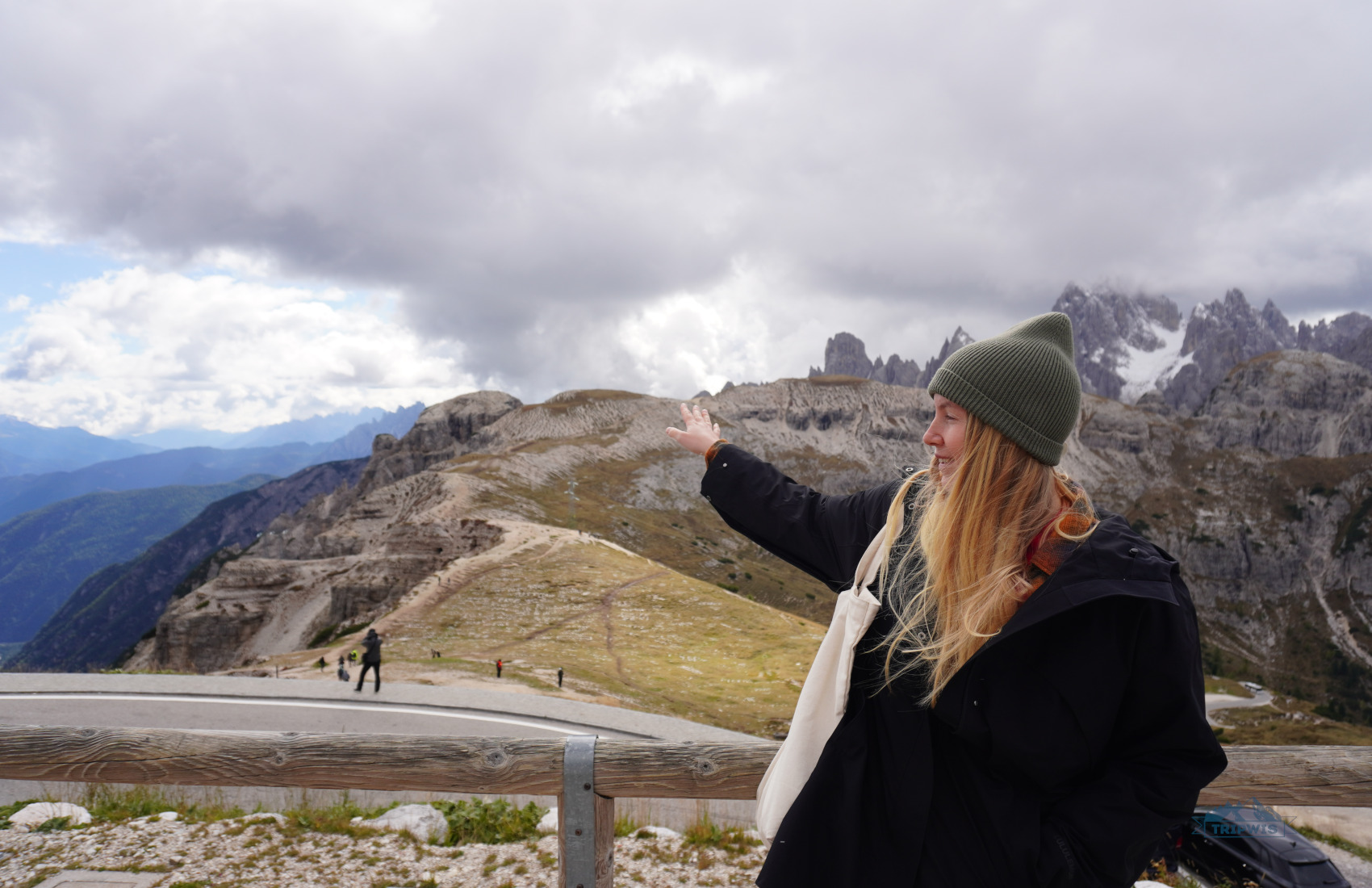
They are starkly different from the other locations I’ve covered so far – here, there’s not much greenery, just a boulder-strewn arid desert that sits at the foot of the mountains. It’s very “surface of the Moon” like, which is a change of pace from the lush pastures of Alpe di Siusi and thick spruce forest around Lake Sorapis.
❗️The local municipality enforced a mandatory prior online booking of the toll road access and parking spot at Rifugio Auronzo – the starting point for the trail. Why? Tre Cime has long been an extremely popular Dolomites destination (and the toll road has been here for ages), but lately the traffic and road congestion has been getting out of hand. In an effort to preserve the natural beauty of Tre Cime, such measures were put in place.
❗️❗️Online booking isn’t the worst part of it – what definitely made me uneasy was the €40 per car price tag (for 12 hours, and there’s no hourly rate) that came with it!
Still, the demand to visit Tre Cime and circle around its south and north faces hasn’t lessened – the drama of the sight, paired with welcoming rifugios, quaint chapels, ample viewpoints, and even remnants of WWI structures and caves are the pulls that made us drop the big bucks and set off on the hike on day 4 in the Dolomites.
- Book your slot online prior to coming here – without a reservation, they won’t let you past the toll gates
- Same-day bookings are not permitted; shoot for at least 2 to 3 days in advance (a week in high season)
- You can save some cash and take a bus to the trailhead; depending on where you’re coming from, the price ranges from €10 to €22
- Tre Cime di Lavaredo hike is 11.4 kilometers in length, with a total ascent and descent of 600 meters. It’s not that hard, the “moderate” difficulty rating comes from the long distance. It will take you on average 4 to 5 hours to complete the circuit
- You may cheat a little and cut your journey short at Forcella di Lavaredo viewpoint (3.5 kilometers form the trailhead). Here, the picture-perfect panorama of Tre Cime is on full display, and nothing will quite beat this view. You can snap a few pictures, pause at a rifugio for a hot beverage and head back
- It is the highest altitude hike we did in the Dolomites! It’s almost always cold here, and the whipping winds make you regret you didn’t bring a warm layer. It was early October and there was snow on the ground
- If you still have some energy left after completing the loop (or turning back halfway, I don’t judge), there is an option to hike to the Cadini di Misurina viewpoint. It’s a short hike from Rifugio Auronzo (in a different direction from the peaks), and it takes around 30 minutes one-way to reach the panorama
Lake Antorno and Lake Misurina
 |
 |
🅿️ free for 2 hours
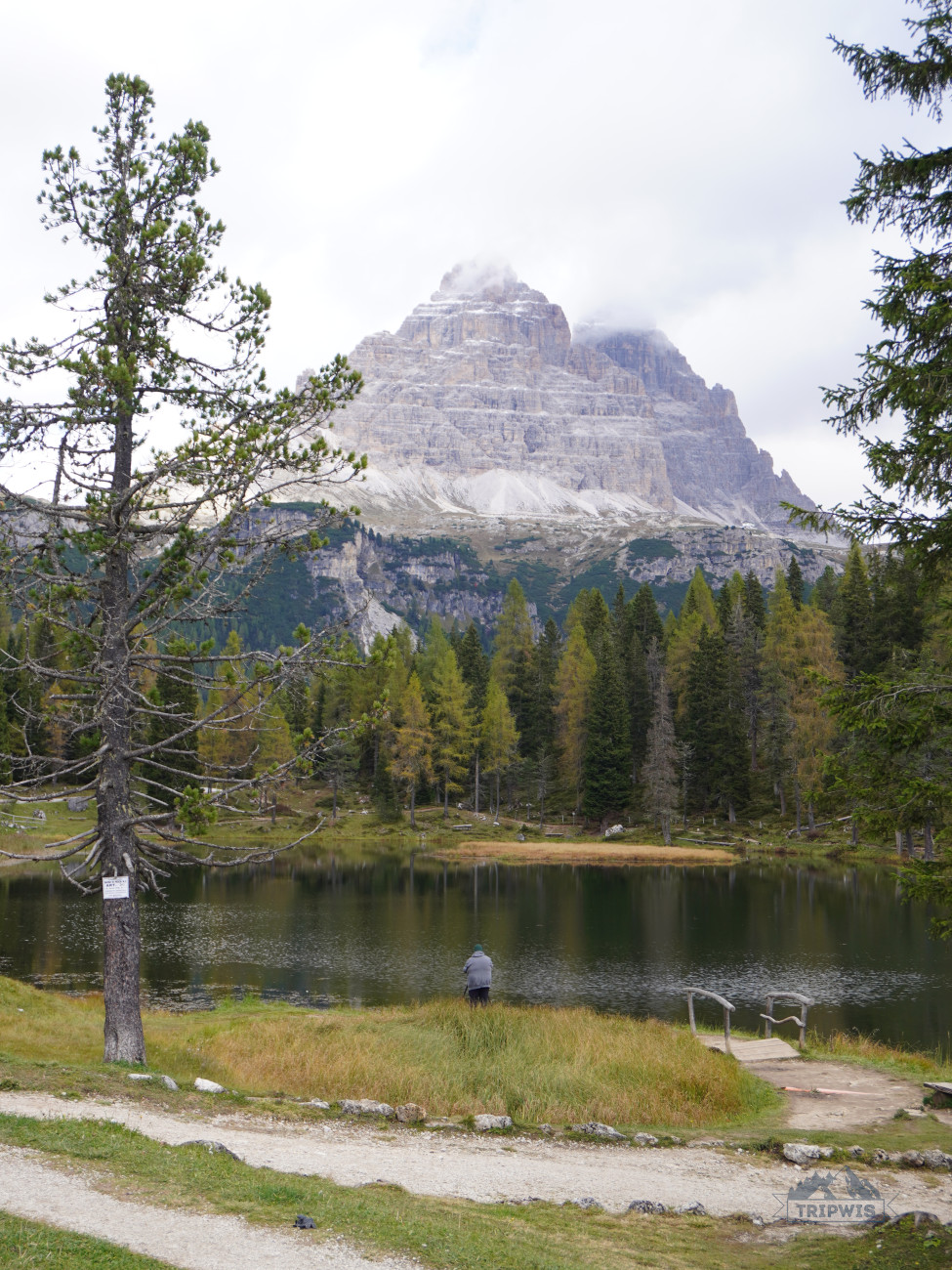
After the hike, we decided to dedicate the rest of the day to the Dolomites’ lakes, in whatever shape or form they came to be. Thankfully, the drive back from Tre Cime was ripe with opportunities – first came the small Lake Antorno. The southern faces of the Three Peaks, Cadini di Misurina, and Sorapiss mountain are visible from here. There’s free parking by the lake, which gives you just enough time to loop around the water.
🅿️ €2 per hour
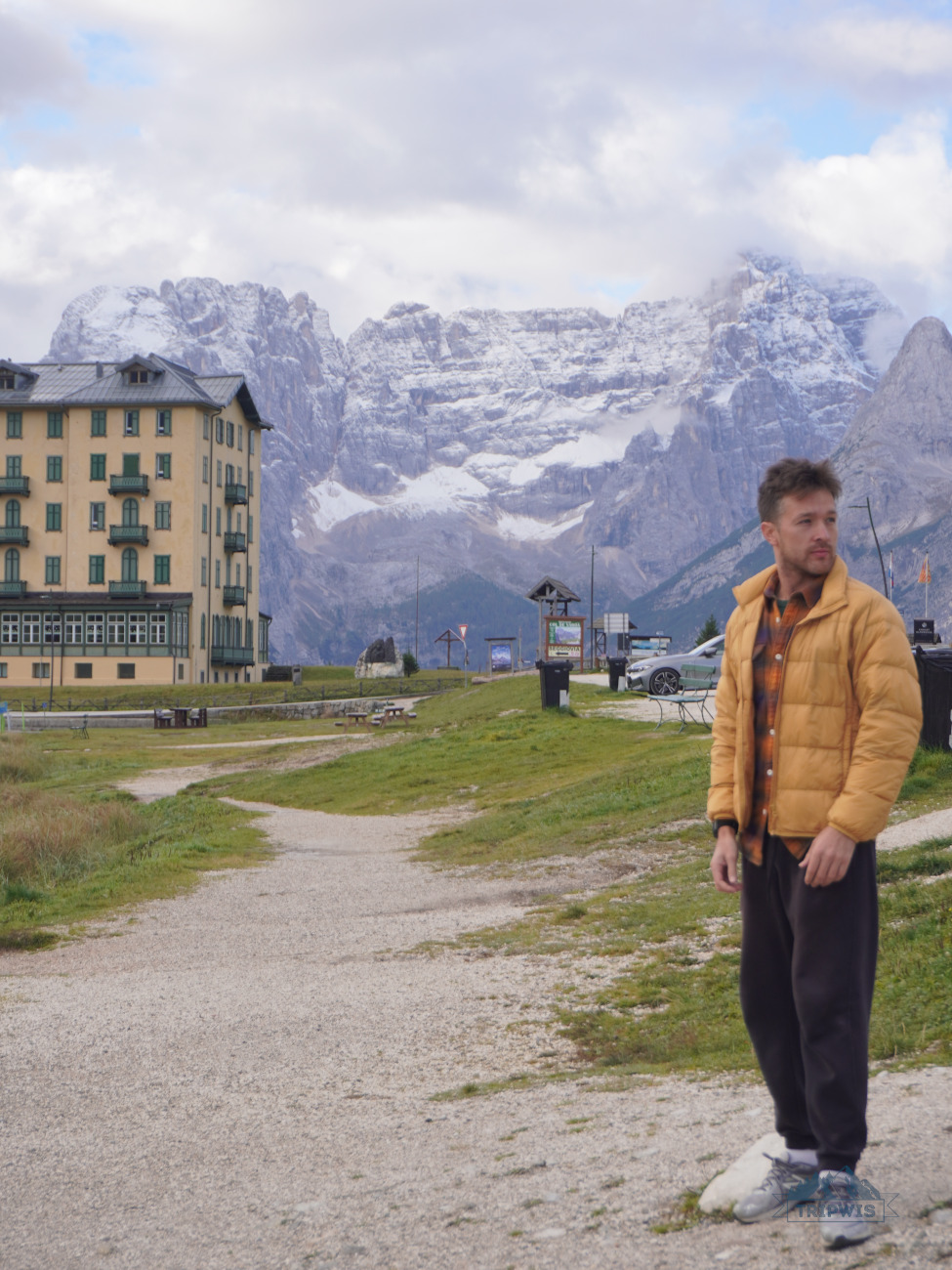
Lake Misurina proved to be a picturesque destination as well. They say that it is best to visit it at either sunrise or sunset – the reflections of the surrounding mountain groups (Sorapiss and Cristallo) in the water get a makeover with the bright sun rays. There’s public parking available next to the lake.
Lago di Braies (Pragser Wildsee)
 |
 |
🅿️ from €15
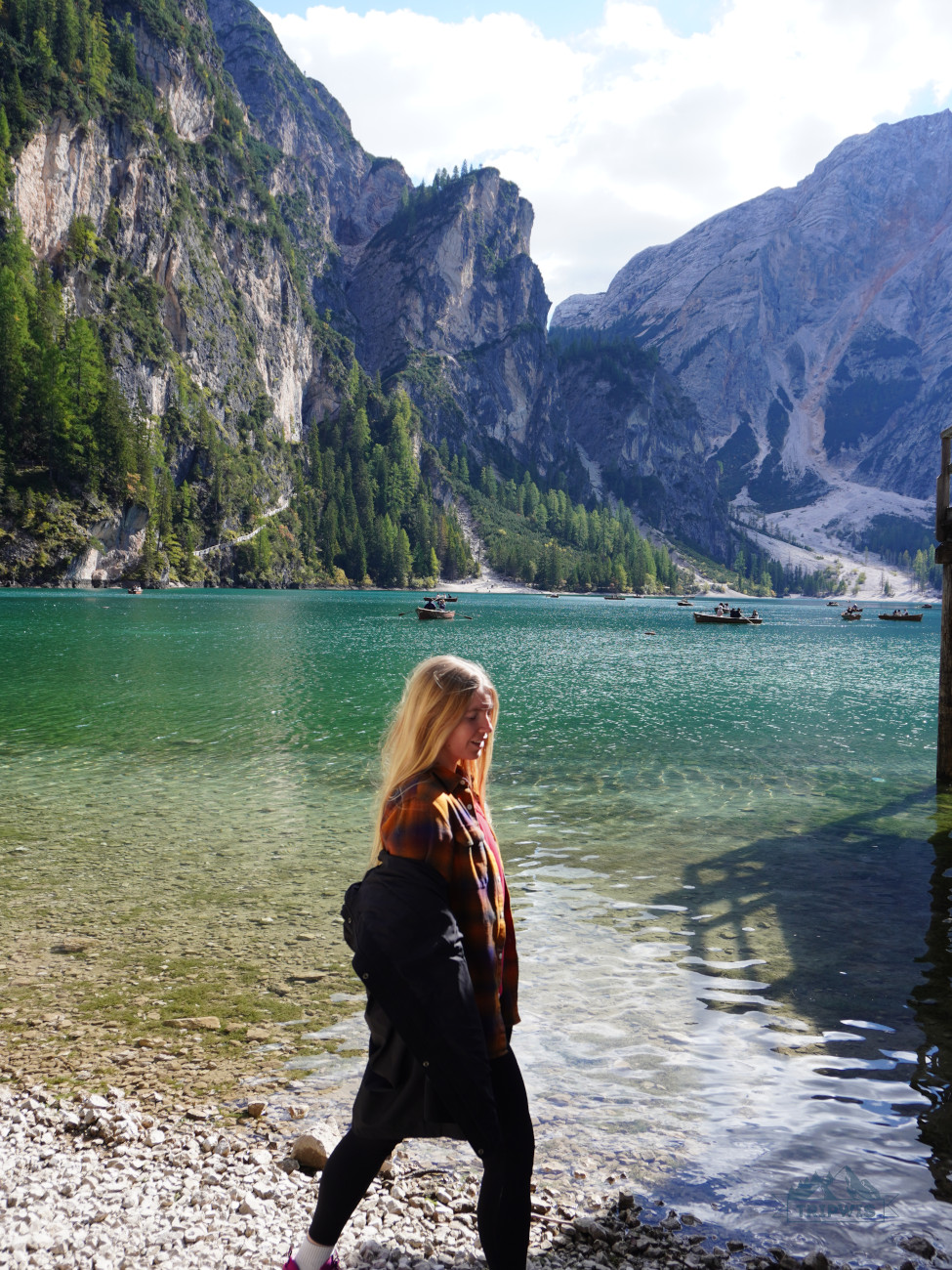
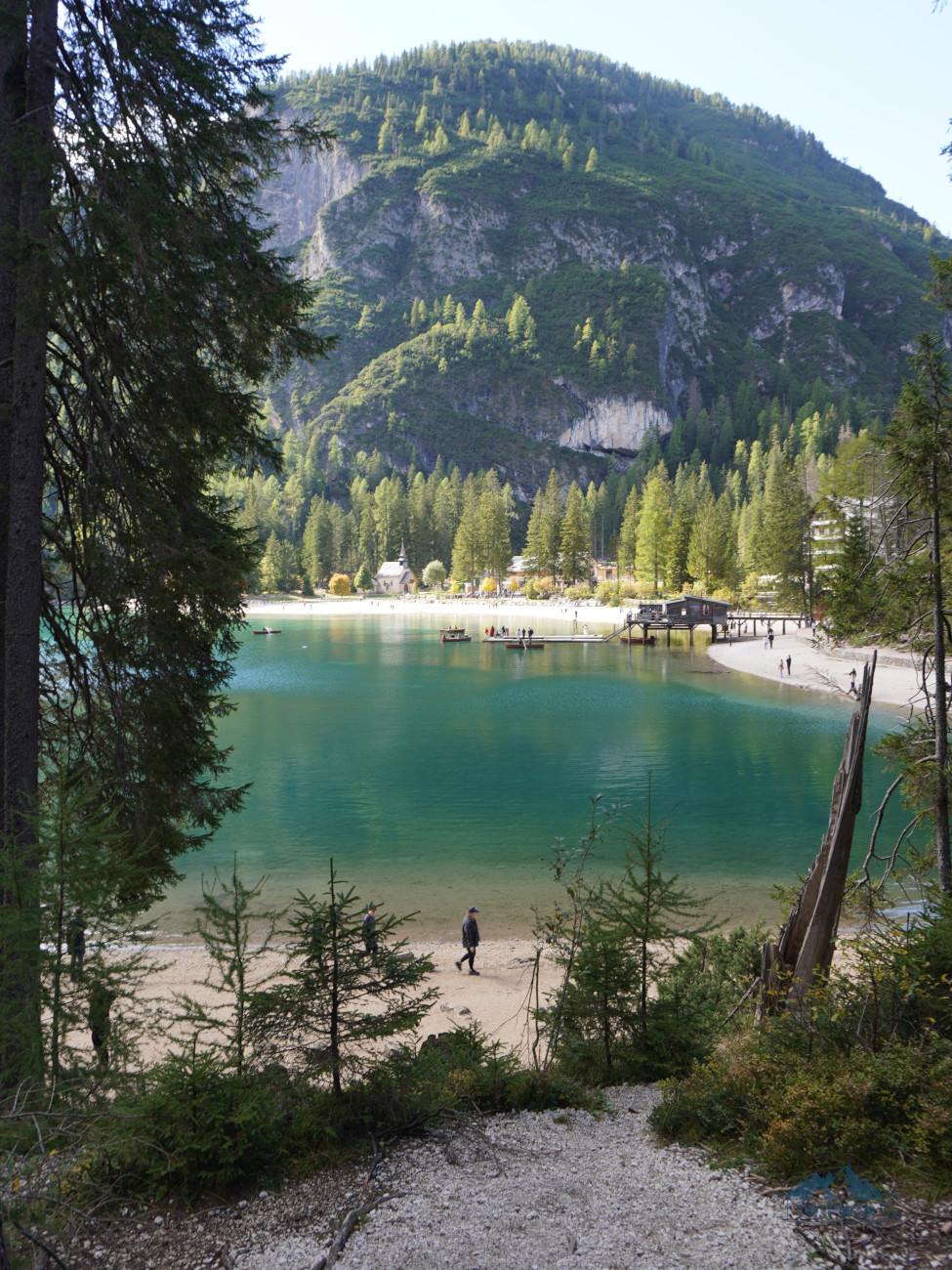
Yet another “must-see” body of water in the Dolomites, Lago di Braies stands out as one of the most popular destinations in the region due to its beauty and accessibility. Even in the shoulder season, there were tons of people here!
This large emerald lake is a dreamy place to capture – the surface of the water mirrors the pale white Seekofel mountain that guards Lago di Braies, and the charming boathouse, together with rowboats that glide across the scene.
You can walk around the lake or rent a rowboat. However, know that your experience will not be that of calm and solitude – Lago di Braies is as crowded as Disneyland on a weekend.
If the crowds do not deter you, maybe yet another set of restrictions will:
- Just like with Tre Cime di Lavaredo, there are driving restrictions to the lake. Between July 1st and September 15th, access to Lago di Braies between 9:00 a.m. and 4:00 p.m. is only permitted by public transportation, on foot, by bicycle, or upon presentation of an online reservation
- Book your tickets online before coming here
We came to Lago di Braies outside the period with these limits, so after we walked around the lake for a bit (dodging crowds of families with strollers in the process), we decided it was time to hit the hay and left the lake at 2:30 p.m. Plus, we had a long drive to Western Dolomites, to the general area of Val di Funes ahead of us.
Where to eat for day 4 in the Dolomites: Tre Cime di Lavaredo has no shortage of mountain huts – Rifugio Auronzo, Rifugio Lavaredo, Rifugio Locatelli. Most of them serve a mean lasagna, which you can then follow with a strudel to share and two coffees (€45 total for two people). Alternatively, you can re-visit some Cortina d’Ampezzo joints OR look into Dobbiaco eateries (Hans Pizzeria Restaurant will satiate your cravings), since this town also serves as a great getaway to Tre Cime.
Where to stay:
— 3* Hotel Rosengarten (Dobbiaco; from €150 a night)
— 2* Hotel Montana (Cortina; from €210 a night)
— 4* HOTEL de LËN (Cortina; from €400 a night)
Day 5 – Adolf Munkel trail
 |
 |
Base town: Santa Maddalena or something close (our pick – Gasthaus Zum Weissen Kreuz)
Focus point: Adolf Munkel trail
What to expect: Cinematic mountain views, out-of-body relaxing experience, a bit of hiking, holy destinations, and the wrap up of your Dolomites itinerary!
The accumulated fatigue might start to catch up with you on the day 5 of your Dolomites itinerary – that’s the way the cookie crumbles, there’s no getting around it. However, I believe that it is essential to finish your mountain adventure with a true banger of a trail; Adolf Munkel definitely steps up to the challenge!
Adolf Munkel trail
 |
 |
🅿️ €10 per car
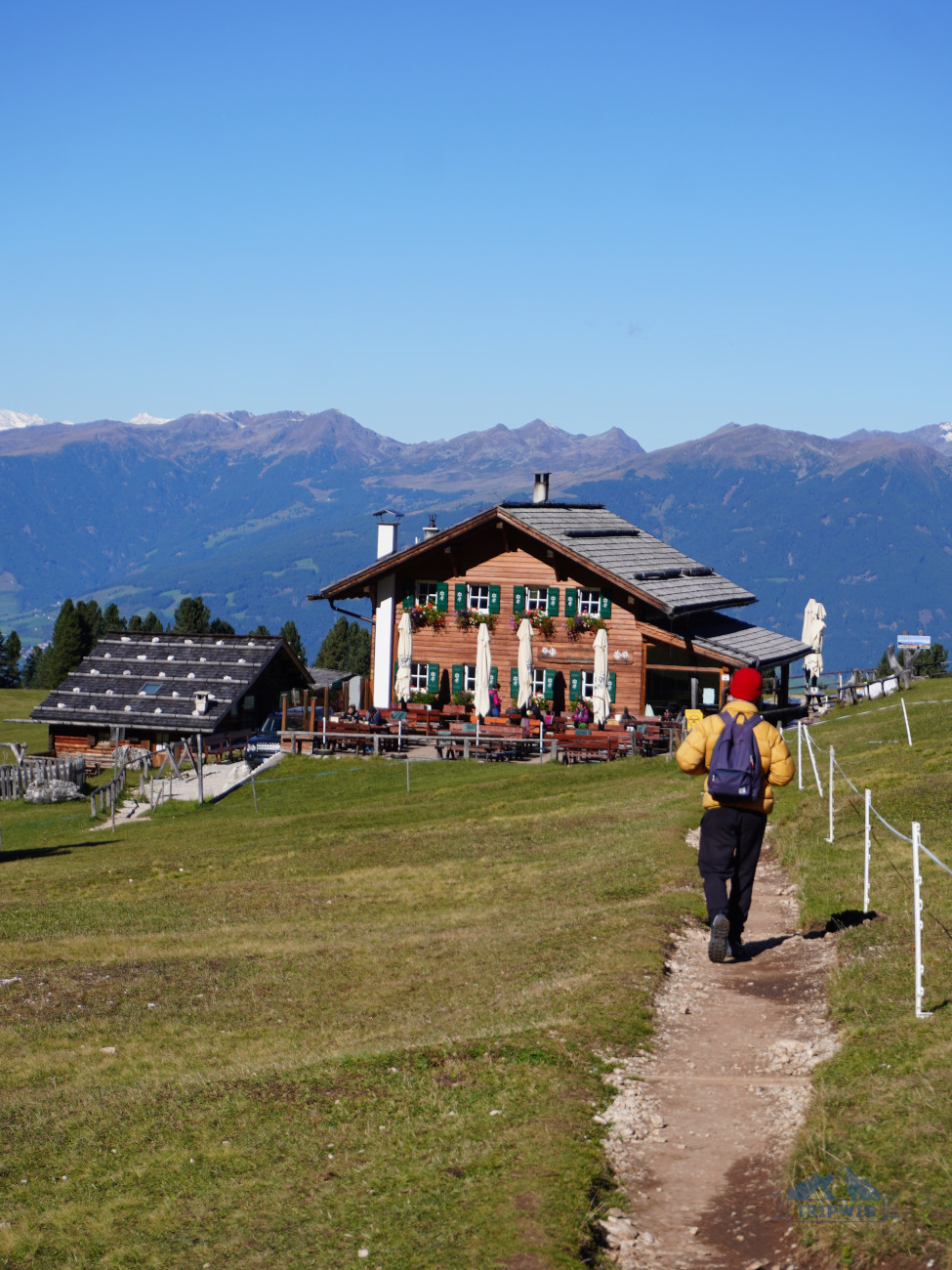
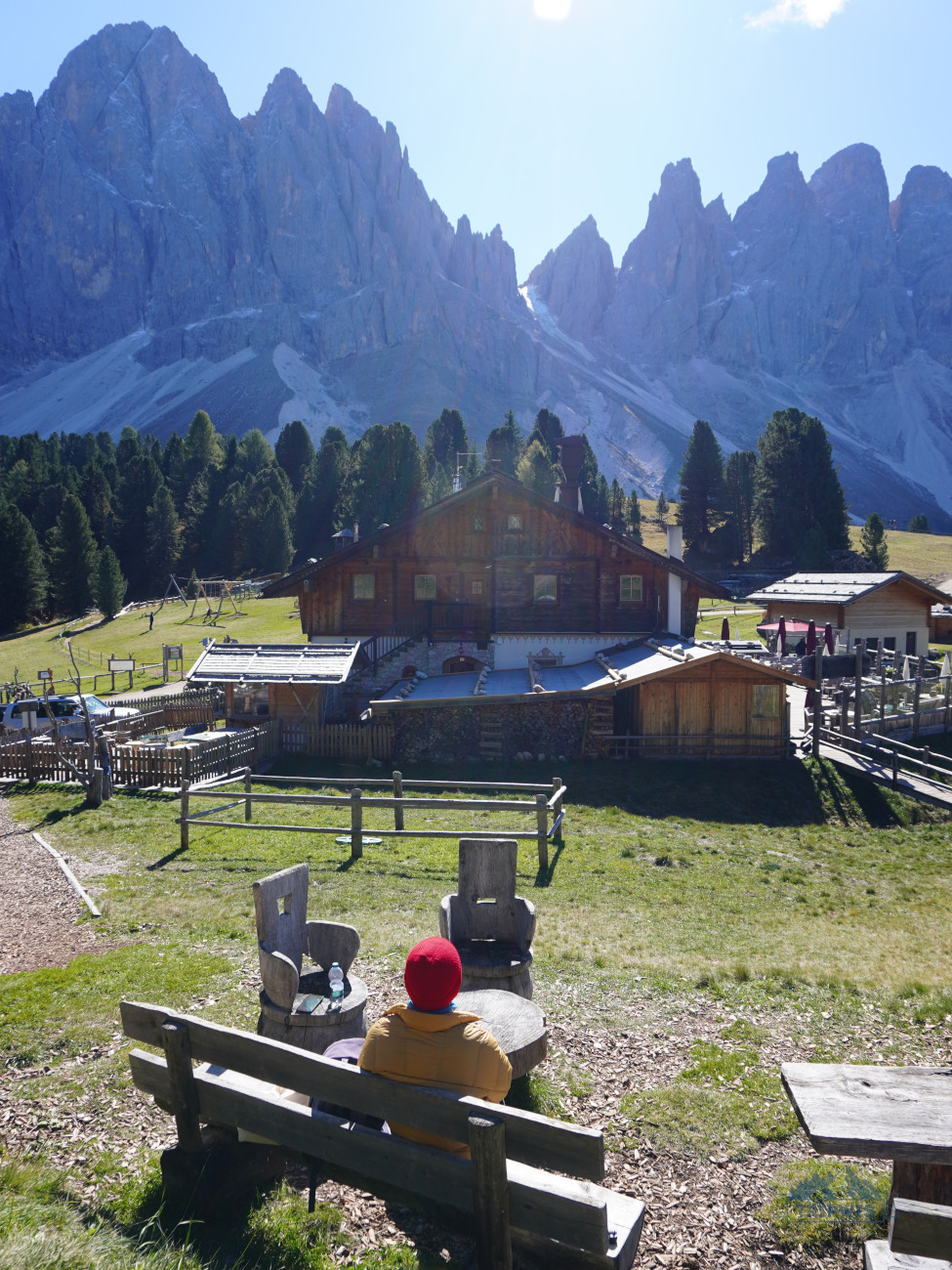
Set in one of the most picturesque valleys of the Dolomites – Val di Funes – Adolf Munkel trail is an amalgamation of every aspect we loved in other routes in the region.
The scenery is constantly changing as you’re navigating the path: First, there’s lush spruce and larch forest that hides you from the elements, then its mountain foothills – the base of the peaks so close you can almost touch it; walk more and you emerge into one of those storybook pastures – green, vast, and adorned with quaint mountain huts. Behind you there are peaks of the Odle / Geisler Mountains which you can admire once you stop for rest at the iconic viewpoint of Cinema delle Odle (Geislerkino).
Sounds like a true dream, right? The trail is not at all technical – Adolf Munkel is on the longer side, totaling at 9.5 kilometers with 464 meters of overall ascent and descent. There is no point that feels too hard here – it’s a lengthy restorative walk that will take you a tad over 3 hours to complete (but I would set aside 4 hours, since you’re guaranteed to take your sweet time lounging about at Rifugio delle Odle).
- Come to the trailhead early to snag a parking spot, there are two of them. Alternatively, you can turn it into a late afternoon hike – the views of the mountains are much clearer after 2 p.m. (the sun is not behind the Odle group anymore)
- If you’re short on time, you can get to the cherry on top of the route – Geisler Alm – in just an hour, granted you set off in the anti-clockwise direction
At around 1 p.m., we made it all the way back to the parking lot. Invigorated with the sights, we had a couple more stops to make on our way to Bolzano.
Chiesa di Santa Maddalena or Chiesetta di San Giovanni in Ranui
🅿️ €4 per hour
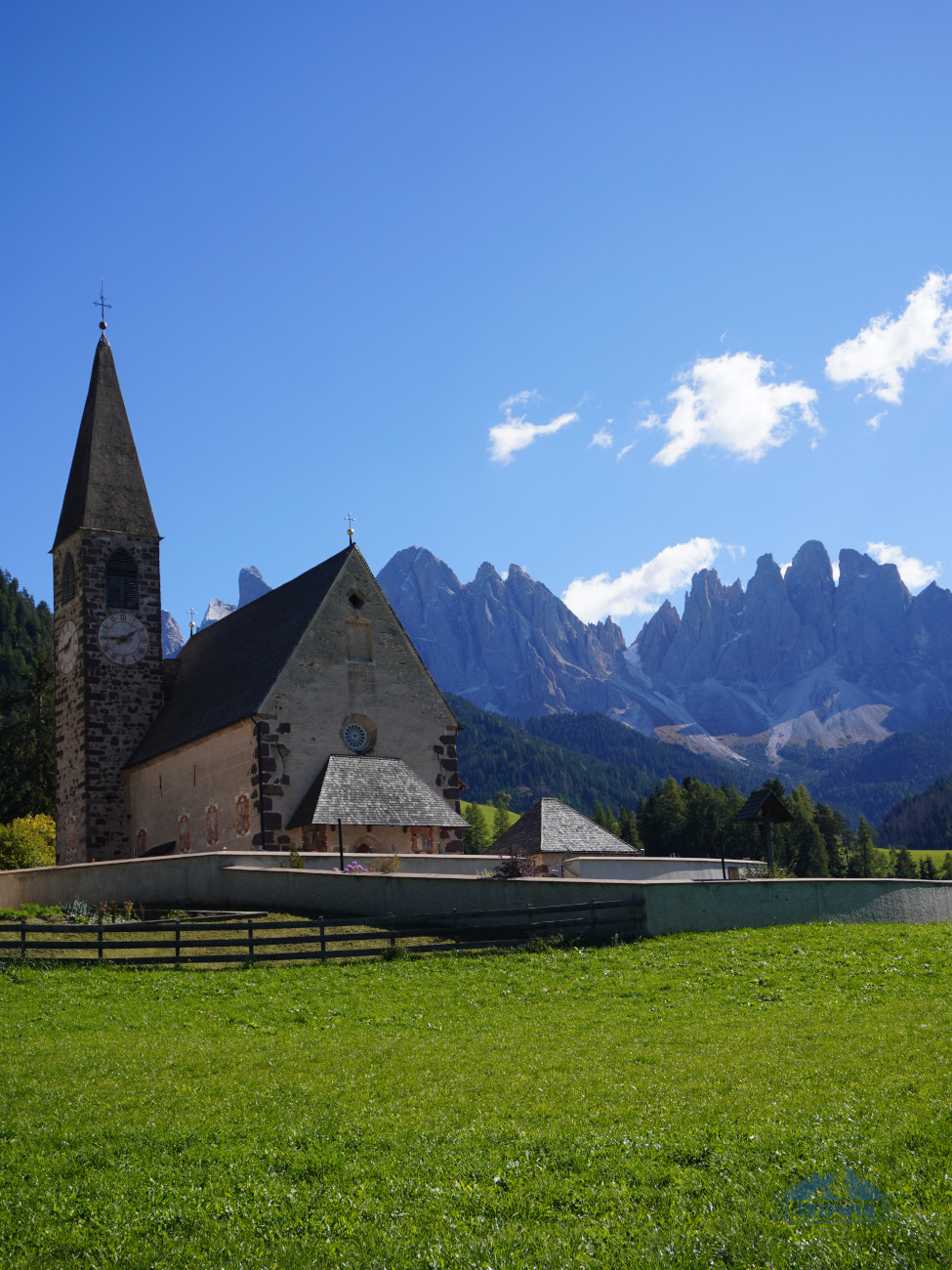
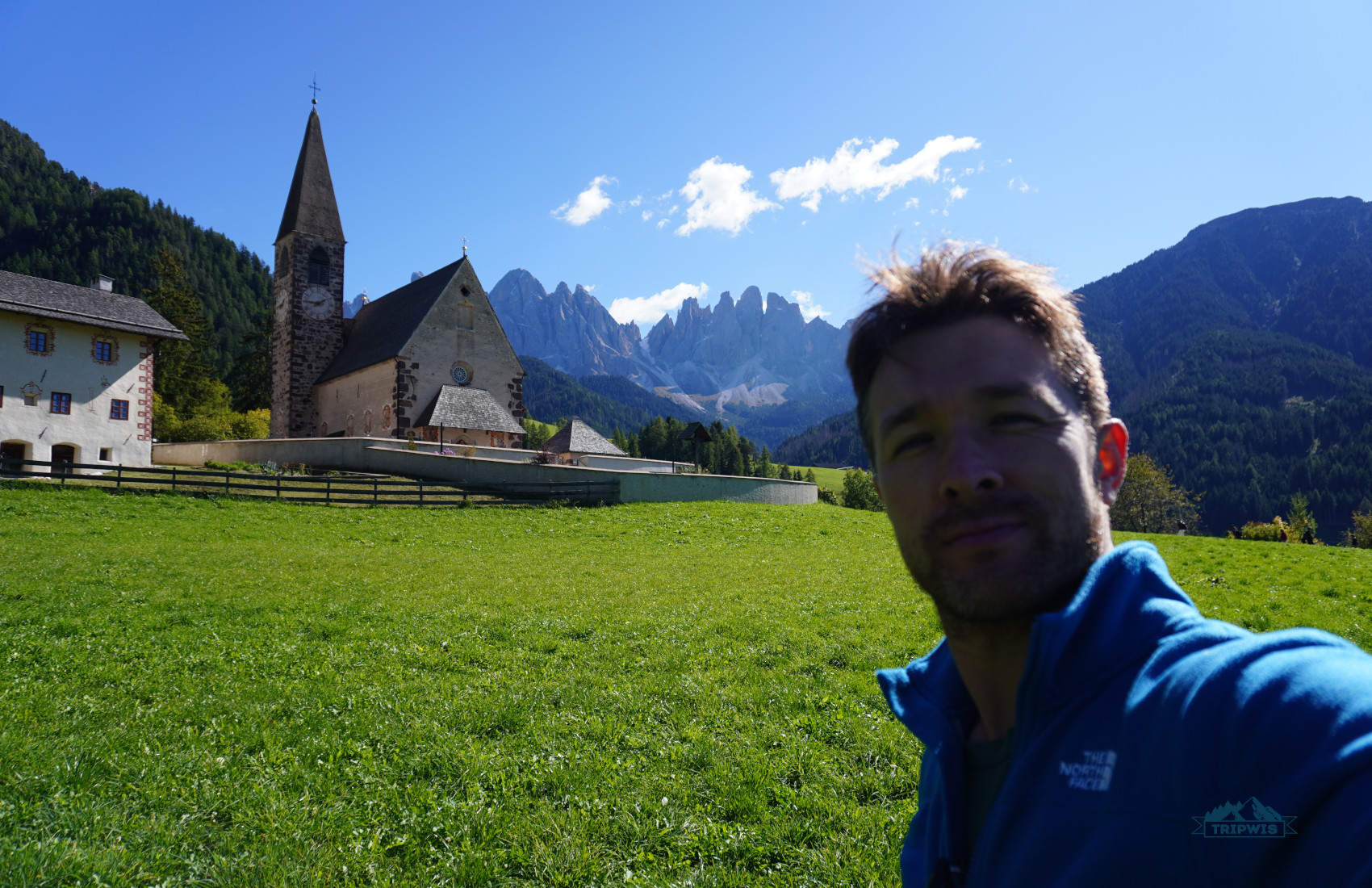
These two iconic Val di Funes churches are a great chaser for the Adolf Munkel trail. They will help you prolong the elevated mood you’ve acquired on the hike by giving you glimpses into the familiar landscapes and adding an architectural eye candy in the form of Baroque and Gothic establishments.
❗️Note that you cannot drive right to the churches; you can leave your car in the designated parking areas and hike all the way to the places of worship
For Chiesa di Santa Maddalena (Santa Maddalena Church), the walk up will last about 20 minutes. Chiesetta di San Giovanni in Ranui (Church of St. John) is even closer to its respective lot – 10 minutes and you’re admiring the cathedral set opposite the dramatic Odle mountains, with forest and valley framing the view (but you have to pay €4 to access Church of St. John, since it is set on private property!).
After checking out the churches, our autumn road trip across the Dolomites was finally over. I believe that this west-to-east loop is one of the most beautifully planned progressions you can do in the region – the fullness of days and the sites visited complement each other, creating a seamless flow that can be enjoyed by many.
Where to eat for day 5 in the Dolomites: Since it’s your last day in the Dolomites (and you will not reach “civilization” until very late in the day), your best bet is grabbing a meal at one of the mountain huts of the Adolf Munkel trail at Malga Zannes, Malga Casanago, Rifugio Odle / Geisler Alm, or Dusler Alm. In Bolzano, treat yourself to a humble pie at Pizzeria La Veneziana or class your act up in Löwengrube (one of the oldest restaurants of Bolzano).
Where to stay:
— 3* Hotel Fines (St. Magdalena; from €140 per night)
— 4* Hotel Tyrol (St. Magdalena; from €285 per night)
What about 3 days in Dolomites? Or a week?
While on our experience five days in the Dolomites is a sweet spot, time-wise, for a first-ever visit, you can potentially work with a different time frame.
Your Dolomites itinerary for 3 days might need some compromise and trimming of the fat. Depending on your desires and financial (or physical) abilities, you might cut Tre Cime di Lavaredo or Lake Sorapis from your plan.
It can look something like this:
- Day 1: Alpe di Siusi Panorama loop trail in the morning and Seceda Ridgeline in the afternoon (you might want to take the cable car from Ortisei this time, since hiking from Col Raiser might be too much for the day)
- Day 2: Tre Cime di Lavaredo OR Lake Sorapis (I would recommend hiking to the lake and then exploring Cortina d’Ampezzo in the evening)
- Day 3: Adolf Munkel trail and churches of Val di Funes
This 3-day breakdown does involve a lot of moving between the provinces. Alternatively, you can spend your limited time in the Dolomites by focusing on just one valley (so, having one home base). You could settle in Cortina and do Lake Sorapis, Tre Cime di Lavaredo, Lago di Braies, and other unique destinations of the Eastern Dolomites.
A 7-day Dolomites road trip itinerary proves to be an easier task to plan for! There are so many other fascinating Dolomites sites to fill your extra two days with:
- Cinque Torri – if you didn’t feel like the three peaks of Tre Cime were enough, then might I suggest you visit the “Five Towers”, or Cinque Torri. The site is also set in the Eastern Dolomites, not too far from Cortina. There are many hiking trails of varying difficulty lapping the mountains. The area around Cinque Torri is also famous for being an open-air museum for WWI – you can check out the remnants of the past via trenches, tunnels, and even soldiers’ barracks.
- Torri del Vajolet – another alternative to Tre Cime; this one is closer to Bolzano. These towering jagged spires might remind you of Seceda (at least a little bit), but once you hike all the way to the base of the range, you will be taken aback by the site’s unique otherworldliness and sheer monumental beauty.
- Chiusa – a great stop after your Adolf Munkel shenanigans; this charming town looks like it’s been preserved in time: The narrow streets are fit with colorful facades and traditional shop signs, and the Kloster Säben (Monestry Sabiona) that overlooks Chiusa feels as if it’s still a medieval pilgrimage site.
My tips on Dolomites itinerary planning
 |
 |
Now that we’ve figured out the itinerary portion, let’s leave you with some practical tips you have to know before visiting the Dolomites:
- Once again, your starting point
First things first, decide where you’ll be starting your Dolomites adventure and which airport you’ll be flying into – Milan, Verona, Bergamo, or Venice. If you’re doing a road trip, that’s where you’ll want to pick up your rental car as well. If you’re traveling in summer, book early – 2 to 4 months ahead is a good rule of thumb. We booked our Lancia through Discovercars and had a seamless experience.
- Price
The Dolomites are generally not a budget-friendly destination – you have to get very creative and jump through lots of hoops to try and save your hard-earned cash here. Watch my Youtube video to get a full overview of the expenses for our latest Dolomites adventure:
Just to sum up though: In total, our trip cost €1,500 for two people, excluding flights. This number includes 5 nights of accommodation, car rental, fuel, toll roads, parking, food, and cable cars – our journey was on a more affordable side, but without going to extremes.
- Parking
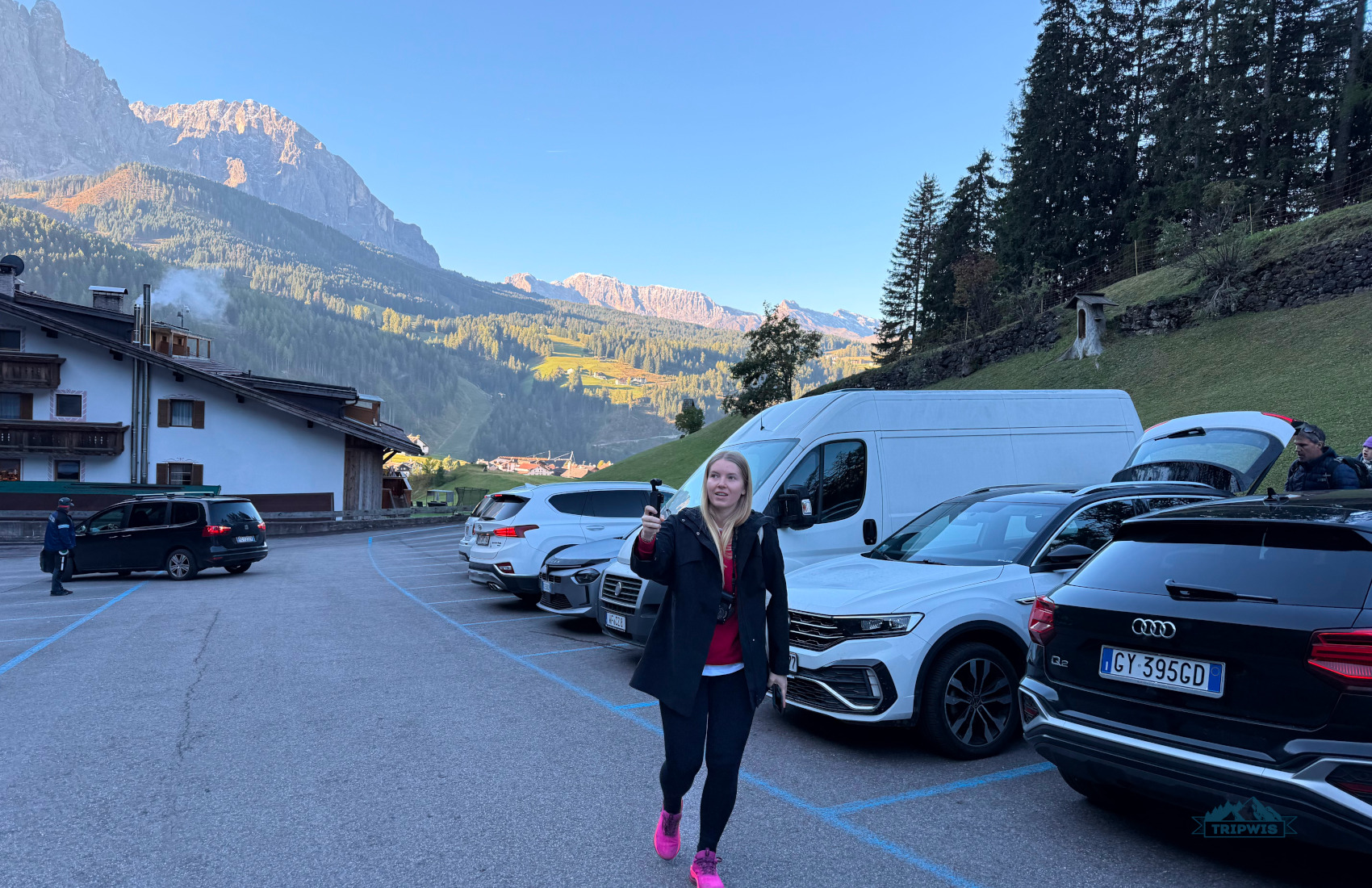
One of the most valuable Dolomites parking tips I can give you is looking for a hotel that offers on-site parking. Doing so saves you half of the worries (and half the parking fees) that you will have during your time here.
Leaving your car at cable car stations or near trailheads is an entirely different thing though – each parking lot has its own price breakdown, schedule, and rules. I give you the full roundup of parking options in my guides where I focus on each separate trail, but just to give you an idea of what you’ll be dealing with:
🔹Alpe di Siusi: There’s a parking lot under the Mont Sëuc cable car station down in Ortisei (€0,5 per hour for a car) and an option to drive as far as Compatsch and leave your car there (€30 per day per vehicle for the closest lot)
🔹Seceda: If you follow my advice and go the Col Raiser route, then you’ll pay €1.5 per hour to leave the vehicle at the lot at the station. If you take the Ortisei–Seceda cable car, then parking will be €3 per hour
🔹Lake Sorapis: Free roadside parking near the trailhead
🔹Tre Cime di Lavaredo: The most pain in the butt parking experience in the Dolomites. Prior online reservation is mandatory and you’ll pay €40 per car for 12 hours (there’s no hourly rate)
🔹Lago di Braies: The most famous lake of the region also plays around with prior booking and road restrictions in high season. The prices range a lot: From €30 per day for the closest parking lot (P4) to €15 for the farthest one (P1)
🔹Adolf Munkel: €10 per car at the lot near the trailhead
- Lifts
 |
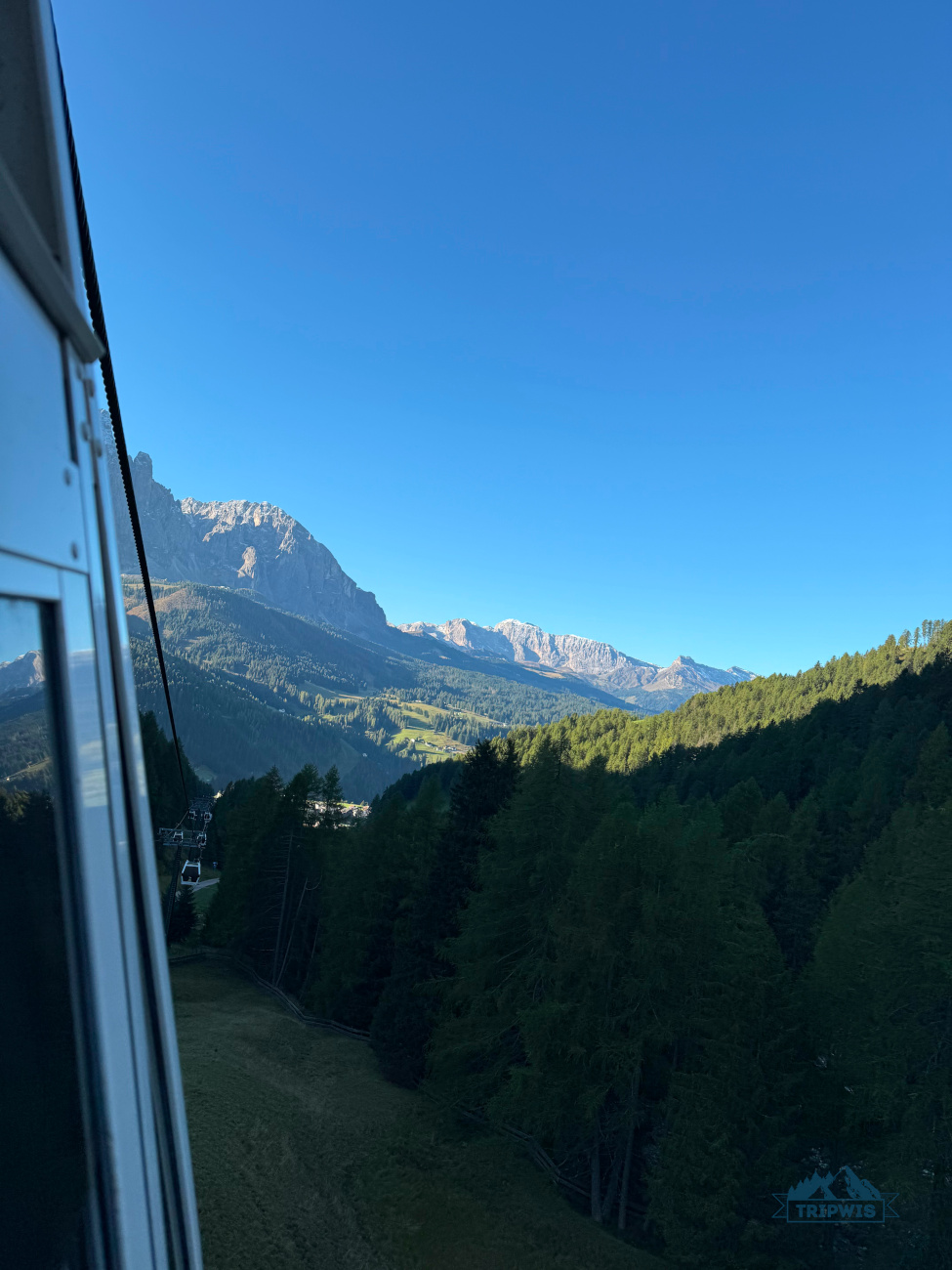 |
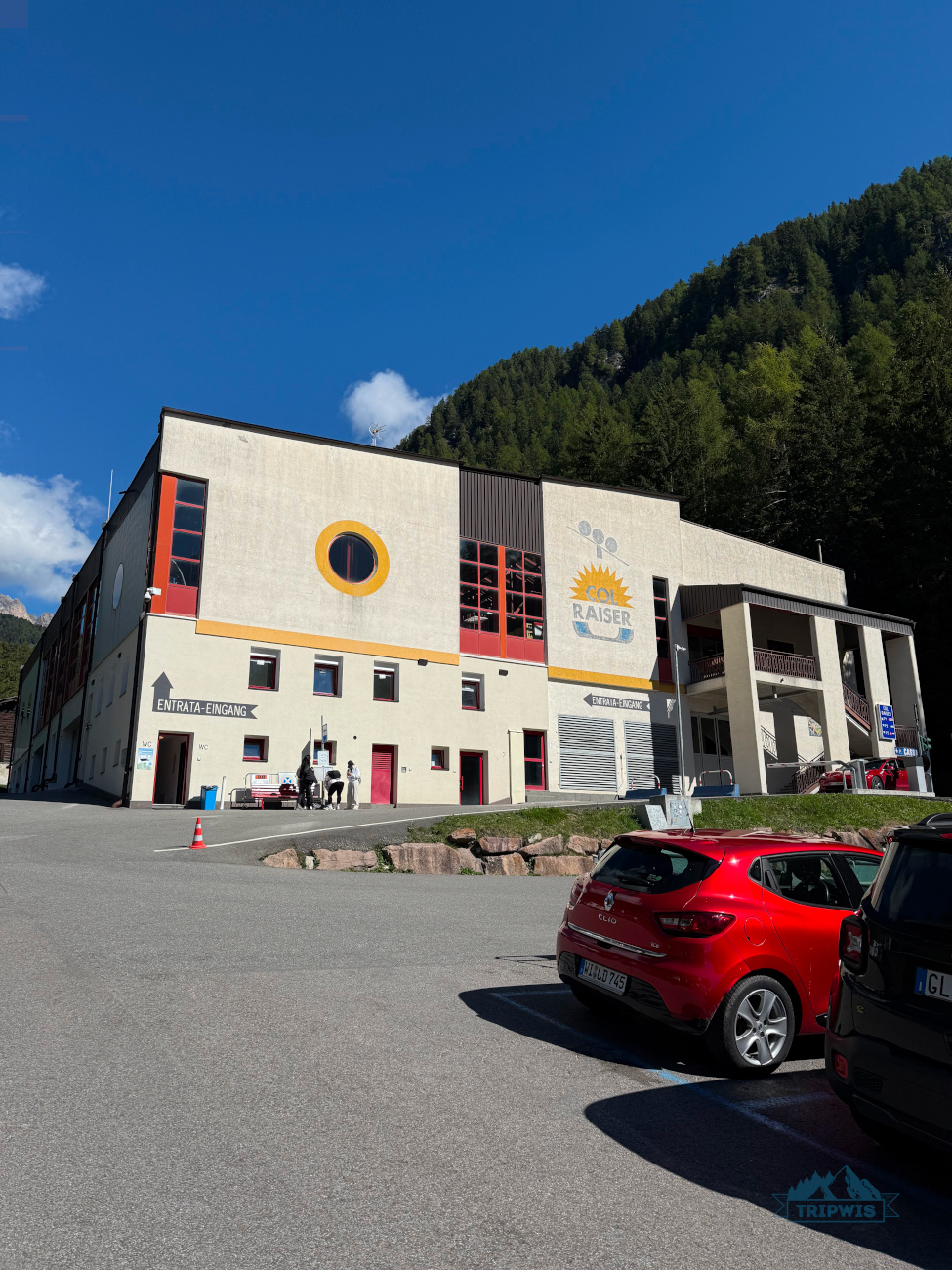
You cannot come to the Dolomites and completely avoid cable cars and lifts – most of the times, they are the easiest and the most comfortable way to get to the high alpine destinations. Due to the sheer convenience and speed with which you get whisked away hundreds of meters up, the prices for this luxury are understandably high and range around €30–€70 per person.
❗️We have taken two cable cars during our 5 days Dolomites itinerary: Mont Sëuc cable car to Alpe di Siusi for €41 roundtrip per person and Col Raiser cable car to Seceda for €34 roundtrip per person.
Apart from the price, you have to monitor Dolomites cable car opening dates – they are dependent on weather and snow conditions. In general, most major lifts in the Dolomites operate year-round, with two prominent seasons: Summer (late May to early November) and winter (early December to early April). In the periods between these seasons, the lifts stop their operations for maintenance work.
Speaking of closures, cable cars are not the only operations that might not be there in shoulder season – rifugios, bus lines, some roads, and even restaurants and hotels do take a breather after busy summer months. Check in with my Dolomites seasons guide to get the full picture.
- Early starts
You might have noticed a running theme throughout my 5 days Dolomites driving itinerary – early starts are how you avoid crowds, snag a parking spot, get the best soft lighting for photographs, and enjoy the trails in their unhurried morning glory.
Go to sleep earlier and pack a breakfast picnic to have on the trail – during our shoulder season trip, we loved bringing our drip coffee bags, hot water, and some snacks to have at the iconic viewpoints. If you’re visiting the Dolomites in high tourist season, then you can make full use of the mountain hut (rifugio) breakfasts (and lunches, and dinners).
- Cash
Even though we’re nearing the year 2030, cash is still king in some more remote areas in the Dolomites. Mountain huts, smaller car parks, and even gas stations all ask for cash for their services (even if they take credit cards, sometimes this option may not work – reception is spotty in the mountains).
Keep some euro on you at all times and you’ll be fine!
- Weather
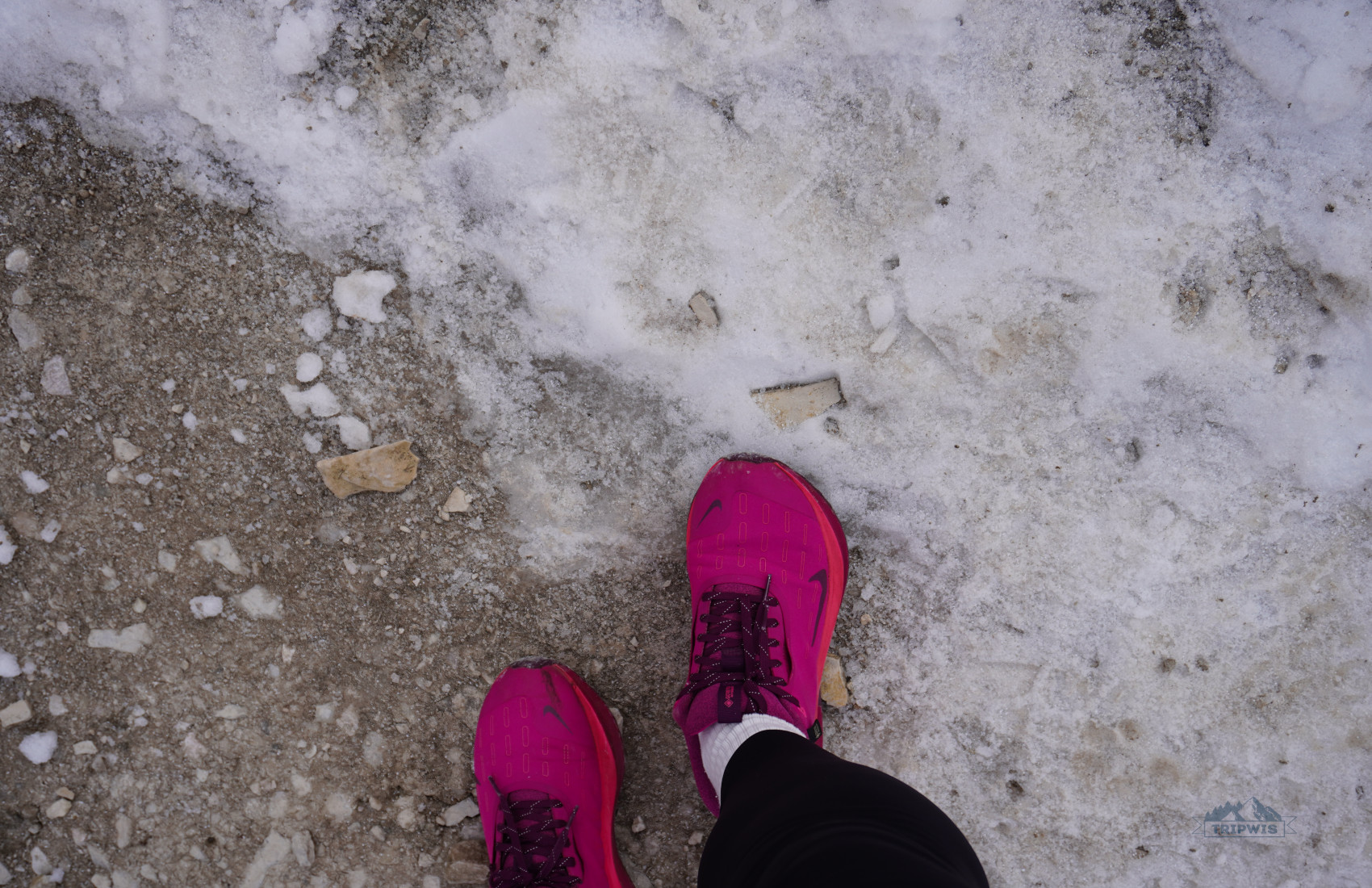
Weather in the Dolomites is highly mercurial and unpredictable – instead of looking at a week’s forecast to plan your itinerary, check with the weather app the morning of your adventures. That way, you will get the best approximation of what exactly is going to happen in the Dolomites. However, sometimes we went so far as taking our chances hour by hour – even with rain on the horizon, the mountains did their thing and the clouds parted, leaving us to enjoy our outing with a clear sky above!
- Rich cultural heritage
Expect to see the names of places in two (or even three) languages – Italian, German, and Ladin. The Dolomites’ province of South Tyrol was annexed to Italy from Austria after WWI, so the mix of cultures and languages is a thing here. It’s not that confusing when you look on the bright side – you get both strudel and gelato, goulash and pasta, beer and wine.
- Other essential tips and tricks
— It is not necessary to have a car in the Dolomites, but it will make your time here much easier and more comfortable. Rent a car via Discovercars and leave the public transport charades behind!
— If you’re exploring the Dolomites by car (and follow my itinerary), it just makes sense to cover both Western and Eastern Dolomites. Divide your time between the destinations near Ortisei and Cortina d’Ampezzo and you will get the most well-rounded Dolomites experience!
— Do not underestimate some hikes in the Dolomites (like we did going into the trek to Lake Sorapis) and always leave at least an hour as a buffer before sundown. They’re natural trails and many things might slow you down. Just in case, make sure to have offline maps at the ready for when trail signs are not present (or when you made the wrong turn).
— Be vigilant about not overdoing it – the Dolomites are rich with sites and experiences, but it is very important to leave some “slow blocks” in your itinerary: An evening to stroll along Corso Italia in Cortina, a couple of hours to leisure about at a rifugio on the trail, etc. It’s very important not to have a constant “go-go-go” mentality in the Dolomites, and slow down to smell the speck dumplings, at least once a day.
— Combine iconic Dolomites destinations with some lesser known, more humble sites – pause at Lake Antorno after hiking around Tre Cime di Lavaredo, pop by Chiesetta di San Giovanni in Ranui upon completing the Adolf Munkel trail… You get the idea!
— Book your accommodation in the Dolomites way in advance, particularly for summer season. If you want to stay at a rifugio, you have to reserve your spot months prior – preferably as soon as the bookings open, usually in February or March.
— Pack layers for the hikes in the Dolomites (one base layer, one waterproof layer, one warm layer) and do not forget about sun protection! Plus, have some good hiking boots or proper sneakers to avoid injuries on the trail.
— Do not be a careless tourist: Try to limit your contribution to overtourism in the Dolomites. Do not jump fences, wade into lakes that prohibit swimming, trample the flowers, or leave trash behind. Leave the natural settings exactly as you found them and the Dolomites will be eternally grateful!
And there it is – my comprehensive guide to five extraordinary days in the Dolomites. You can follow my itinerary to a T or use it as a launch pad for your personal mountain region agenda. Whatever you do, I hope you have an amazing time exploring the magical Dolomites!