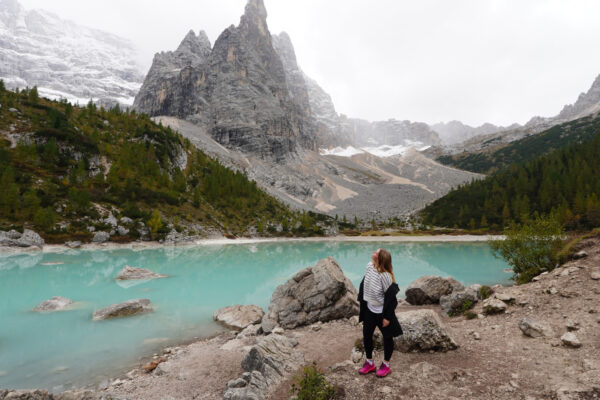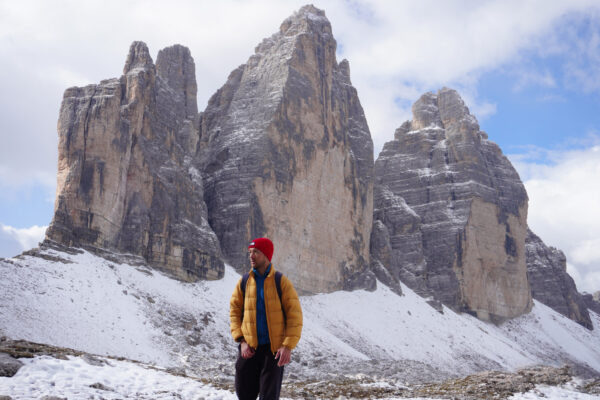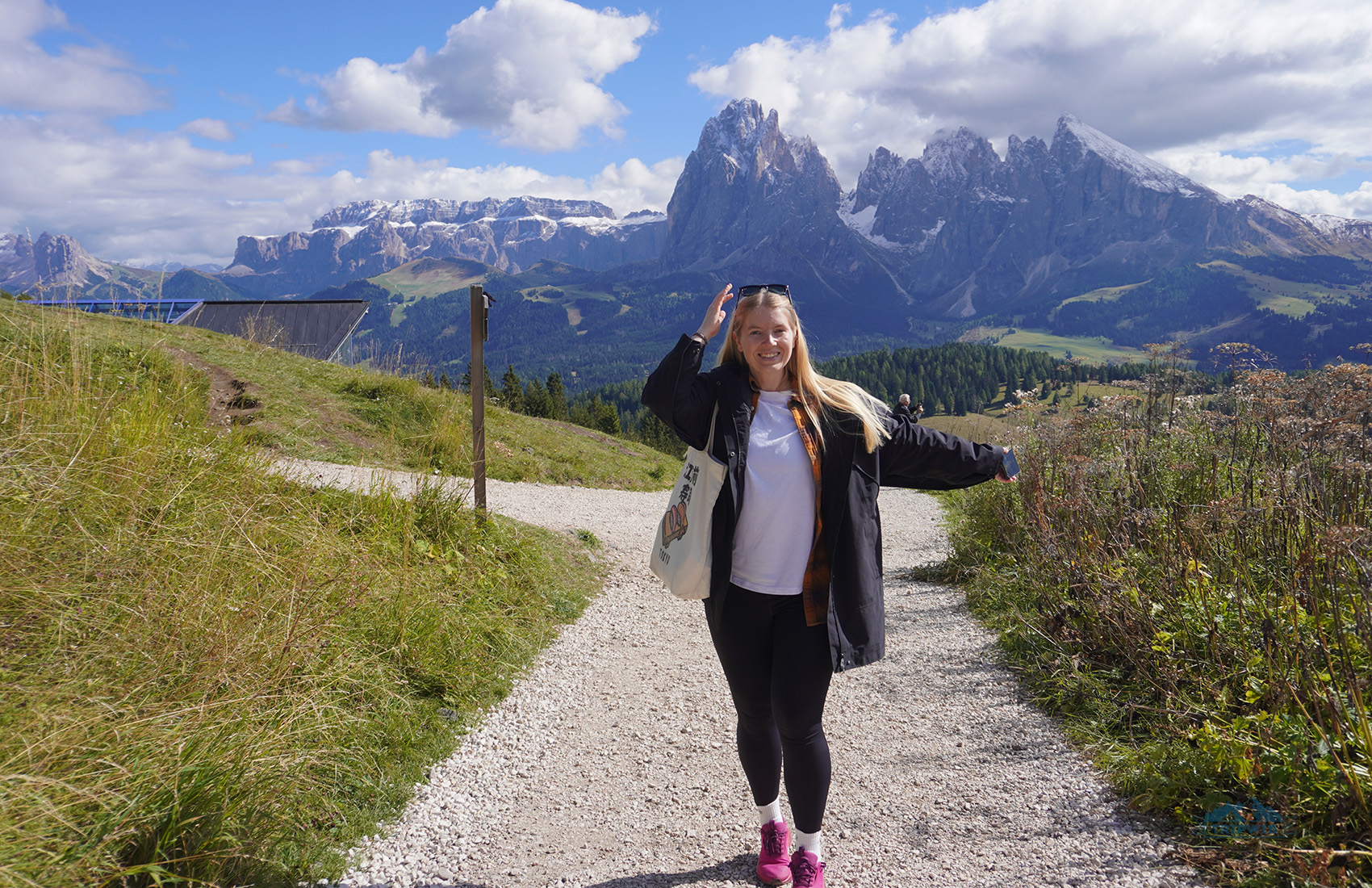
When I first saw the Alpe di Siusi and Sassolungo mountain unfold in front of me, I froze — it was that beautiful. Later, after traveling all over the Dolomites, it was these views I kept coming back to. And if I had to choose just one place in the Dolomites to recommend, it would be Alpe di Siusi.
The best part is that you don’t have to work for it physically but you still get plenty to see — vast green pastures and rugged snow-dusted peaks, with hillocks bejeweled by wildflowers and dotted with shingle-roofed huts.
This magical destination requires some prior planning, so I have created the guide to Alpe di Siusi (Seiser Alm) to help you figure out the best hikes in the area, the ways of how to get to the plateau, and where to stay in South Tyrol for the most well-rounded experience. Let’s begin!
Article contents
- Panorama trail overview
- 4 ways to get to Alpe di Siusi — cable car, driving, staying at a hotel, and a bus
- What to expect from the Panorama Trail (+lots of beautiful pics!)
- Where to stay in Alpe di Siusi?
- When to visit and other tips
- Other best hikes in the Dolomites we did
Alpe di Siusi Panorama Trail overview
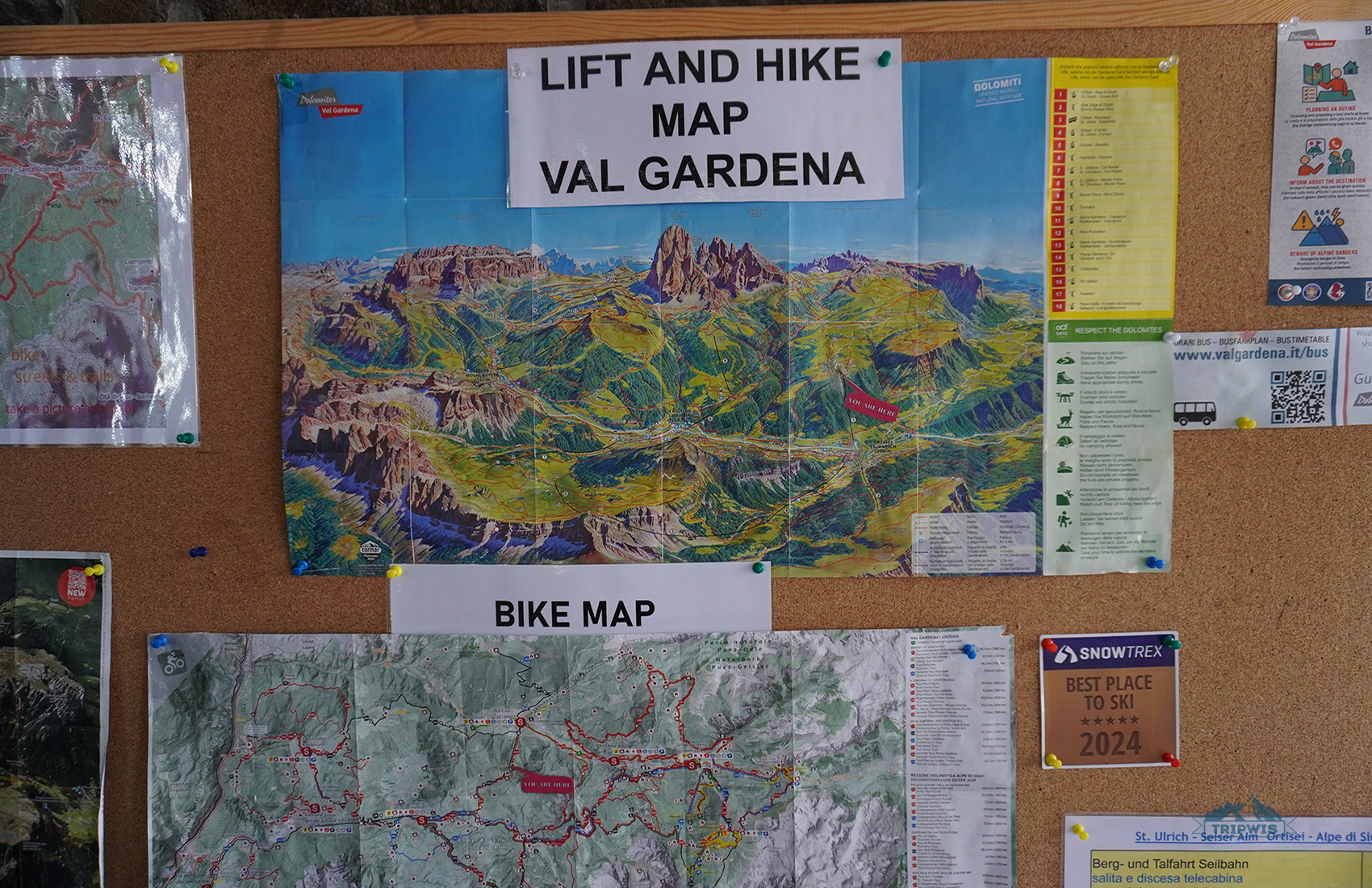
FYI: Val Gardena is a huge valley, and Alpe di Siusi is a part of it
The impressive range of hiking routes and viewpoints in Alpe di Siusi can lead to choice overload and decision paralysis — how can you fit all the best things into one experience?
We’ve chosen the best short hike in Alpe di Siusi as our guidepost for this article — the Alpe di Siusi Panorama Trail. It’s a loop hike that gives you a full survey of the valley and the towering Sassolungo Group of mountains. It will also have you pass two mountain huts to maximize your Dolomite adventure with South Tyrolean food!
Panorama Trail is an easy hike. It starts and ends with Mont Sëuc Cable Car station, and mostly runs on gravel paths, with some stretches of wider paved roads. There are usually a lot of people hiking here, even in the off-season, with mountain bikers zipping past. There might be some cars, but it’s a rare occurrence — only guests checking in and out of Alpe di Siusi’s hotels can drive here.
Alpe di Siusi Panorama Trail stats:
- Distance — under 4.5 kilometers
- Elevation gain — 110 meters, most will happen on the last stretch back to the cable car station
- Hike time — around 2 hours, depending on how many breaks you do
- Hike difficulty — easy
Here’s a map of the hike, make sure to check it out before I break it down in more detail further down.
How to get to Alpe di Siusi?
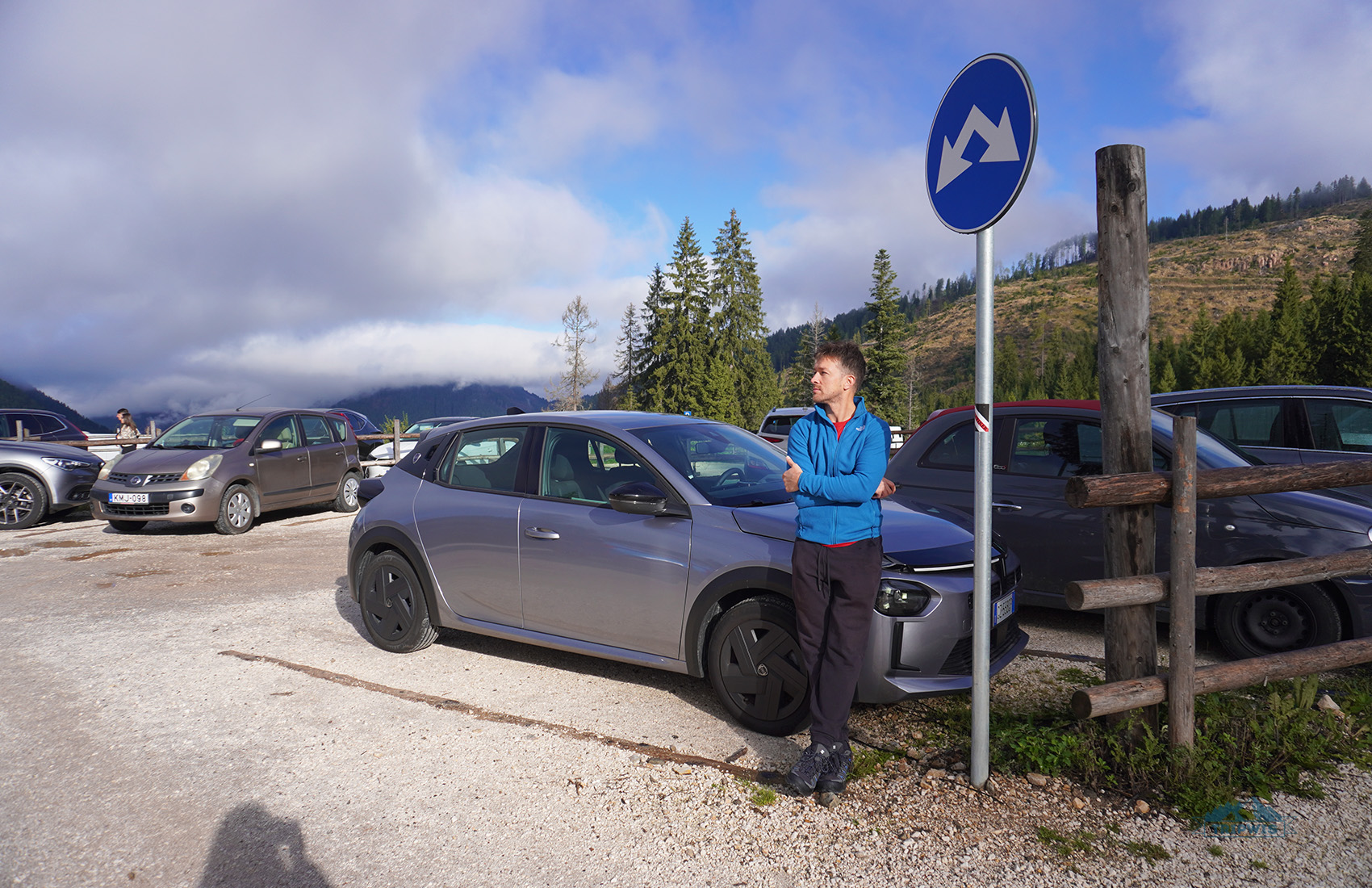
It was our first time driving an Italian Lancia car!
Well, you have to get to the Dolomites first. You can follow our example:
🔹We flew into Milan from Barcelona — €20 per person
🔹Picked up a car that we booked through Discovercars.com — €80 for six days
🔹Reached Ortisei (St.Ulrich) in four hours — €19 for toll roads
🔹Dropped our suitcases at Monte Pana Resort — €200 a night with half board
🔹And made it to Alpe di Siusi (Seiser Alm) the next day — €35 per person for a cable car
I should probably address the parentheses () situation before I dive into the detailed breakdown of how to get to Alpe di Siusi (Seiser Alm). You see, Alpe di Siusi is located in the South Tyrolean province of the Dolomites. Because of a few twists and turns of history (South Tyrol was once part of Austro-Hungarian Empire), the places here usually have two names — Italian and German — and are used interchangeably, particularly online.
These are the main locations’ names you have to know to navigate the choices that are to follow:
- Alpe di Siusi (Seiser Alm) — the main focus of my article, the largest alpine meadow in Europe
- Ortisei (St. Ulrich) — a popular resort town and central base for accessing Alpe di Siusi via a cable car
- Siusi allo Sciliar (Seis am Schlern or Seis, for short) — this mountain village serves as another main getaway to the plateau
- Compaccio (Compatsch) — a small settlement that sits directly on the plateau; you can park here for free (see details below as it’s not an easy thing) and do the hike to all the action
Side note: If the whole two-name thing wasn’t complicated enough, sometimes local signs throw in a third (!) name into the mix. Take Alpe di Siusi, for example: You have the Italian Alpe di Siusi and the German Seiser Alm. But you can also see the name Mont Sëuc. The name comes from Ladin — a unique language mainly spoken by people in the Dolomites in Northern Italy.
Whew! South Tyrol does not make it easy on its guests, that’s for sure. From this point till the end of the post, whenever you come upon a place name that you’re not sure of, you can come back to this section and clear the air. I am guilty of using the Italian and German names interchangeably — after a few main segments to follow, you will be doing it too!
You’re now ready to look into the four existing ways of how to get to Alpe di Siusi:
- The cheapest way to visit is to drive up to the plateau and park your car near Compatsch. From there, hike all the way to the trail.
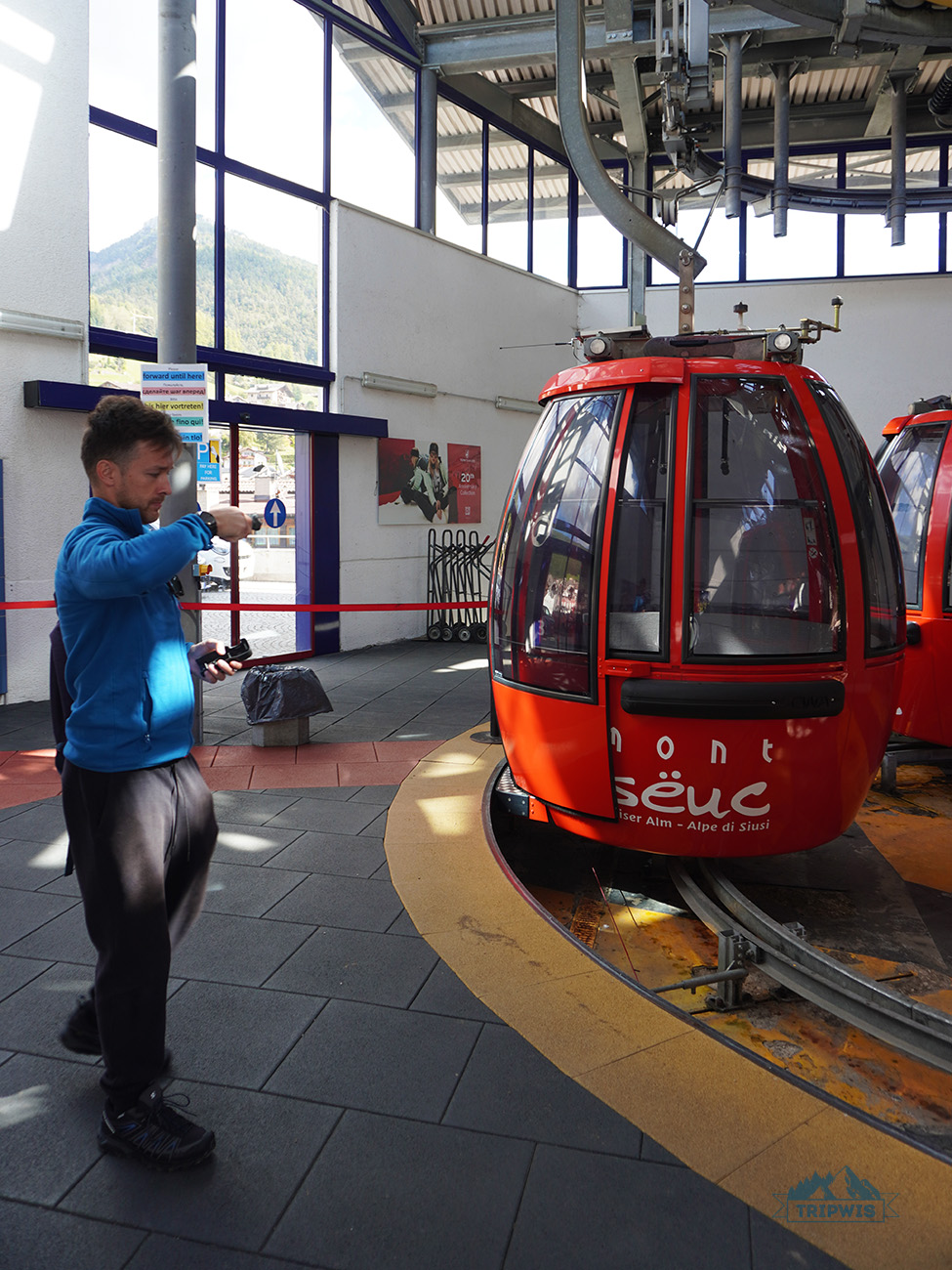
- The most convenient way (and the one we chose) is to ride the gondola up to the Mont Sëuc Cable Car station on the plateau.
Take the Ortisei-Alpe di Siusi cable car (most popular option)
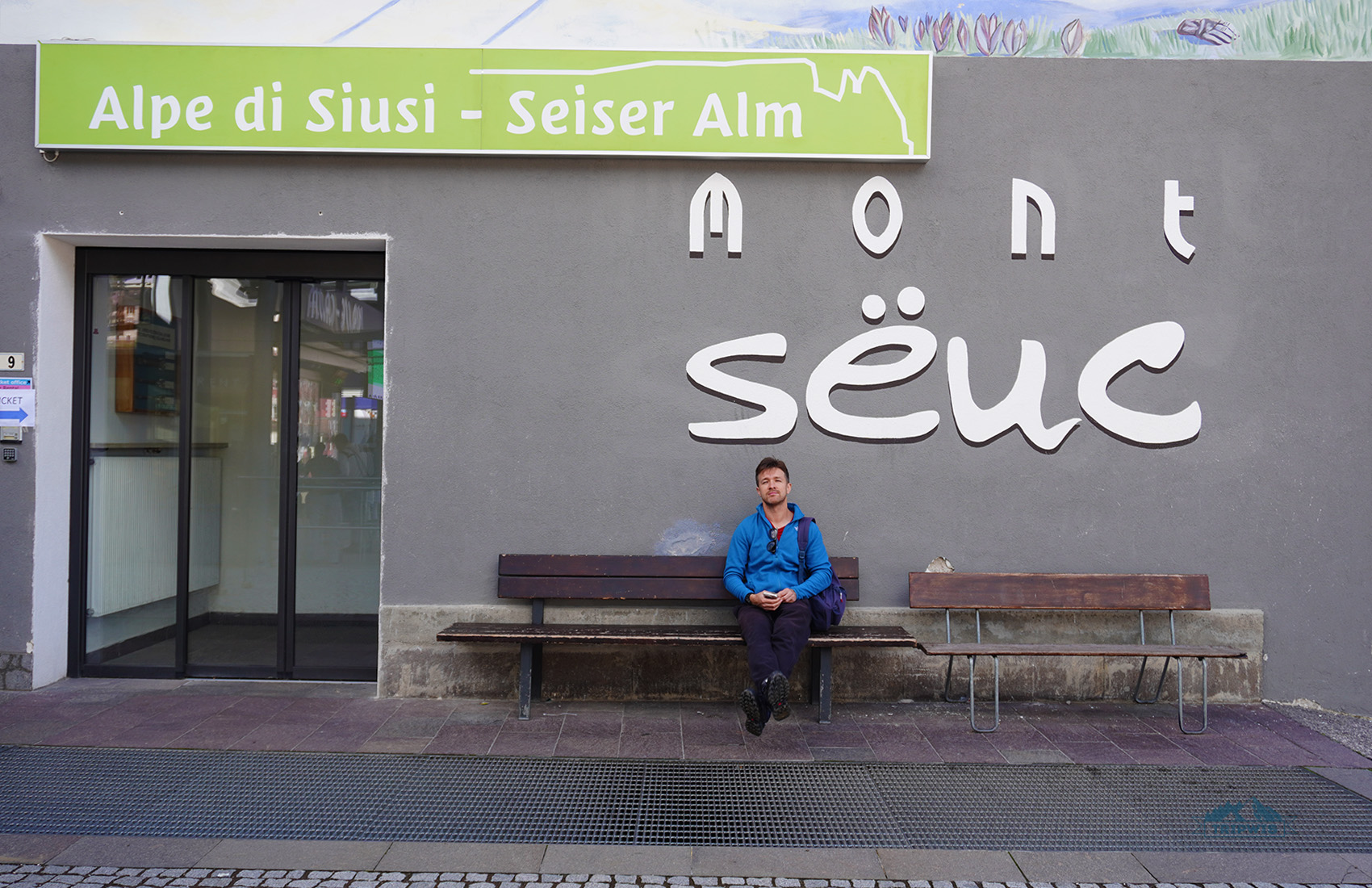
A clear example of a place name repeated in THREE languages in South Tyrol 🙂
A cable car from Ortisei (mainly known as Mont Sëuc Cable Car) is the option we went with during our exploration of the valley. This gondola lift takes you from 1,236 meters above sea level to 2,000 meters in under 15 minutes!
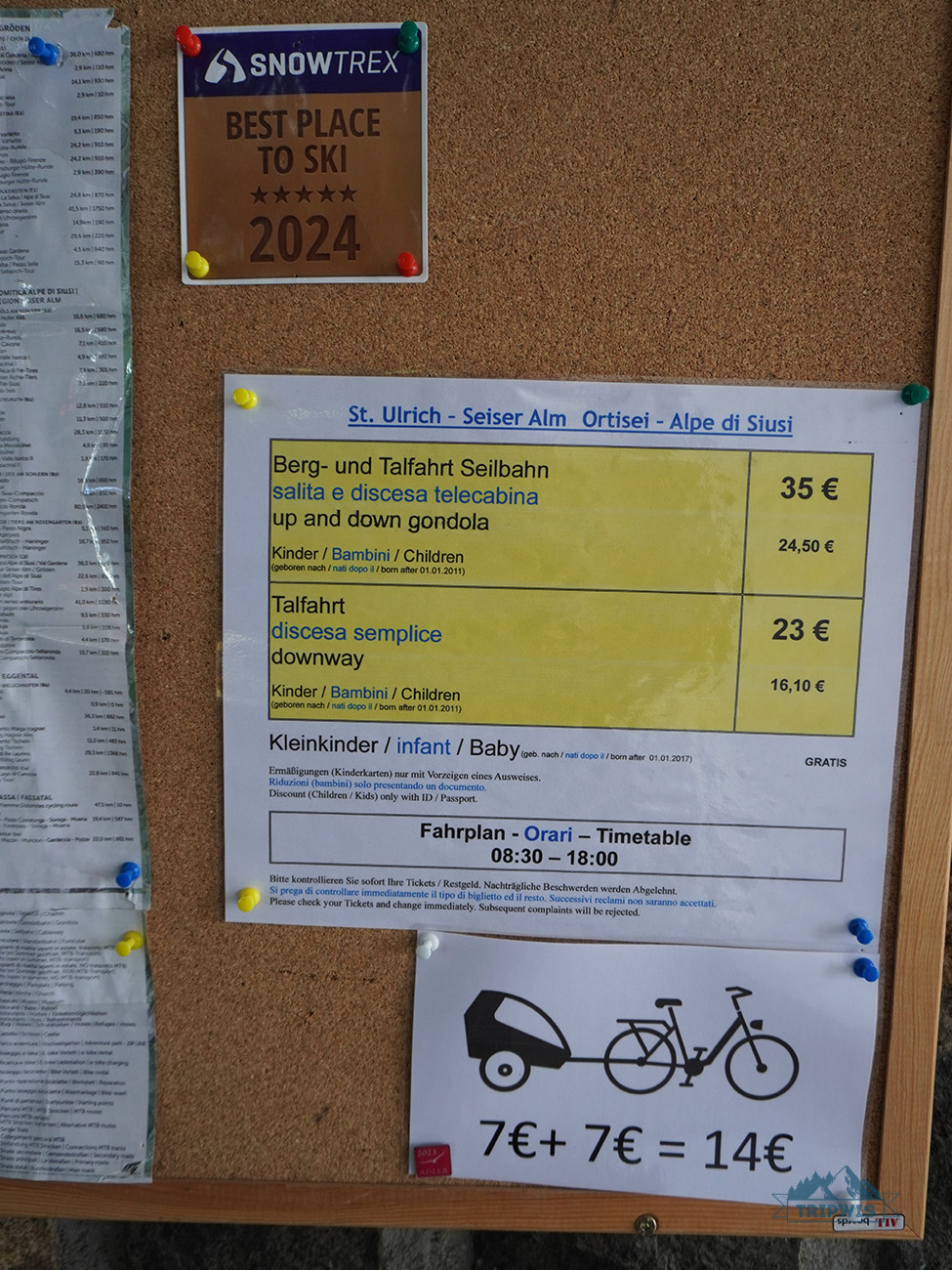
Mountainous destinations are usually synonymous with a pricier experience, and this cable car is no exception. Here are the Mont Sëuc Cable Car ticket prices:
- Roundtrip gondola ride — €35 for adults, €24,5 for kids
- One-way gondola ride — €23 for adults, €16,1 for kids
- Roundtrip gondola ride + chairlift ride* — €40,8 for adults, €28,6 for kids
The prices tend to fluctuate between summer and winter seasons in Alpe di Siusi. The 2025–2026 winter season prices are €39 both ways and €26 one way.
*This chairlift runs from the cable car’s top station down into the valley, basically replacing most of the hike (but what’s the fun in that?.. unless you’re a guest at one of the valley hotels, of course).
 |
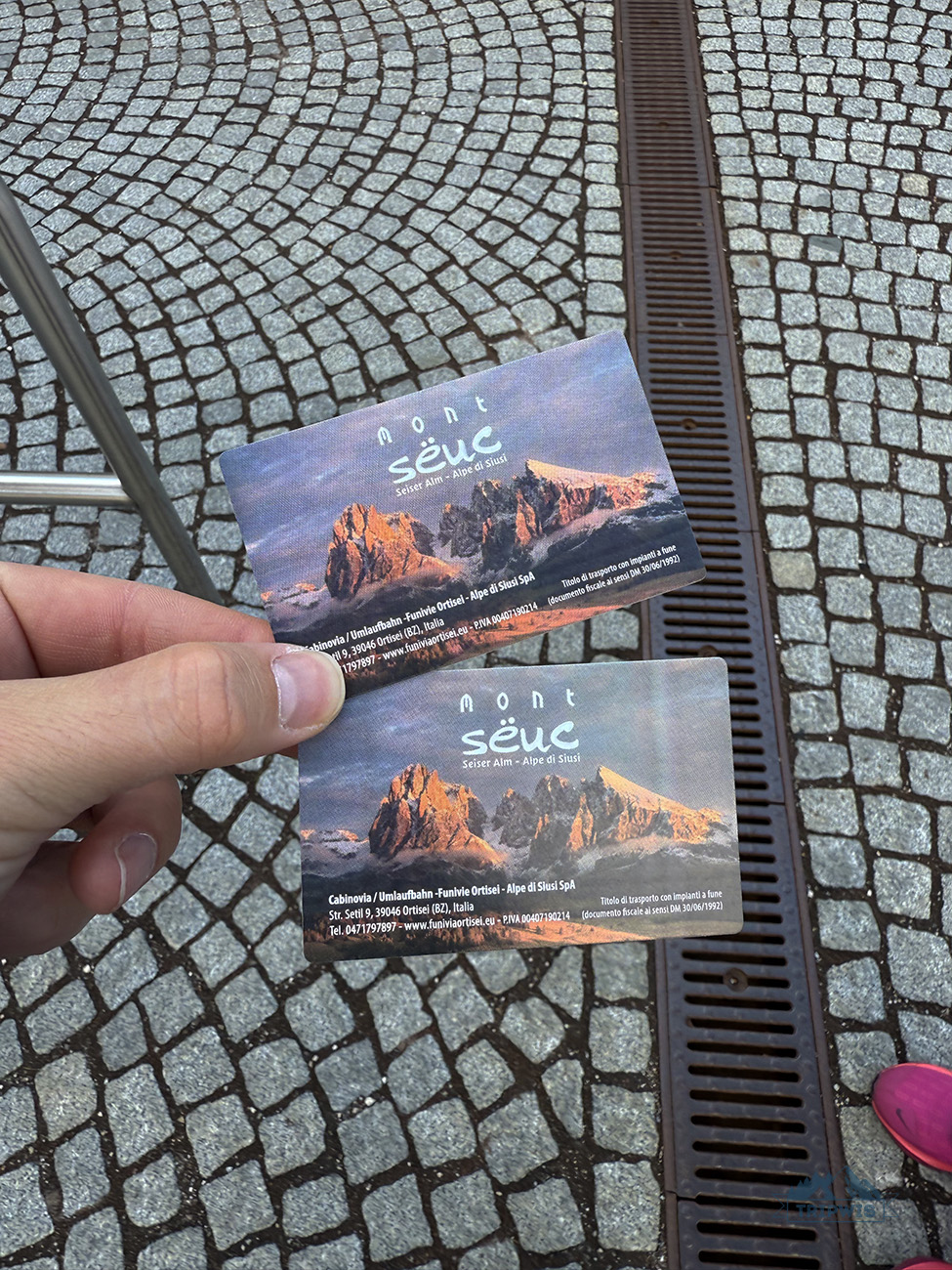 |
Don’t you ever lose this ticket! It’ll cause lots of troubles
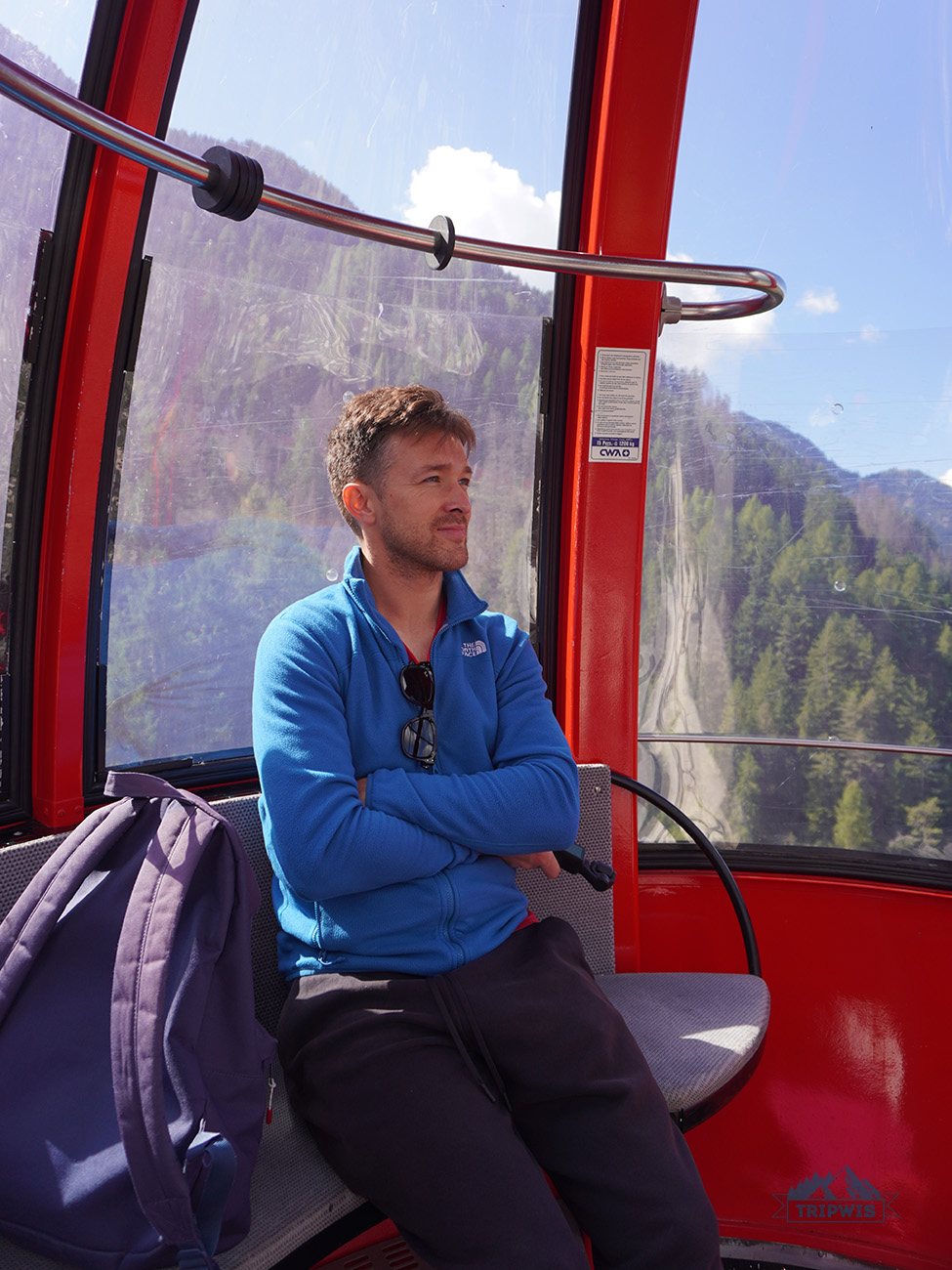
As you ascend the impressive 800 meters in altitude, enjoy the stately and awe-striking Dolomite mountains starting to reveal their full glory. The egg-shaped red gondolas are pretty roomy (they fit up to 15 passengers), especially if you ride in off-season. We visited Alpe di Siusi in late September, and there was no line, so we could choose any cabin we wanted. We were the only two people in our gondola, which was a nice VIP-like experience. During high season though, once the cabin seats are full, the remaining riders are expected to ascend the mountain while standing.
Mont Sëuc Cable Car runs year-round; operating hours are from 8:30 a.m. to 5:30 p.m. Though seasonal changes in schedule may apply, moving the closing time a half an hour back or forward.
The location of the cable car station in Ortisei is great — a pedestrian bridge connects the destination with the village center. It’s also easy to reach the station by car — if you’re not staying in Ortisei, you’re likely to arrive to the village in a rented vehicle. One thing that could tamper with an otherwise amazing experience is the parking situation.
Alpe di Siusi cable car parking in Ortisei
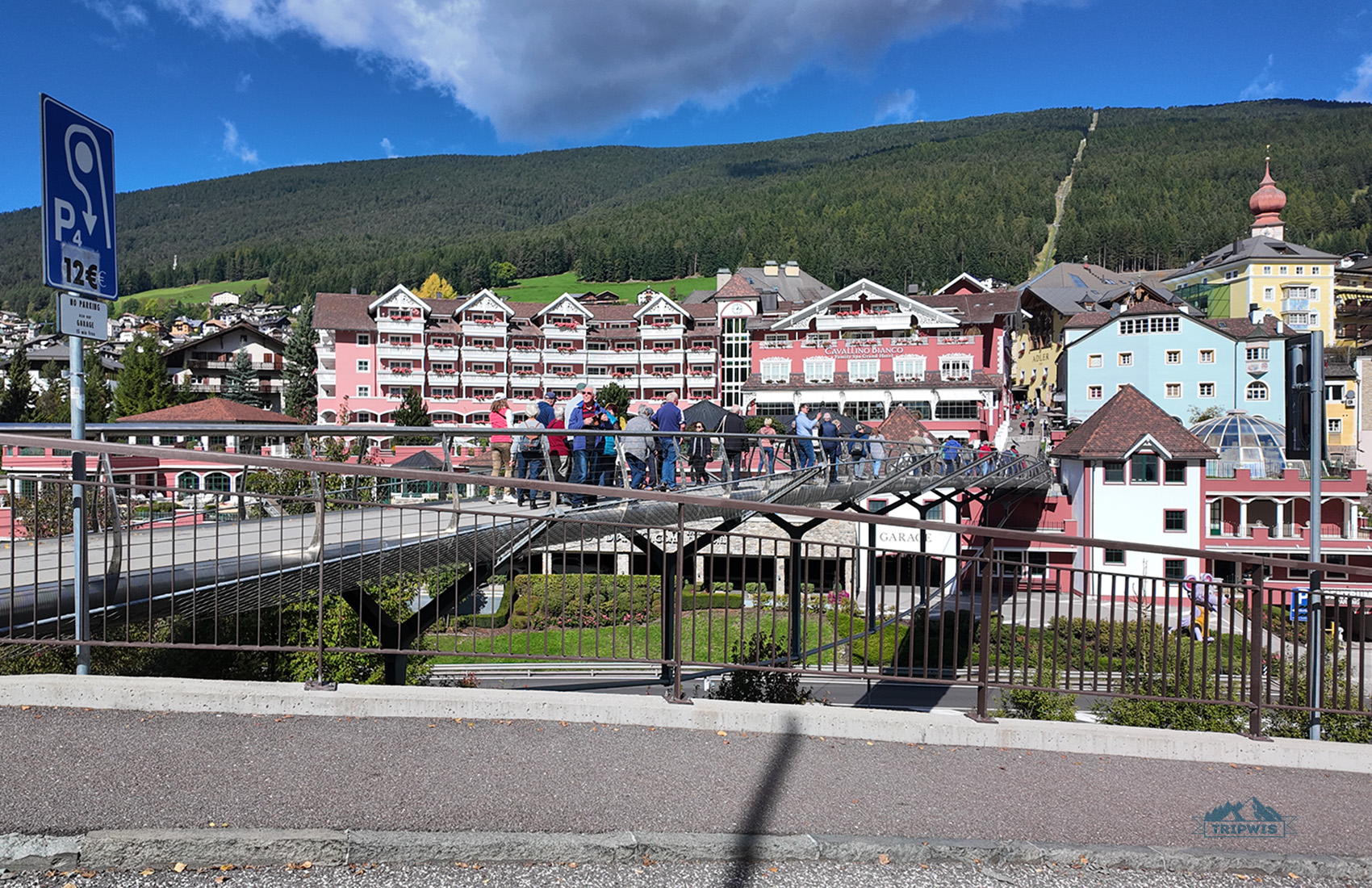
Answering the question of Alpe di Siusi cable car parking, there are a couple options to consider:
- There is a large garage located under the station itself. It has three levels, and hourly rate is €0,5 / €2,5 (summer / winter)
- There is another outdoor car park close to the station — Parking Setil. Here, you pay €8 / €16 for an entire day (summer / winter)
Personal experience: It took us two tries (!) to park at the station. First, we came around noon and were met with a sad “Zero spots available” notice at the underground garage entrance. There were spots available for the all-day parking for €12, but we didn’t want to pay that much. We came back an hour later and managed to finally snag a spot. After the hike and the gondola ride back to Ortisei — around 4 p.m. — the lot had 17 open parking spaces.
So, I came to the conclusion that it is better to come here either early in the morning or after 3 p.m. — especially in high tourist season!
Drive to Alpe di Siusi (to Compatsch) — no cable car needed
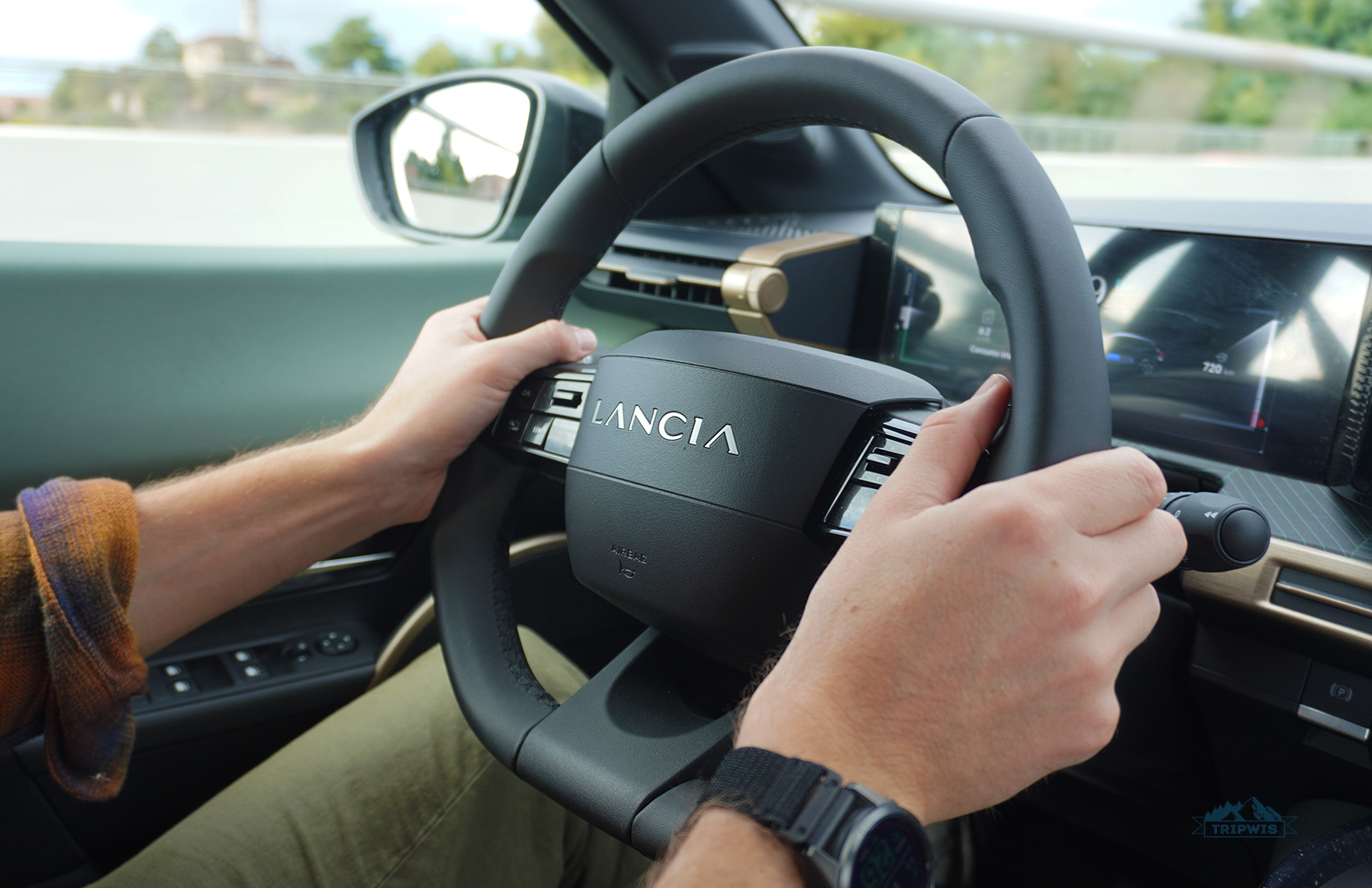
If you are, for some reason, not entirely fond of the idea of taking a gondola ride, or if you simply want to save a bit, then driving to the plateau of Alpe di Siusi is an obvious choice.
It is best to use the services of Discovercars to rent a car in Italy. They have amazing rates and deals! Our new Lancia Ypsilon cost less than €80 for six days (we made total use of off-season prices).
Important: Alpe di Siusi is a designated Landscape Conservation Area, which means focused commitment to keeping the nature here in pristine condition. The main part of these efforts is restricted car access to the plateau year-round — private cars cannot drive from Seis to Compatsch between 9 a.m. and 5 p.m.* You should also know that there aren’t any physical barriers or checkpoints on Alpe di Siusi; you’re expected to be familiar with car access restrictions. If you break the regulation, expect to get a fine (we’re talking €100+). But don’t you worry about getting trapped here — you can exit the plateau at any time.
*There is a loophole to the rule, which I will uncover in the next section.
❗️ Strictly until 9 a.m. you can drive to the town of Compatsch and leave your car before accessing the trailhead at:
- Parking place P2 Compatsch — daily rate is €30 per vehicle, no hourly rate. Since you’re as close as you can possibly get to the trails, this is the most popular car park on Alpe di Siusi.
- Parkplatz P4 — a small FREE lot next to P2 for 10 or so vehicles. But here’s the catch: You can park for 2 hours max! Given that this limit starts counting from 8 a.m., this parking works well for a morning hike between 6 a.m.* and 10 a.m.
- Parking place P1 Spitzbühl — daily rate here is €15 per vehicle (cash only), you cannot pay by the hour. Though it is a cheaper option, the location of P1 isn’t great — you’re looking at a 30-minute walk to Compatsch. There’s a minibus #14 that runs between the two (June 15–September 28); a single fare is €4, but P1 ticket gives you a discount.
*Note that there’s no overnight parking on either of the lots — you cannot park here between 11 p.m. and 6 a.m.
Is there free parking in Compatsch? The P1 Spitzbühl parking lot is free from November until May.
The Alpe di Siusi hike from Compatsch takes about 50 minutes / 3,5 km to merge with the Panorama Trail I’m focusing on in this post. From there, you can walk 1,5 kilometers more to Sporthotel Sonne, enjoy the views, and head back.
Book a room at one of the Alpe di Siusi hotels
 |
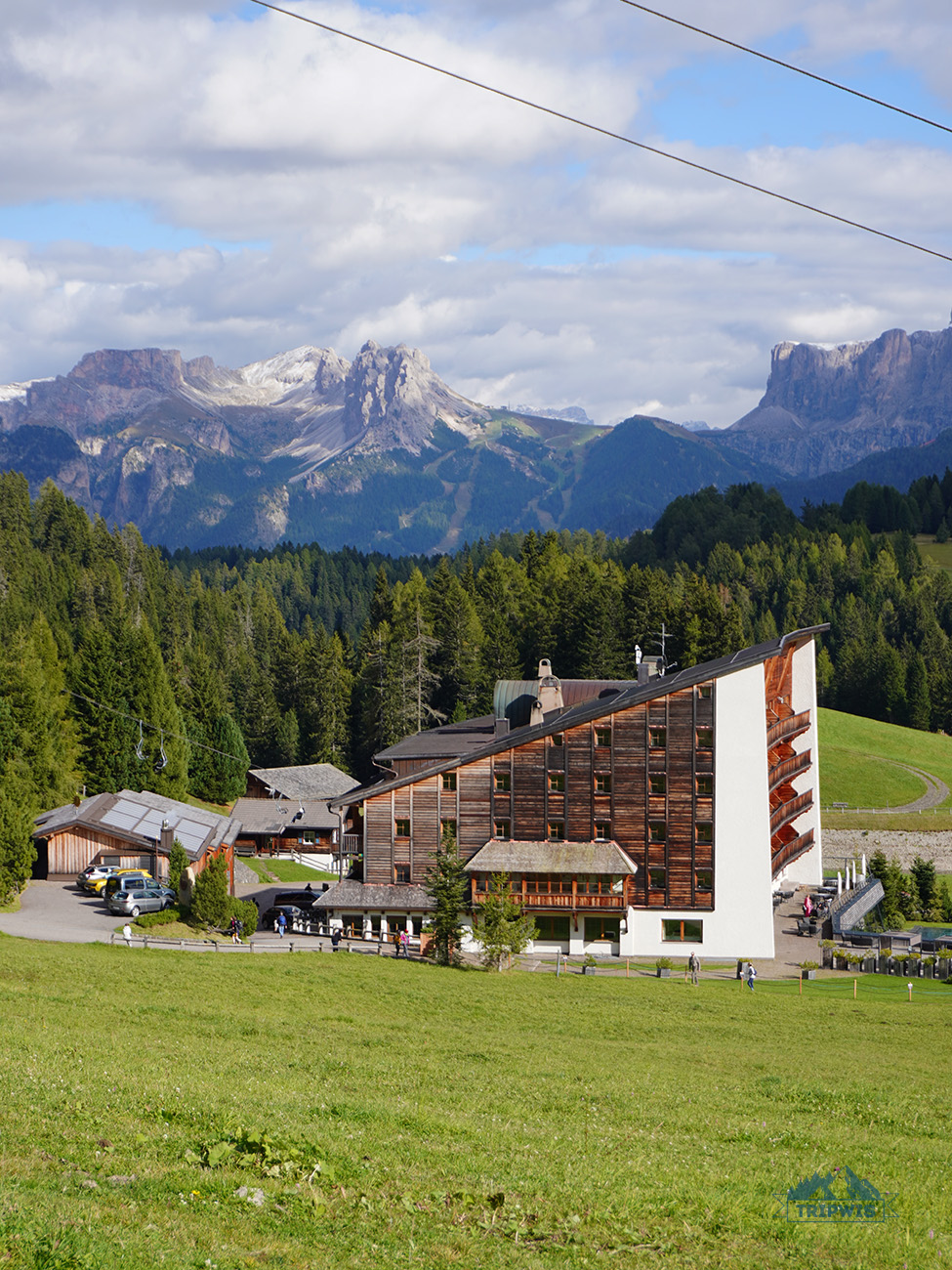 |
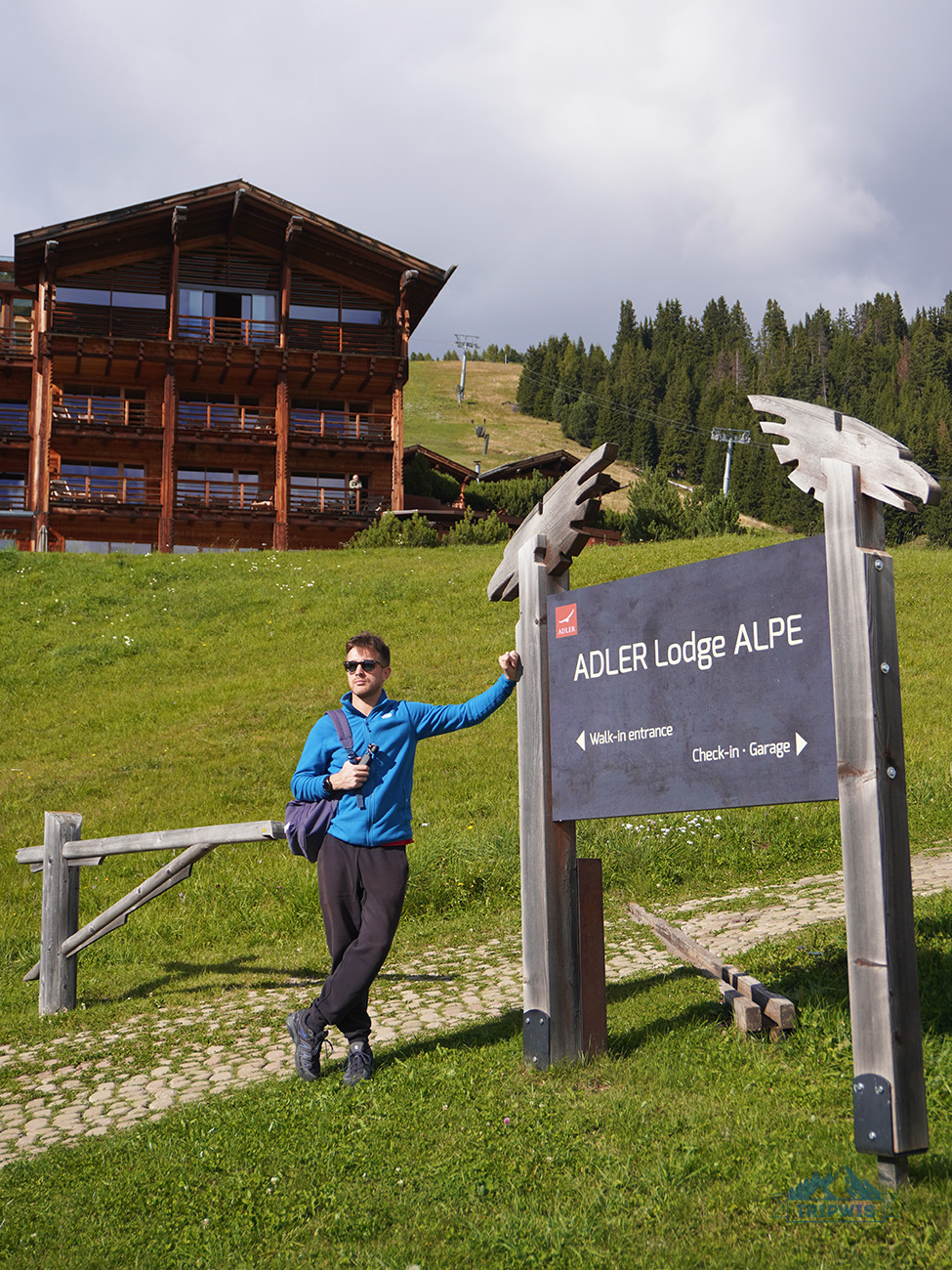
This is the loophole I have been hinting at — there is no parking past Compatsch on Alpe di Siusi, except for parking at the hotels located on the plateau. Doing so makes total sense — staying overnight on Alpe di Siusi allows you to bypass all the cable car/parking/timing confusion that the rest of the tourists have to wrestle with.
There is, however, an asterisk to your freedom of movement if you’re a guest of the hotels. It’s true that you can arrive and depart from your booked accommodation at any time. However, if you’re not driving to check in or exiting the area after checking out, you have to follow the same rules as the rest of us mortals — no usage of private cars on Alpe di Siusi from 9 a.m. until 5 p.m. But it is highly unlikely for you to want to make day trips to other destinations. Once travelers come here, they usually commit to exploring Alpe di Siusi to the fullest!
Here’s the TL;DR on Alpe di Siusi hotels (there’re very few of them):
- 4* Sporthotel Sonne (from €450 per night) — a gorgeous hotel that makes it a point to purposefully frame mountain views from all the suites and facilities. We passed it by during the Panorama Trail hike and it looked like a wonderful place to stay at.
- 4* Icaro Hotel (from €350 per night) — the one hotel on our list that we didn’t see, but based on the reviews I can say with confidence that this is a great and (relatively) budget-friendly accommodation option on the plateau. You would pass Icaro if you were hiking to the Alpe di Siusi Panorama Trail from Compatsch.
Take a bus to Alpe di Siusi (to Ortisei or Compatsch)
Getting to Alpe di Siusi by bus is an option too. I’ll take as the starting point the city of Bolzano — the capital of South Tyrol that is easily reached by train from Milan.
From Bolzano to Ortisei: 350 bus departs from the bus station every hour. The ticket price is €7,5 one way; the journey takes 1 hour.
From Bolzano to Compatsch: 170 bus to Seis from the same station with hourly departures; the journey takes about 40 minutes and costs €5. From Seis, you can proceed in two ways: Take the Seiser Alm Express (route 10) bus to Compatsch for €21 one way (€30 both ways). Or take the Seis—Alpe di Siusi Aerial Cableway up to Compatsch. A roundtrip ride will cost you €28,5, a one-way ride — €19,5. You can then hike from Compatsch to Alpe di Siusi (I’ve covered this option above).
And there you have it! Alpe di Siusi’s well-connectedness to the rest of the province means a myriad of choices. But prices for infrastructure and services are the things to worry about here.
Hike from Ortisei to Alpe di Siusi
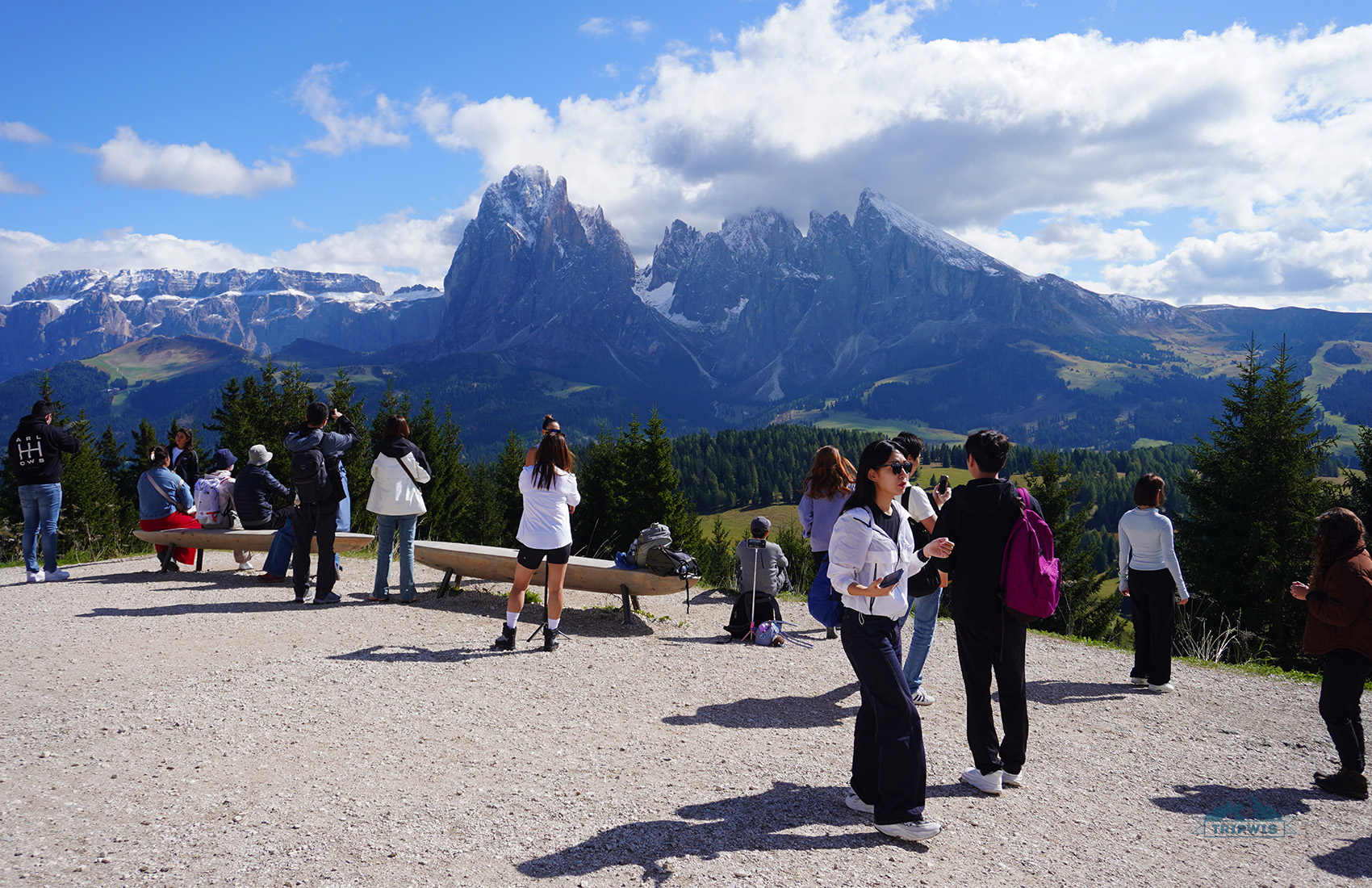
Can you hike to Alpe di Siusi from Ortisei instead of taking a cable car? It turns out that this is a popular option amongst the more intrepid and resilient travelers.
The Alpe di Siusi hike from Ortisei is hard. You cover around 4 km and gain almost 700 meters (!) in elevation. That’s a lot. You are guaranteed to be huffing and puffing by the end of your two-hour hike. Thankfully, you merge with the Panorama Trail right around the mountain hut, where you can eat, drink, and take a general breather.
Personally, if I wanted to make the hike between Alpe di Siusi and Ortisei, I would do it on my way back, after a comfortable cable car ride up and general shenanigans on Alpe di Siusi itself. The descent is harder on the knees, but easier on the rest of the body.
Best hike in Alpe di Siusi: Meadows, mountains, and rifugios
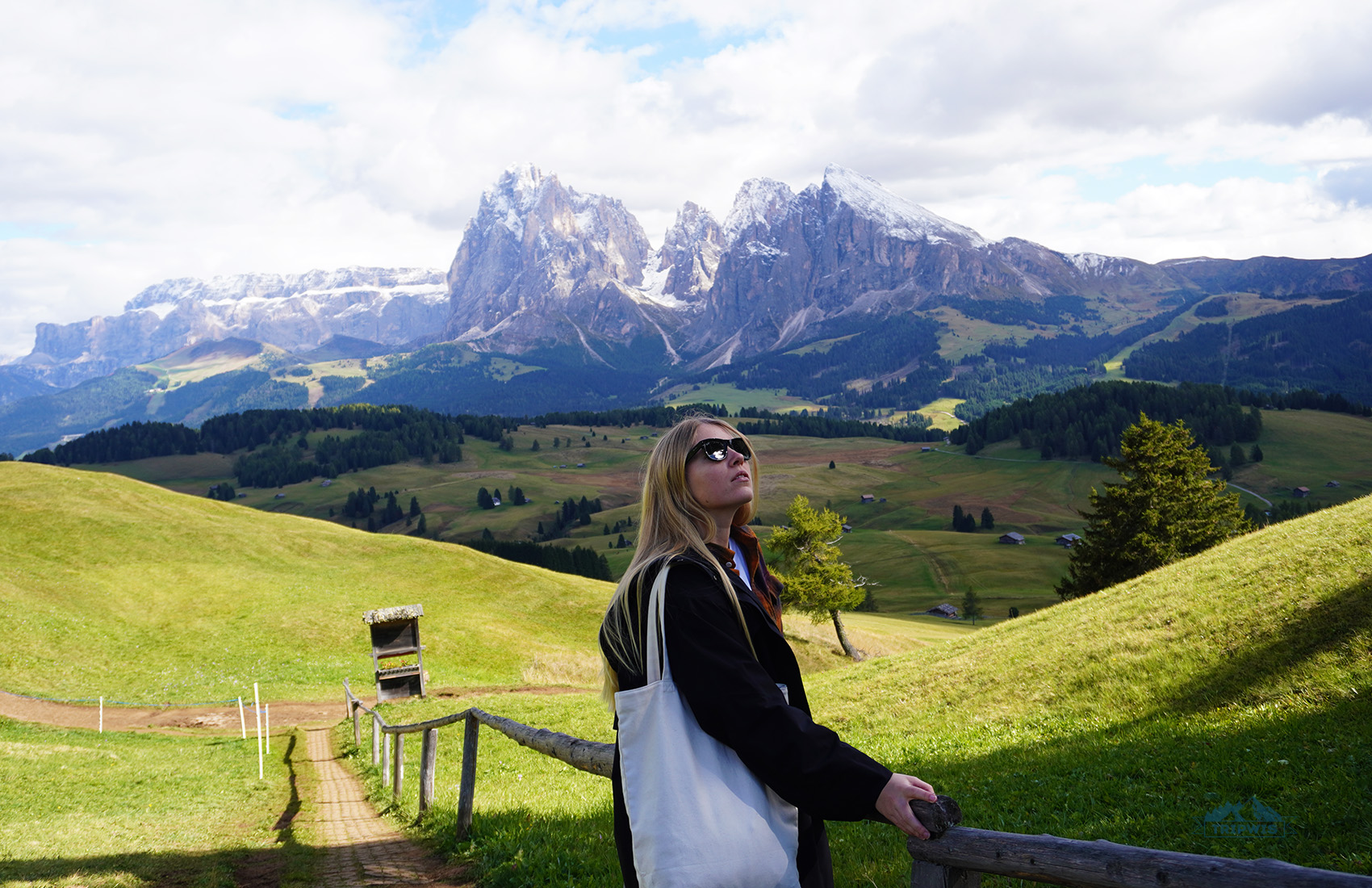
Giuseppe Verdi said it best: “You may have the universe if I may have Italy”; and though South Tyrol has been part of Il Bel Paese for just over a hundred years, the statement rings true to the entire province and Alpe di Siusi in particular. From peaceful meadow walks to strenuous mountain climbs, the list of things to do in Alpe di Siusi has something for everybody, so it makes sense to proclaim my love for this place right out of the gate.
Here’s our experience of hiking Alpe di Siusi Panorama Trail. You can also watch the whole thing on my YouTube channel if you like your information to be presented in a manner that’s a tad more dynamic ⬇️
After you disembark your bright red gondola from Ortisei, you find yourself at the Mont Sëuc Cable Car station. The thing that will undoubtedly catch your attention is a towering group of mountains — Sassolungo — that dominates the horizon right as you’re exiting the station. The mountain group’s main peaks are Sassolungo (Langkofel) and Sassopiato (Plattkofel). However, these granite giants are not the only ones you are set to witness while on the hike — the sheer wall of gray rock of the Schlern (Sciliar) Massif will also rise to the occasion as you make your way forward.
After admiring the showstopper peak that is Sassolungo, we started off on the trail, taking the path up the hill to the right — the so-called Panorama Trail. The routes on Alpe di Siusi are clearly marked with signs, so it’s hard to get lost here.
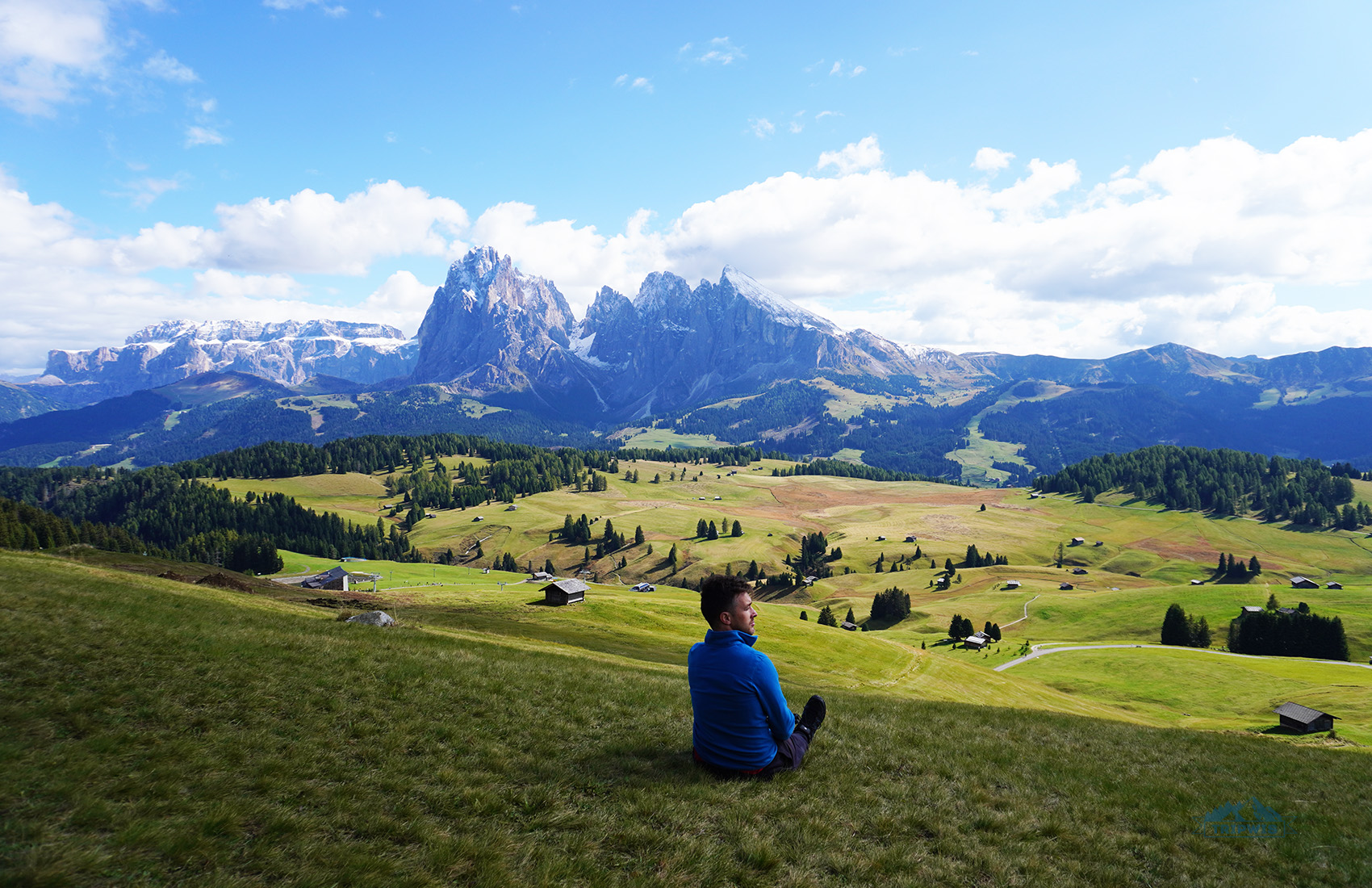
After a short 15-minute walk, you arrive at your first viewpoint (Viewpoint Bench Panorama), where you can admire the vast landscape of the plateau. Personally, I was overcome with desire to run down the emerald-colored hill — which would’ve been a more pleasant experience than, let’s say, Cooper’s Hill Cheese-Rolling and Wake (traditional English event when you chase a cheese wheel down a steep hill), since Alpe di Siusi’s pasture is less sloped and more plush-looking.
Once you start feeling antsy and a little tired, a saving grace comes into view — your first rifugio on the Panorama Trail!
Side note: Rifugios are essentially rest stops on the trail — mountain huts where you can eat, drink, have a breather, and even stay at. Their names usually start with either Schwaige (German for mountain hut) or Malga (Italian version). Each hut has its own operating schedule, but most of them are guaranteed to be open between May and October.
 |
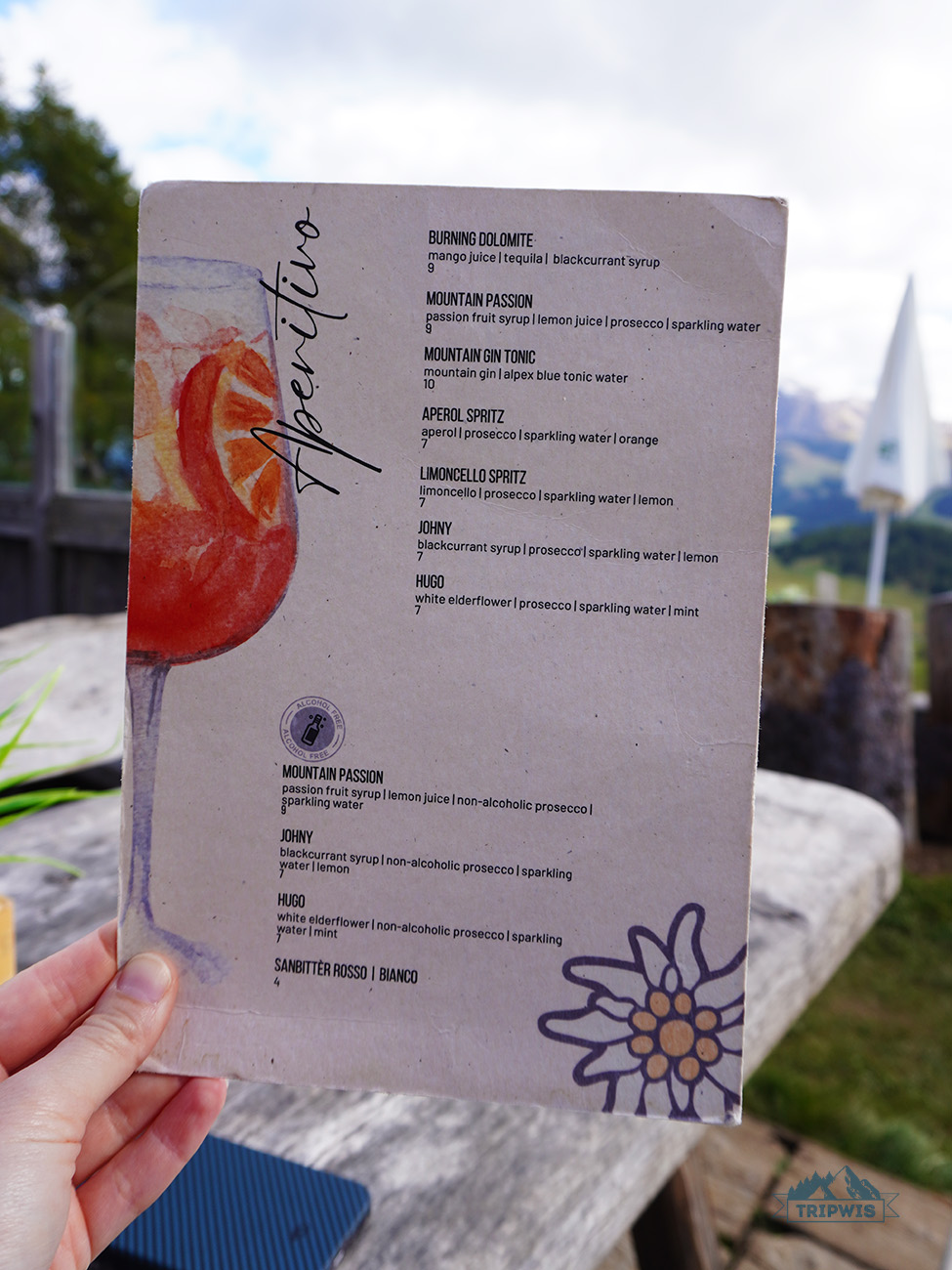 |
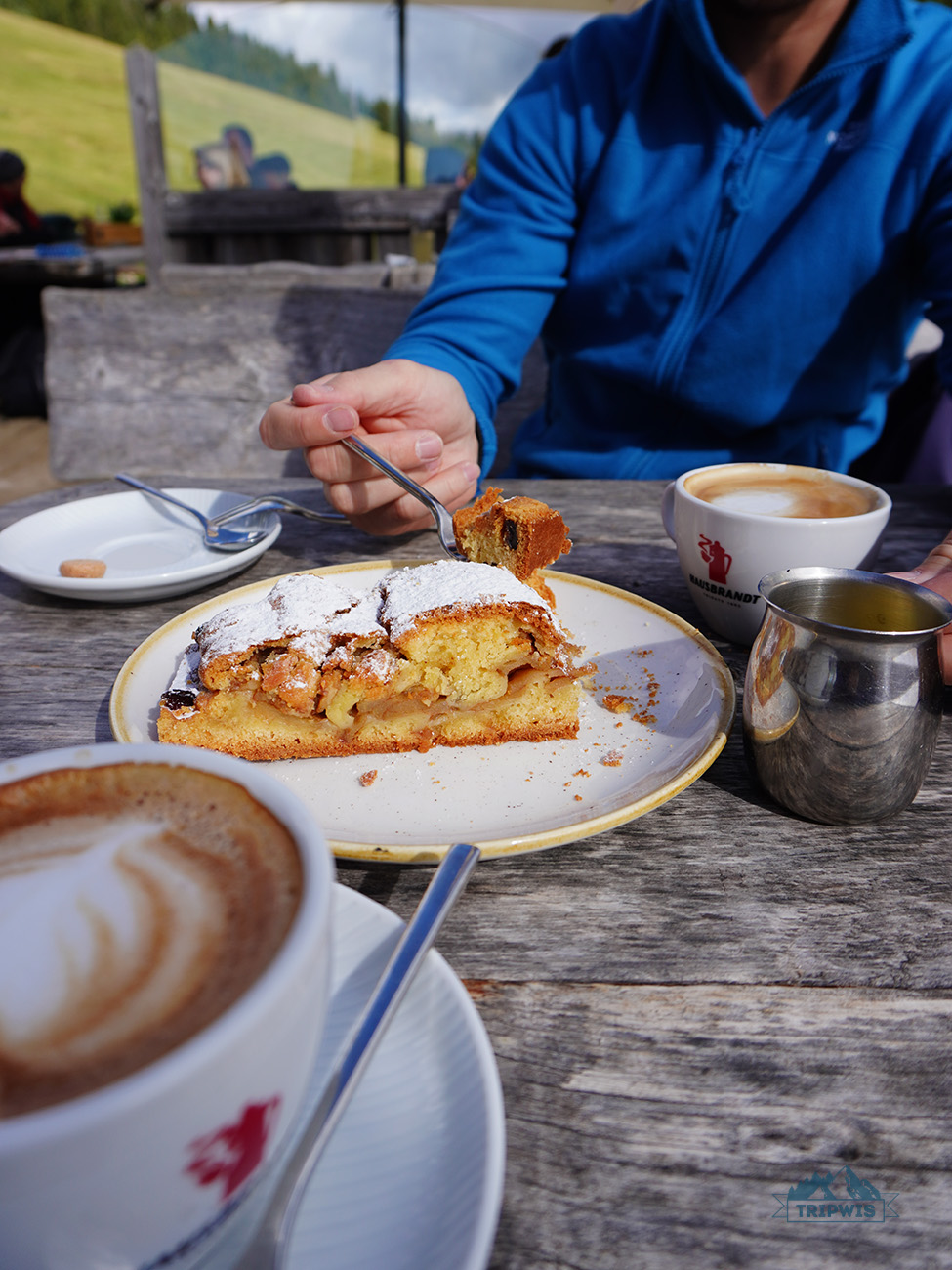
So, the first rifugio of two on this route was Malga Contrin, where we stopped for a quick refuel of a cappuccino (€3,5) and a homemade strudel with custard (€7,5). If you want a more substantial meal here, you can do so too:
- Starters cost on average €17
- Mains are around €20 (goulash with homemade speck dumplings seem to be the main event here)
- You can wash the hearty South Tyrolean cuisine down with a bottle of beer or some grappa for €5
Lounging about on log chairs and wooden benches after a meal is essential here — you can appreciate the stunning view even more once you’re full!
After you’ve rested enough to continue, you have a choice to make — you can go down into the valley for the full loop or, alternatively, you can walk back the way you came from.
We chose to stick it out with the Panorama Trail, taking the dirt road deep down into the smooth green valley. It’s hard to imagine that Alpe di Siusi’s classic meadow wasn’t here in the first place — the area used to be covered with thick spruce and larch forests, which were cut down over the centuries to make room for pastures!
 |
 |
Once you’re more than halfway into your trail, you will come upon the next essential viewpoint on Alpes di Siusi — Belvedere. It is an unofficial spot that is crazy popular with photographers, with many coining the place as the main destination of the Alpe di Siusi sunrise hikes. We didn’t come here for sunrise, but it is supposedly the vantage point to capture the beautiful Alpenglow.
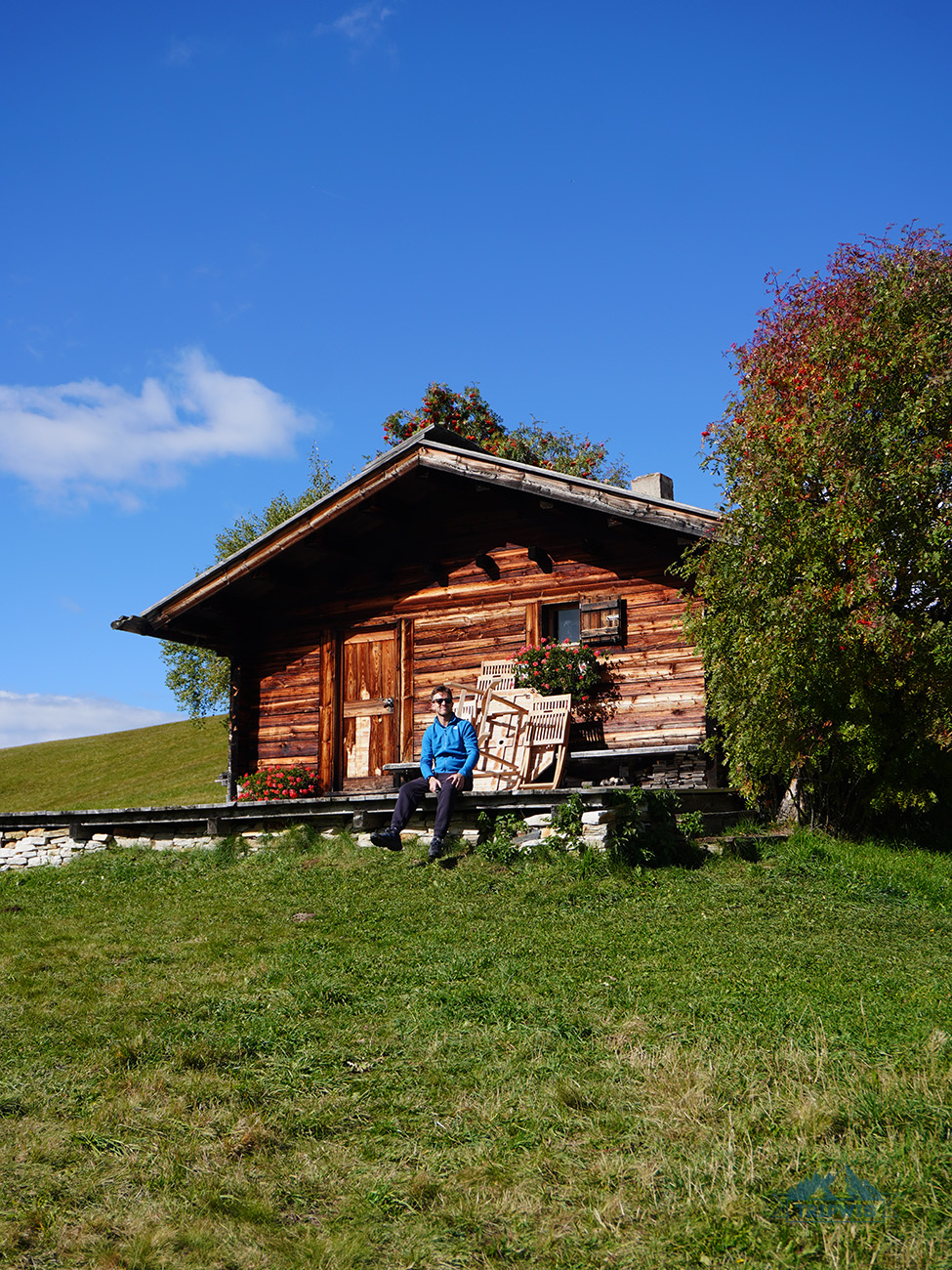
As you make your way in the general direction of the cable car station, you will pass by the iconic wooden houses that are strewn about the valley. Most of them look abandoned, since their main usage is storage, but they create a vibe that is simply unmatched!
After you’re done admiring, you will come upon the last stop on the Panorama Trail — another mountain hut, Malga Schgaguler Schwaige. Since this rest stop sits at the intersection of more trails than the previous one, it is usually more crowded. The prices here are on par with the first rifugio.
You need some extra energy to make it back to the cable car station — the last 20 minutes are the hardest part of the trail, since it’s where most of the elevation gain happens (you’re essentially climbing the hill up from the valley).
The entire Panorama Trail took us two hours to complete — it would’ve been an hour and a half, but we spent 30 minutes grabbing a bite and lounging about on the grass at the first rifugio. After doing it, I’m sure that this is the best hike in Alpe di Siusi — it covers all the necessary experiences in a reasonable amount of time.
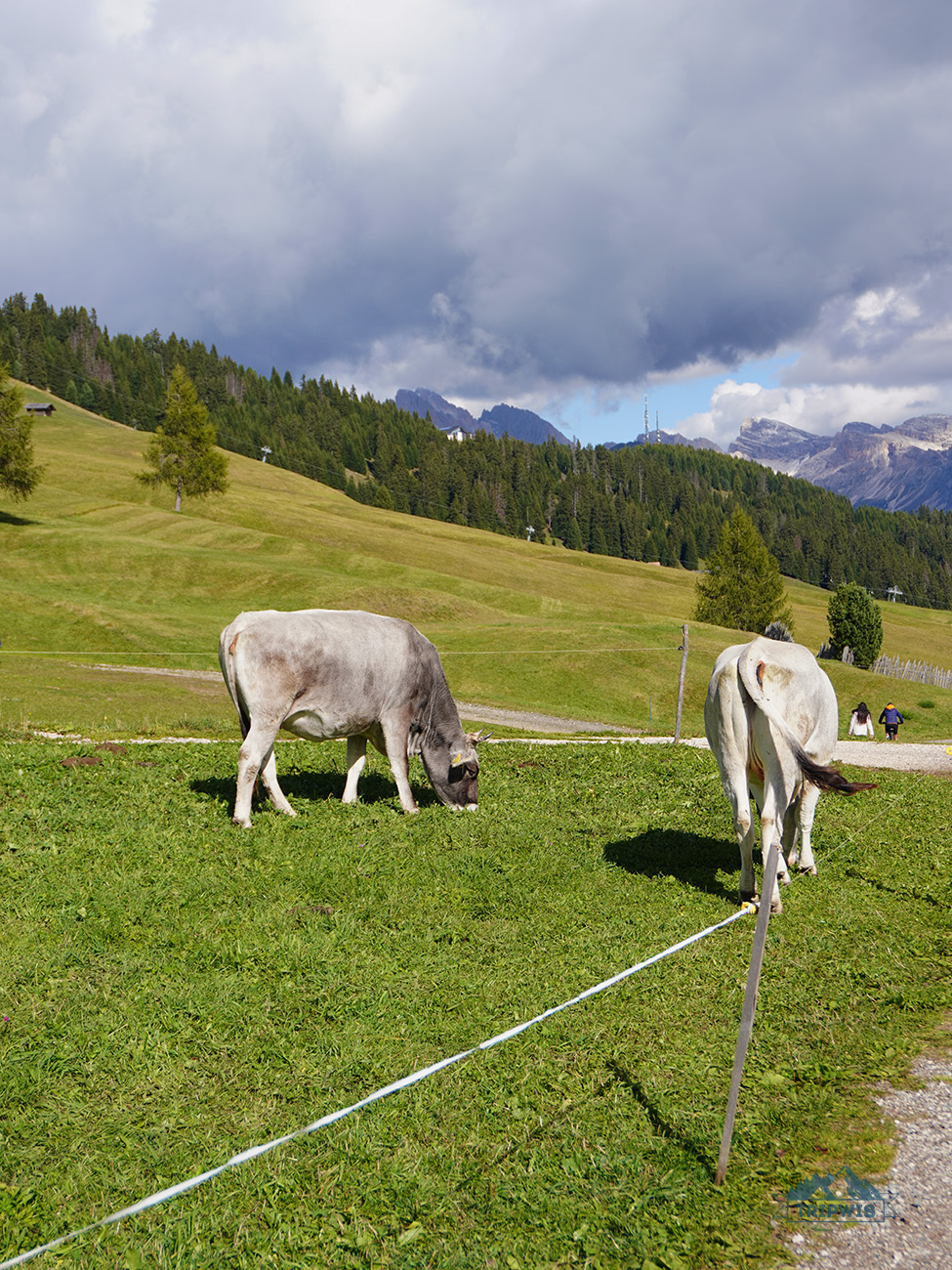
And the list of hiking routes doesn’t stop there! With dozens of unique paths that make up the different trails (they are usually numbered or lettered, like path 6A or 9), you can potter about and create your own route by seeking out and going after sites that speak most to you. I consider the Panorama Trail to be one of the best trails on Alpe di Siusi, since it gives you an extensive look on the plateau’s legendary features (mighty mountains, vast meadows, grazing cows, — you know the drill) within a short amount of time, which is perfect for first-time visitors.
Where to stay in Alpe di Siusi?
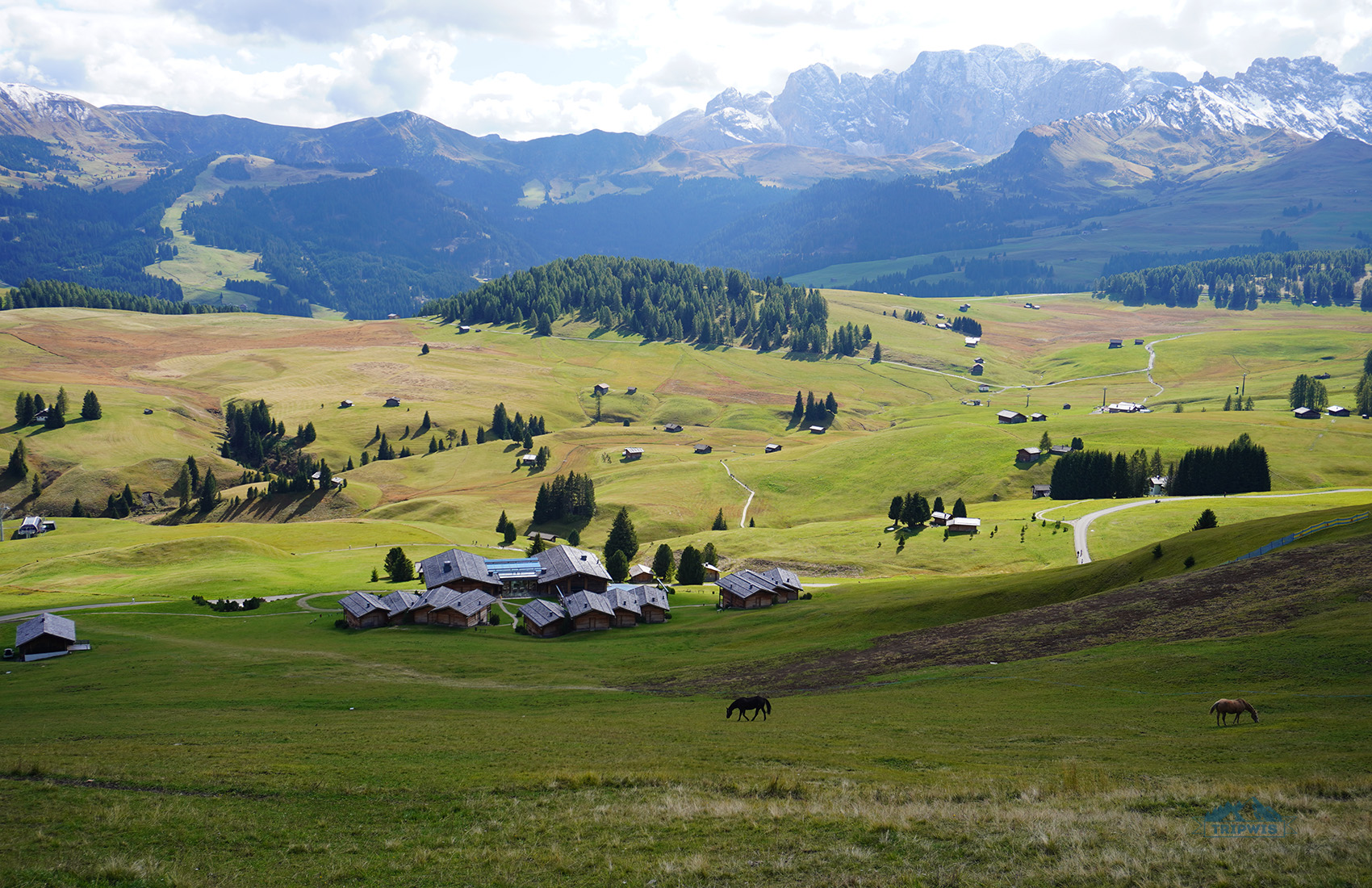
There are essentially three choices of where you can stay to have the best access to the hikes of Alpe di Siusi.
Stay on the meadow — from €450 a night
Staying at a hotel on the plateau provides you with winning access to the many trails of Alpe di Siusi, but the convenience comes at a price — quite literally! The majority of the hotels on the meadow offer five-star luxury accommodations that are not affordable for the average Joe. However, trips like this one don’t happen often — you can treat yourself to an opulent stay on Alpe di Siusi!
- 5* COMO Alpina Dolomites in Compatsch (from €770 a night) — with two Italian destinations covered under the iconic COMO umbrella (Tuscany and Dolomites), this Compatsch darling is a treat for the eyes and the soul. The unique design choice of a modern glass-fronted style with natural touches and earthy tones maximizes the opportunities to appreciate the hotel’s gorgeous setting. COMO offers a myriad of other accoutrements, all top-of-the-line and lavish, like expected (thermal pools, sauna, fitness center, — they’ve got it all!).
- 4* Sporthotel Sonne (from €450 per night) — a gorgeous hideaway with cozy suites and top-of-the-range amenities. A choice of an indoor and outdoor pool, as well as a fully decked-out spa center (hot tub, massages, the works!) surprisingly pale in comparison to the views opening up from floor-to-ceiling windows — jagged peaks of the Dolomites do not look real, no matter how long you spend staring at them.
- 3* Piccolo Hotel Sciliar in Compatsch (from €180 a night) — this is the most basic option you’ll find on Alpe di Siusi both in terms of price and amenities. Because the rooms are relatively affordable, they get snapped up fast: For the summer season, you’ll want to book at least 5–6 months in advance.
Stay in Ortisei — from €200 a night
The largest and the most popular town in Val Gardena, Ortisei provides great opportunities for getting to Alpe di Siusi. If you stay here, you can avoid hefty parking fees and just walk to the cable car station.
- 4* Hotel Luna Mondschein (from €450 a night) — set within a 15-minute walk to the cable car station in Ortisei, this fancy hotel offers rooms that are smart and comfortable and the facilities to write home about — the hotel’s spa is fit with Turkish hammam and Finnish sauna, among other things. Free underground parking is available for guests — a great feature for travelers with rental cars.
- 3* Hotel Maria (from €200 a night) — an amazing hotel set even closer to the gondola lift station (a five-minute walk and you’re there). The hotel is a perennial favorite among the holidaymakers — it is considered to be “reasonably” priced (at least when compared to other options in the area), and you get a good deal for your buck in terms of service.
Stay in Seis — from €140 a night
Seis am Schlern’s cable car is yet another convenient way to get to Alpe di Siusi. The ropeway will take you to Compatsch, where you can start your hike to the heart of the meadow.
- 4* Waldrast – Forestside Living (from €325 a night) — a beautiful alpine-style hotel set within a 13-minute walk of the Seis cable car station. Slick designer furniture of the suites goes well with overall bucolic atmosphere — there is a lot of wood used in the interiors. The outdoor pool opens up on the beautiful panorama of a pine forest, fuzzy with its feathered tops, and the ice-clawed rocks of the mountain peaks in the distance.
- 4* La Paula Apartments & Suites (from €320 a night) — a small boutique hotel with a winning location (at least in regards to the cable car station, which is a 15-minute stroll away). The rooms and facilities at La Paula are planned in the way that allows floods of natural light to penetrate the interiors, which means you can drink in the views of the surrounding mountain tops for as long as your heart desires, from every corner of the structure.
- Garni Hauenstein (from €140 a night) — a family-run guesthouse in 8 minutes from the cable car station. I’d even say it’s a great and budget-friendly base for exploring the entire Val Gardena area! From Seis, you can come and go whenever you like — without being affected by any Alpe di Siusi car restrictions.
 |
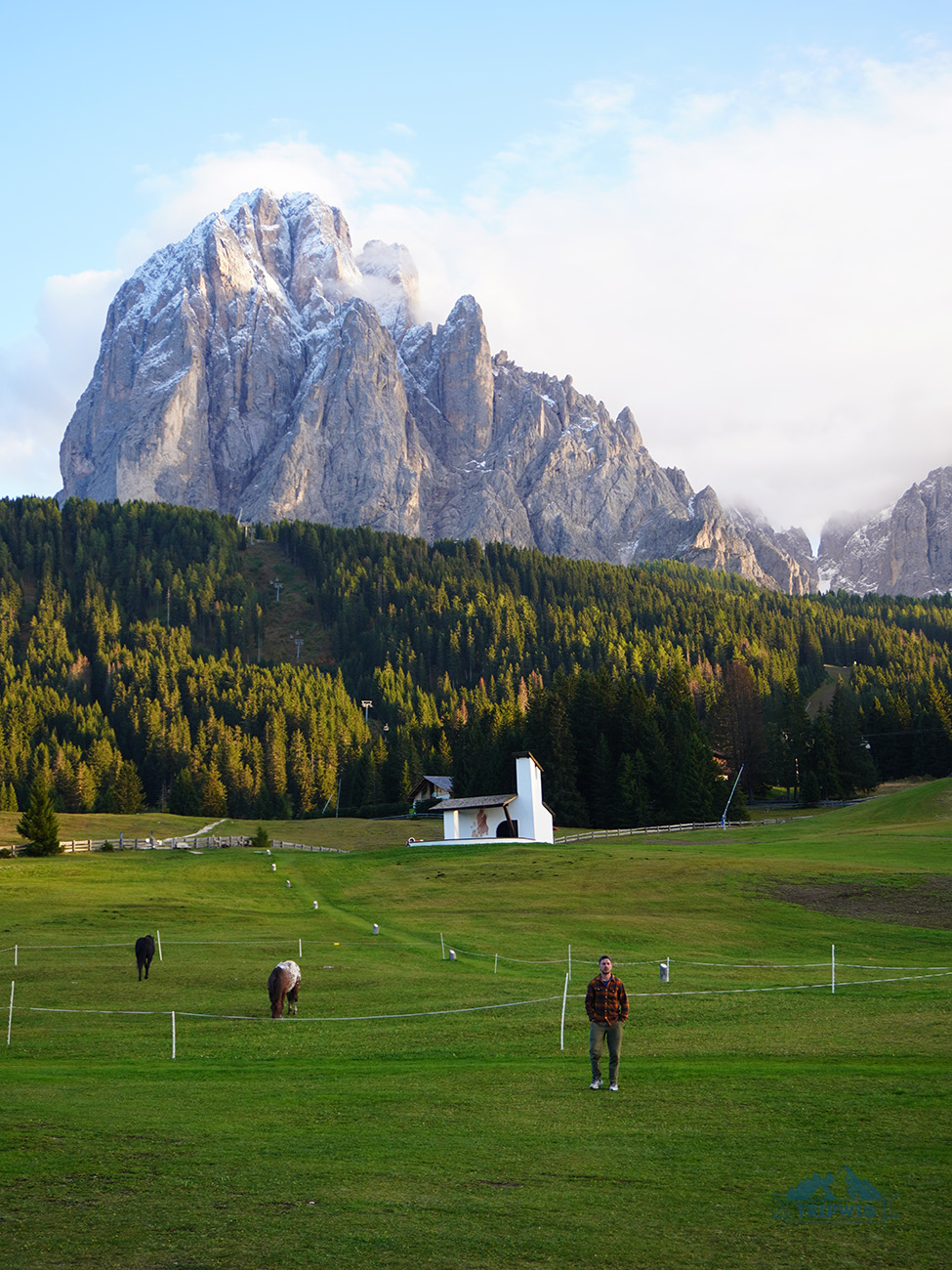 |
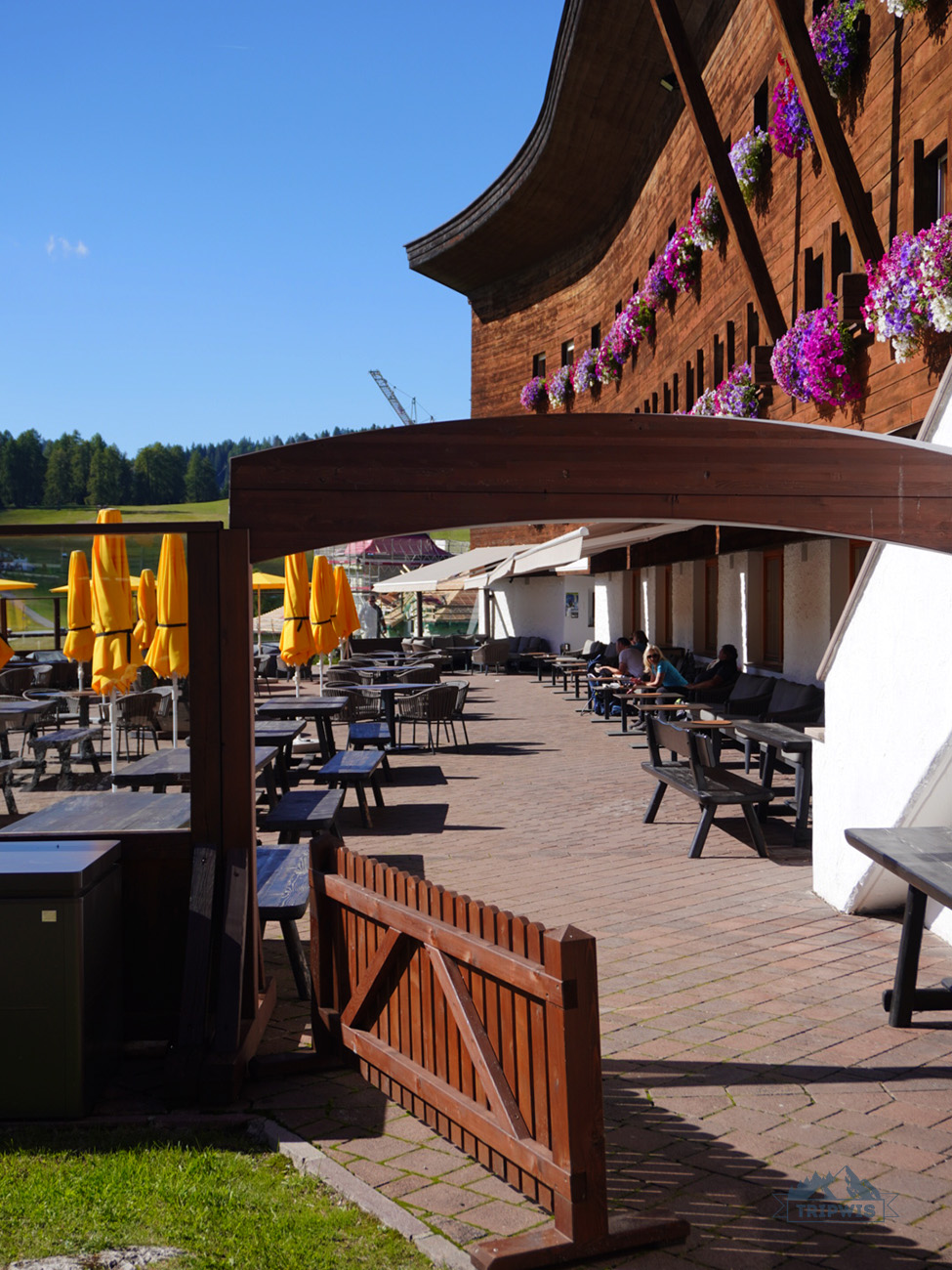
I spent hours sitting on the Monte Pana terrace despite the chilly weather. I just couldn’t take my eyes off that wonderful view!
Of course, you can also look outwards — a rental car would guarantee easy transportation between your hotel and the plateau. You would have to think about parking, but I hope that you have figured out the best option for you. Let me plug in my favorite accommodation option in the Dolomites one more time:
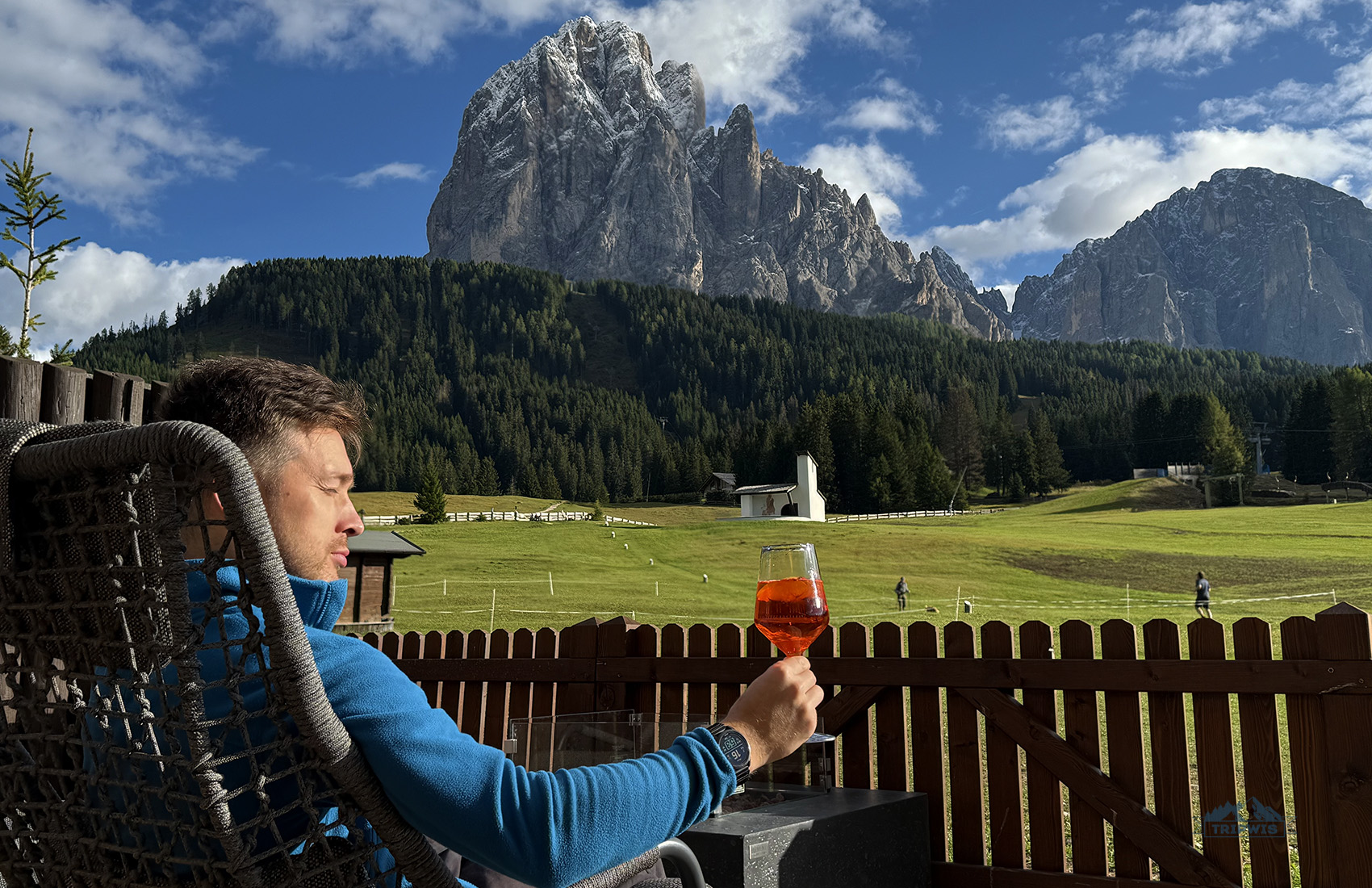
- 4* Monte Pana Dolomites Hotel (from €210 a night) — first of all, the view of the Sassolungo mountain from the hotel’s terrace is much closer than in Alpe di Siusi! It’s an impressively swish hotel that also offers half-board (great breakfast buffet and à la carte dinners) options of a stay. With rustic design (exposed oak beams) and sumptuous room furnishings (on a more modern side), the hotel feels both fresh and venerable. There is free parking on-site, AND you can reach the Ortisei cable car station in 10–15 minutes by car.
When to visit Alpe di Siusi — and other tips
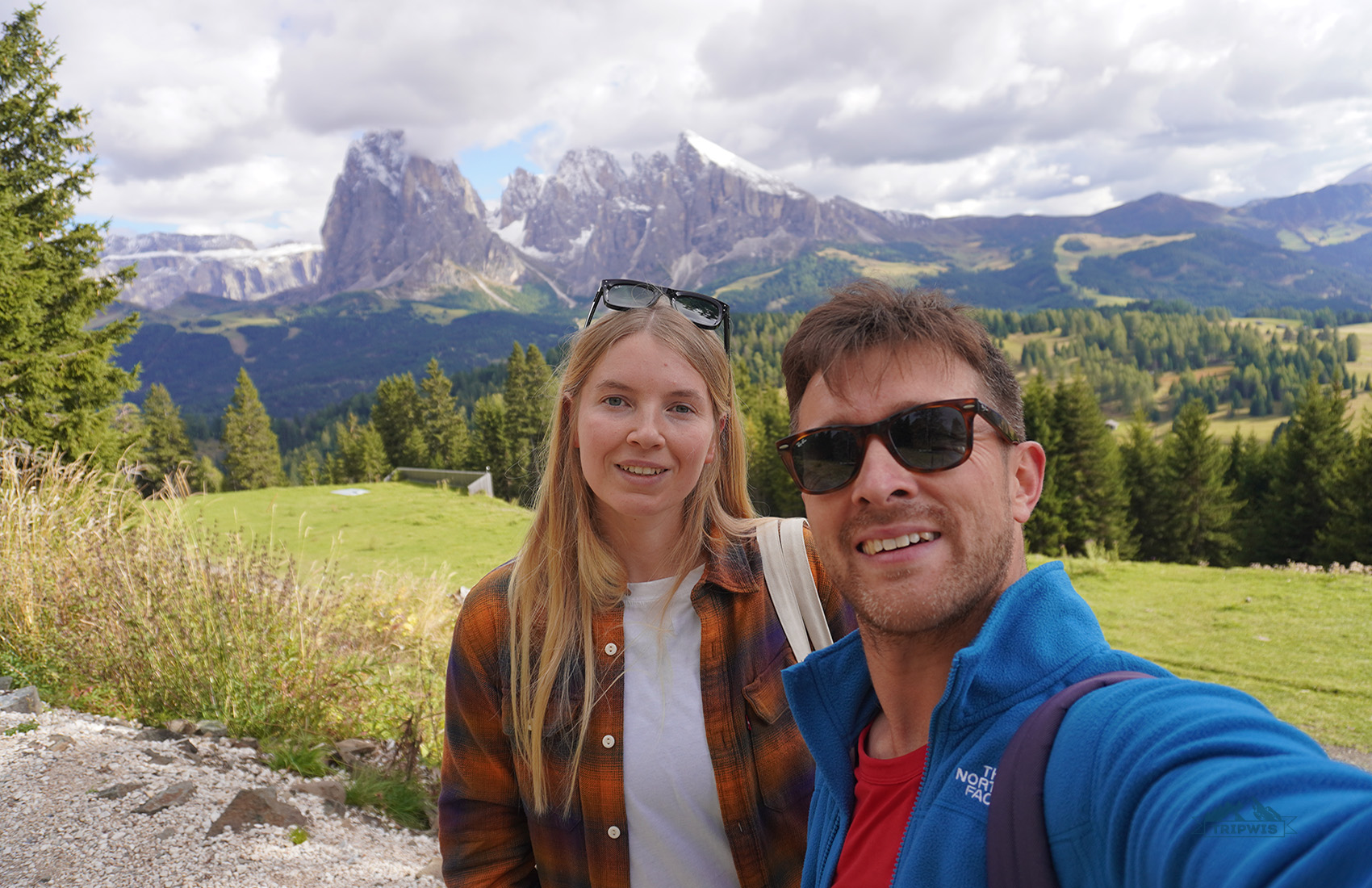
What is the best time to visit Alpe di Siusi? It all depends on your desires: Exploring Alpe di Siusi in the fall, in my opinion, is the best decision you could make. We were here in late September, and the weather was amazing — slightly cool (but nothing a warm layer couldn’t fix), with no rainfall (or snowfall, for that matter) in sight. There were fewer crowds, since it’s the off-season. Summer months are ideal for the sight of smooth rolling meadows covered in the sea of crocuses and other wildflowers. Winter brings top-notch off-piste skiing and other cold-temperature activities (like sleigh rides, for example).
Is there skiing in Alpe di Siusi? The Alpe di Siusi-Val Gardena area is the largest ski region in the Dolomites (it covers more than 180 km of slopes!). Most of the slopes are intermediate, with some easy and a few difficult level options. Ski season starts in early December and ends in early April. Overall, there’s some great, family-friendly skiing here!
Is there public transport to Alpe di Siusi? You can take the Seiser Alm Express bus (route 10) from Seis to Compatsch. If you consider cable cars to be public transport, then there are quite a few public transport connections to the plateau.
Can I drive to Alpe di Siusi? If you’re not a fan of cable cars, you can drive as far as Compatsch (remember about a ban on driving between 9 a.m. and 5 p.m). You can drive on Alpe di Siusi itself only if you’re staying at one of the hotels located on the meadow.
Is there hiking to Alpe di Siusi? There are many trails that start at either Ortisei or Compatsch that take you to Alpe di Siusi. You can hike here, but some routes may be challenging.
Is Alpe di Siusi the same as Seiser Alm? Yes, both names refer to the same place. The plateau is interchangeably called Alpe di Siusi in Italian, Seiser Alm in German, and Mont Sëuc in Ladin.
 |
 |
How long to hike Alpe di Siusi? It all depends on the trail you set out on: You could do a short Panorama Trail with active hiking time of 1.5 hours, or go for the Meadows Circuit Trail that will keep you occupied for five hours. There are other hikes, with even longer routes, but they’re most suited for professional backpackers.
What to wear when hiking Alpe di Siusi? You don’t need any special gear for the Panorama Trail, a pair of sneakers (preferably non-slip) is all you need. I think that you can even get away with hiking in Birkenstocks in the summer here (Birks nation rise up!). However, pack some layers for the hikes — sudden temperature drops or wind gusts are a normal thing in this landscape.
Can you wild camp on Alpe di Siusi? Wild camping is strictly prohibited on the Alpe di Siusi plateau. Leave your motorhome at a parking lot and explore the area on foot.
Are there passes I could buy for Alpe di Siusi? If your base point is Ortisei, there is a summer season offer of Gardena Card you could look into — it provides unlimited ski lifts (18 that are covered) for six (€152) or three (€118) consecutive days.
Can you bring dogs on Alpe di Siusi? Yes, you can! A cable car ride for your furry friend will cost €7. The dog should be muzzled on a gondola ride and leashed on the meadow when passing livestock. Bring plenty of water (and poop bags) for your hike and enjoy your time together on Alpe di Siusi!
Is Alpe di Siusi worth it? Yes, there’s no doubt about it! Even after spending more than €70 for the roundtrip cable car tickets on the two of us, we didn’t feel a tingle of regret or disappointment. The largest alpine pasture in the world will take your breath away, and you will pay up again and again just to get closer to these spellbinding views.
Best hikes in the Dolomites
 |
 |
Our latest Dolomites adventures included four more hikes in spectacular locations, each offering a unique experience:
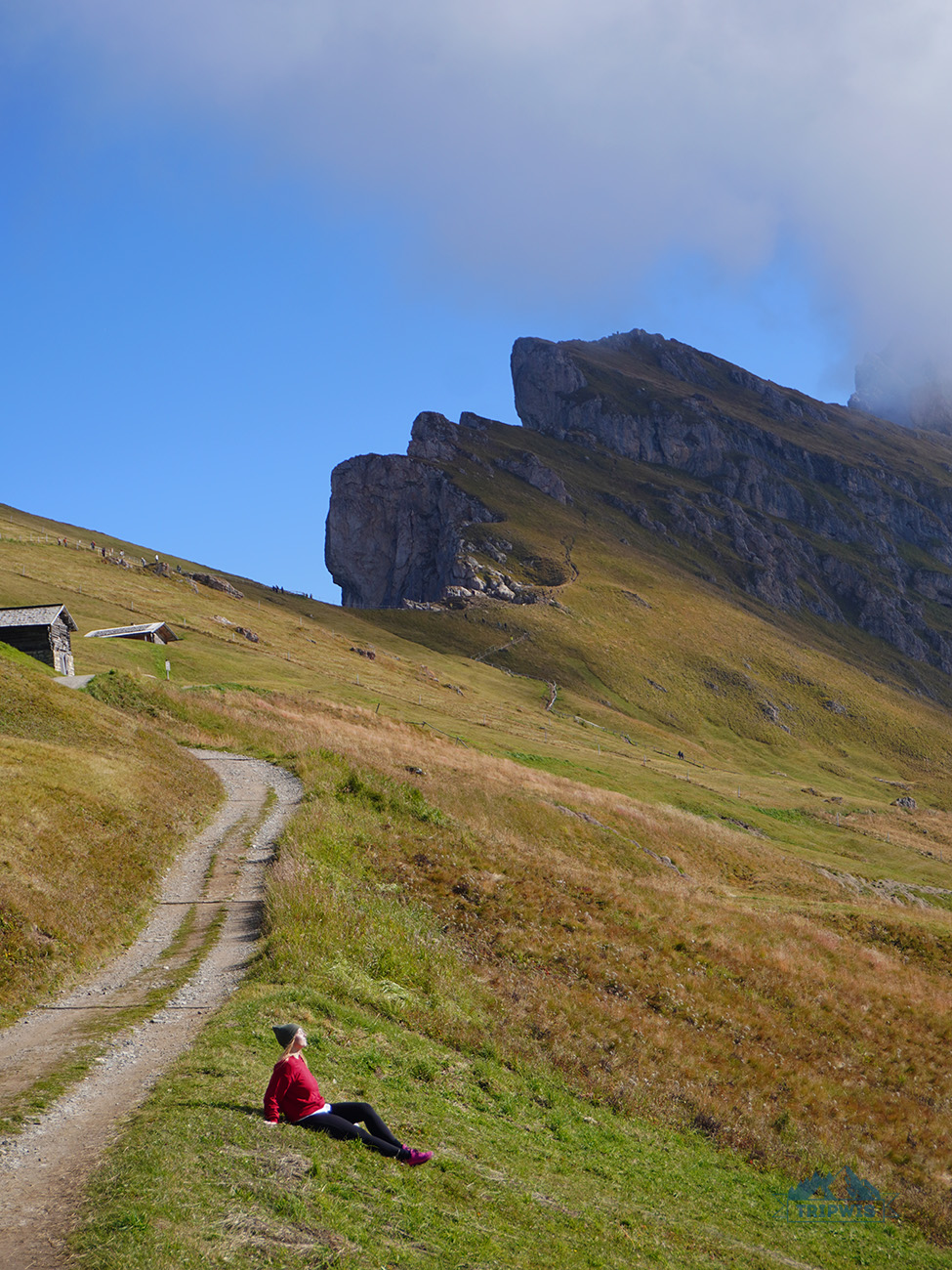
- Seceda Dolomites — with Seceda needle-like peaks as the main event of the many trails in the area, it’s no wonder that travelers flock here in bunches.
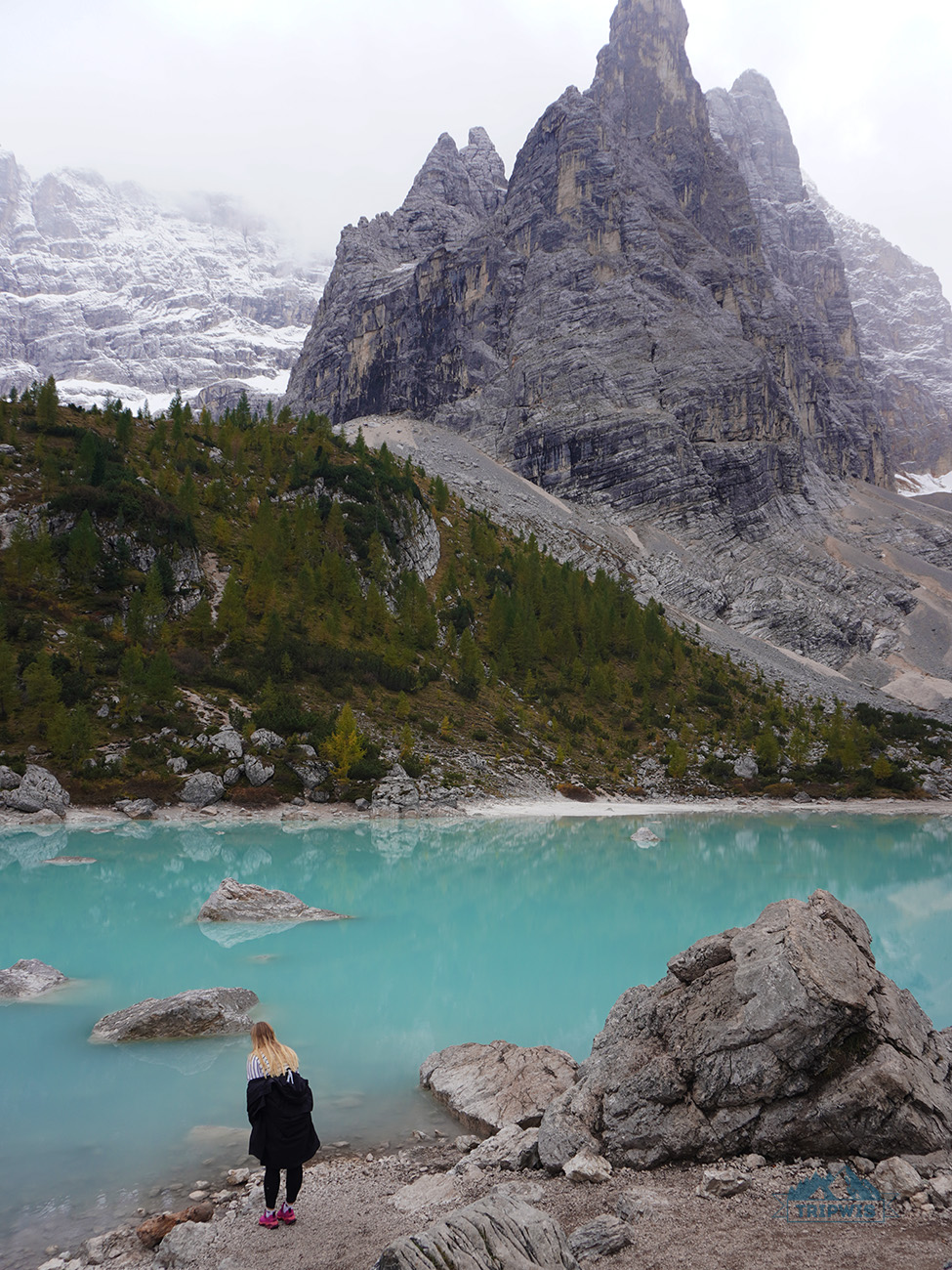
- Lake Sorapis — a moderate-to-hard trek (4.5 hours there and back) to the blue lake is one of the most exciting experiences we’ve had in the Dolomites so far!
- Adolf Munkel — a perfect easy-to-moderate 10 km loop hike that offers a wide variety of terrain: Forest stretches, rocky parts, alpine meadows — all with the remarkable panorama of the Odle Group towering peaks.
- Tre Cime di Lavaredo — the hike that shows you one of the Italian Alps’ most popular profiles of the “three peaks”. Again, it’s a 10 km loop trail with easy to moderate skill level required. Here, rocky slopes are interspersed with boulder-strewn meadows, the rifugios are aplenty, and the stakes high! The parking situation at the trailhead, however, dropped the hike to the last place of our rating.
What is the most beautiful hike in the Dolomites? In my opinion, it’s the hike to Lake Sorapis — though it was pretty challenging, the beautiful reward of a glacial lake made it all worth it.
Here’s where we stayed in the Dolomites to tie all these places into 5-day itinerary:
Day 1–3: 📍 4* Monte Pana Dolomites Hotel (from €210 a night) — a charming alpine hotel that has breakfast-included and half-board options, which is amazing, since it’s pretty hard to find a breakfast spot in the area that’s open early in the morning before you set off on a hike. From here, we explored Lago di Carezza, Alpe di Siusi, Ortisei, Gardena and Pordoi Pass, and Seceda.
Day 4: 📍 3* Best Western Hotel Nevada (from €100 per night) — an amazing hotel set in a quaint mountain village of San Vito di Cadore. It was a prime spot to stay in after Lake Sorapis hike.
Day 5: 📍 3* Gasthaus Zum Weissen Kreuz (from €120 a night) — set further north from all the action, it’s a great place to move to after the Three Sisters hike, especially if you want to be closer to Adolf Munkel hike area.